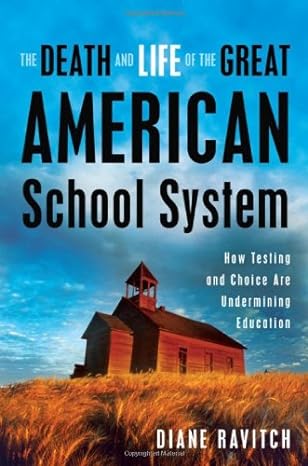
More Thoughts on The Death and Life of the Great American School System

May 13, 2010

More Thoughts on The Death and Life of the Great American School System

The power of grief to derange the mind has in fact been exhaustively noted.

Joan Didion, The Year of Magical Thinking (34)

The most toxic flaw in NCLB was its legislative command that all students in every school must be proficient in reading and mathematics by 2014. By that magical date, every single student must achieve proficiency, including students with special needs, students whose native language is not English, students who are homeless and lacking in any societal advantage, and student with every societal advantage but are not interested in their schoolwork

Diane Ravitch, The Death and Life of the Great American School System (102)

After 9-11, too many of us were just too damn scared to even entertain the notion that our nation was being run by a couple of incompetent poltroons. We are still paying for this in treasure and in lives. Oddly, the same people who would call Barack Obama a socialist for mandating PRIVATE insurance had little problem with a complete federal takeover of the educational system, which has historically been a state and local issue. (The federal government is barely a seven percent stakeholder in education)

Under ordinary circumstances, Republicans would have opposed the bill’s broad expansion of federal power over local schools, and Democrats would have opposed its heavy emphasis on testing. But after September 1, 2001, Congress wanted to demonstrate unity, and education legislation sailed through (94).

NCLB passed in the Senate 87-10 and 381-41 in the House despite the fact that “No one truly expects that all students will be proficient by the year 2014, although NCLBs most fervent supporters often claimed it was feasible” (103).

Today many critics of what they consider invasive federal involvement in the healthcare industry would sue the federal government in the name of the basically moribund (since the Civil War) Ninth and Tenth Amendments. But when George W. Bush was president, instead of standing up to a draconian law which demands the surreal goal of universal success, Republicans as well as Democrats overwhelmingly preferred to toe the line and “[m]ost states devised ways to pretend to meet the impossible goal”(16).

Ravitch does a masterful job of laying out how school administrators across the country were forced to engage in deceptive practices or risk losing their jobs in her chapter entitled, The Trouble with Accountability. She draws on the work of Daniel Koretz and Richard Rothstein and other sober-minded thinkers who are wise enough to eschew a harebrained law which delivered us unto a macabre world where students now “master test-taking methods, but not the subject itself” (159).

Sadly, the Magical Thinking which infects our nation continues to thrive in education. President Obama supports policies which have been proven ineffective and he has appointed a Secretary of Education, Arne Duncan, whose record as superintendent of Chicago schools was dismal if not downright fraudulent:

In 2009, the Civic Committee of the Commercial Club of Chicago released a study demonstrating that the city’s claims of dramatic test score gains were exaggerated….The Study concluded, however, that “these huge increases reflect changes in the tests and testing procedures—not real student improvement” (158).

by Richard W. Bray

Normal

May 6, 2010

Normal

Life is never easy for young Gladys P. O’Shay
And it’s a shilly-shally world that confronts her every day
Cuz’ the planet that she lives on is insane in every way

When she sits down for breakfast wanting bacon, eggs and toast
Her brothers laugh out loud as they chomp down weasel roast
“Why can’t you just be normal like the rest of us?” They boast

Gladys in an outcast and a troublemaker too
And she is the only person in the town of Whackadoo
Who considers it a gaffe to wear her socks outside her shoes

Daily she’s rebuffed by her school’s annoying sentry
For she is the only kid at Lizzie Borden Elementary
Who prefers doors to windows as the proper point of entry

In a world where scholars are less honored than magicians
Gladys is an outcast for eschewing all traditions
Her town has fifty-seven warlocks and only three physicians

Everyone agrees the sun is looking for a bride
So when it’s time for recess and the kids all go outside
Gladys is the only girl who won’t run off and hide

She leaves herself exposed by lying in the grass
And the people are convinced that she’s a crazy little lass
For thinking that the monster’s just a giant ball of gas

All her friends and neighbors think that Gladys is a kook
And her culinary habits trigger strenuous rebuke
For she refuses kitty brains and won’t touch puppy puke

So if you feel like you’re the one who doesn’t quite belong
And everything you do and say seems to come out wrong
Perhaps there is a galaxy where you would get along

by Richard W. Bray

Some Thoughts on The Death and Life of the Great American School System

May 4, 2010

51BHXCoXYZL._SY466_

Some Thoughts on The Death and Life of the Great American School System

Our society is just beginning to recover from a long spell of Magical Thinking. Instead of confronting our problems and dealing with them, Americans spent the better part of a decade hoping that great men on horses would ride into to town bearing sanctified sidearms which fire magic bullets—instead we got George W. Bush in a flightsuit. But after 9/11, most of us we’re too scared to acknowledge or even see The Emperor’s Clothes. We just pretended that there were new, bold serious solutions that would preternaturally eliminate serious issues. Decisive Federal Action would fix public education just as it would defeat Islamo-facism and unfetter the Titans of Finance. Those were some heady times.

Today, our institutions are just beginning to recover from the febrile dreams which have infected (and continue to threaten the very existence of) our body politic. Sadly, no one is yet bowing in obeisance to the heroes who were banished from the Punditocracy for the crime of premature wisdom (i.e., Phil Donahue, Ashleigh Banfield and Robert Sheer). Unfortunately, the overwhelming majority of the people who advocated these asinine and self-destructive policies over the last decade are still running this country and they’re not about to begin pointing fingers at one another.

That’s why Diane Ravitch should be praised for speaking up about her recent recovery from Hedda Payness Disease:

I too was captivated by these ideas. They promised to end bureaucracy, to ensure that poor children were not neglected, to empower poor parents, to enable poor children to escape failing schools, and to close the achievement gap between rich and poor, black and white. Testing would shine a spotlight on low-performing schools and choice would create opportunities for poor kids to leave for better schools. All of this seemed to make sense, but there was little empirical evidence, just promise and hope(3-4).

I remember seeing a documentary years ago about how hospital administrators in the Soviet Union (who obviously knew nothing about how hospitals actually work) used to do surprise inspections in hospitals in which they would randomly swab the walls looking for evidence of bacteria. Consequently, the medical staff wasted a good deal of time scrubbing the walls with bleach. Funny thing about big bureaucracies, they tend to replicate such madness:

Measure, then punish or reward. No education experience needed to administer such a program. Anyone who loved data could do it. The strategy produced fear and obedience among educators; it often generated higher test scores. But it had nothing to do with education (16).

In our age of Magical Thinking, even really smart guys (because we all know that the billionaires are the best among us) like to dream of a simple world with simple solutions. For example, Bill Gates was blissfully “unaware of the disadvantages” of promoting smaller highs schools as a one-size-fits-all panacea for American education:

It was never obvious why the Gates Foundation decided that schools size was the one critical reform most needed to improve American education. Both state and national tests showed that large numbers of students were starting high schools without having mastered basic skills…the root cause of poor achievement lie not in the high schools, but in the earlier grades (205).

After pissing away a couple of billion bucks, the Foundation wised up, but it wasn’t about to admit any mistakes:

In late 2008 the Gates Foundation announced that it was changing course. The $2 billion investment in new small high schools had not been especially successful (although it was careful not to come right out and say it was unsuccessful) (211).

by Richard W. Bray

Kona and Kahlua-Bananas (by Tom)

May 1, 2010


Kona

Kahlua-Bananas

Ingredients:

3 tbsp. butter
1/3 c. light brown sugar
4 Bananas; sliced half lengthwise
1/4 c. Kahlua

Directions:

In a large skillet melt the butter. Sprinkle in the brown sugar. Stir until dissolved. Add Kahlua. Heat until bubbling. Add bananas to the sauce. Cook to heat thoroughly, basting often for 3 to 5 minutes.

Serving suggestions:

Spoon bananas over Vanilla Ice Cream. Sprinkle on toasted almonds or chopped nuts.

How do I Say?

April 29, 2010


How do I Say?

How do I say when it’s over
I meant every word that I said
When the world we knew is dissolving
And the love we shared is dead?

How do I tell you it matters
The joy you brought to my life
When the dreams that we shared are all shattered
And you’ll never be my wife?

How can I tell you I’ll miss you
Every day for as long as I live
When the well that we drank from is empty
And nothing is left to give?

I don’t blame you if you hate me
Cuz’ right now I hate me too
I hate the whole damn world
For what I did to you

I just want to see you happy
But there ain’t nuthin’ I can do
Neither one of us will be happy
Till we get past me and you

Someday when you’re not lonely
Cuz’ you’ve found a better man
I just hope you will remember
When my heart was in your hands

by Richard W. Bray

William T. Power

April 26, 2010

aaaaaaaaaaaaaaaaasjacket

William T. Power

If there’s a perfect job for everyone
There’s only one for me
I must be the boss of everyone
And everything I see

The thing that makes me happy
Is telling people what to do
So cook my food and wash my car
Or I will fire you

You say you’re not my servant
That isn’t my concern
Everyone must serve me
And today it is your turn

My feet are awfully dirty
They have calluses and corns
So get on your knees and wash them
Or you will feel my scorn

Don’t make haste; hop to it
I’ve got meetings to attend
It’s senseless to resist me
I will neither break nor bend

Funny thing about this place is
My doors lock from outside
And it seems I must be shackled
Just to take a ride

I demand to have a chat with
The chap who runs this place
Though this outfit is well-organized
The protocol’s a disgrace

A fellow of my stature
Must be held in high esteem
Am I really in the psycho ward
Or is this just a dream?

by Richard W. Bray

Some Thoughts on The God Delusion

April 22, 2010

Richard Wright

Some Thoughts on The God Delusion

After patient and painstaking work he convinced his friend that his former beliefs were untenable, that science was indeed queen. But to his horror, Krummie had to confess to me, he soon discovered that he had succeeded only in making his friend supremely unhappy. He thought at first that this might pass, but when, after a year, the man remained miserably depressed, Krumwiede resolved, he told me, never again to tamper with a man’s hereditary convictions (89).

The Autobiography of William Carlos Williams

I’m a devout deist, and I’m generally happy about the recent trend of books promoting atheism. The God Delusion by Richard Dawkins is an erudite argument cogently delivered with much wit, and Dawkins is less overtly hostile to religion than many of the other purveyors of Atheist Manifestos recently on the bestseller lists.

Here’s Dawkins quoting Einstein (a great deist who is often mischaracterized as a theist):

I believe in Spinoza’s God who reveals himself in the orderly harmony that exists, not in a God who concerns himself with fates and actions of human beings (18).

If I could pick any creed, I would be a Liberal Secular Jew, but I’m not sure how to make that conversion. This brings me (sort of) to a friendly argument the author had with Robert Winston, whom Dawkins describes as a “respected pillar of British Jewry.”

When I pressed him, he said that Judaism provided a good discipline to help him structure his life and lead a good one. Perhaps it does; but that, of course, has not the smallest bearing on the truth value of its supernatural claims (14).

Goodness, Gracious, Sakes Alive, Mr. Dawkins! People, even scientists, believe all sorts of wacky things, so I’m not even sure how we could ever come to a consensus on what a “truth value” is. Mr. Winston’s personal beliefs about a deity neither pick my pocket nor break my leg. I’m glad to hear that he’s a decent bloke.

When Dawkins looks for “Direct Advantages of Religion,” he doesn’t see much, although he does concede that it has inspired much great art. But Dawkins does not believe that people should be comforted by mere beliefs which are obvious poppycock to the trained scientist. Dawkins quotes ardent atheist George Bernard Shaw:

The fact that a believer is happier than a skeptic is no more to the point than the fact that a drunken man is happier than a sober one (167).

Dawkins makes no effort to hide his condescension, which is a common trait among the New Atheists. Denis Dutton, another God-wrestling scientist, believes that nonbelievers should refer to ourselves as “brights,” an appellation which clearly implies that those who don’t agree with us are stupid. (And there’s nothing wrong with the word Freethinker.)

Lots of good and wonderful and beautiful things come from organized religion, and I’m not just talking about Verdi, Take 6, and El Greco. Organized religion promotes fellowship and improves people’s lives in various ways.

But some people just can’t stand it. Richard Wright, for example, was “disgusted” by the “snobbery, clannishness, gossip, intrigue, petty class rivalry, and conspicuous displays of cheap clothing” which he encountered in church (151). The beauty of the music and rituals is completely invisible to him. As Wright saw things, “[t]he naked will to power seemed always to walk in the wake of a hymn” (136).

I’ll bet Christopher Hitchens wishes he’d said that.

by Richard W. Bray

Chloe and Corn Chowder (by Wayne)

April 19, 2010


Chloe


Chloe

Corn Chowder

Ingredients:

4 cobs of fresh corn
One medium size onion
Several cloves of fresh garlic
1/2 of a red bell pepper
1 cup half & half
1 1/2 cups water
Smart Balance brand margarine spread

Directions:

1. Slice onion and garlic and red pepper
2. Melt 4 tablespoons Smart Balance’ margarine spread in large skillet
3. Add onions/garlic/red pepper
4. Saute for ten minutes on medium heat, stirring until soft
5. Shuck and rinse fresh corn, then remove the corn form cob via serrated knife
6. Add corn to skillet and mix along with two more tablespoons of Smart Balance spread
7. Add 1 1/2 cup of water
8. Allow to cook on medium heat for ten minutes, stirring occasionally
9. Add 1 cup half & half
10. Cook another ten minutes on medium, stirring occasionally

enjoy…

The Decider

April 15, 2010

The Decider

I stepped into the river
It was wet and it was cold
My bones began to shiver
Just like I had been told

I stepped deeper in the river
And it didn’t get any better
I felt my body quiver
And my clothes were getting wetter

I kept descending deeper
And it didn’t feel so nice
I’m a plodder, not a leaper
But it felt as cold as ice

I continued on my quest
My parents did not raise a quitter
I would not fail this test
But the chill was getting bitter

I did not question why
As hypothermia numbed my brain
I’m not the kinda’ guy
Who is threatened by mere pain

They found my body on the shore
No more frigid quests for me
No more chances to explore
No more Brave New Worlds to see

It is true that I am dead
And it’s too late for revisions
But it never can be said
That I don’t stand by my decisions

by Richard W. Bray

Sophie and Twice Baked Potatoes (by Hilary and Richard)

April 14, 2010

Sophie
Sophie

(This is a recipe we first discovered at a cooking class in San Francisco. These hearty potatoes go great with any roast and are easily reheated for a fabulous next day lunch!)

Twice Baked Potatoes (Serves 4 to 6)

Ingredients:

4 large russet potatoes, about a pound each
Olive oil
1/2 cup light sour cream
1/2 cup milk (I use 1% or 2%)
2 T. butter, softened
1 T. heavy whipping cream
1 cup grated sharp cheddar
4-6 strips bacon
1/4 cup green onion
Hot sauce
Kosher salt
Freshly ground black pepper

Directions:

1. Preheat oven to 400. Scrub potatoes clean and poke each in several places with the tines of a fork. Rub the potatoes all over with a little olive oil. Place directly on the middle or top rack of oven. Bake potatoes for 1 hour and 15 minutes or until cooked through. (They should give a little when pressed.)

2. If you’re short on time you can bake the potatoes in the microwave. (10 minutes on high heat for 2 potatoes and 15 minutes for 4 potatoes.) The skins of microwave baked potatoes aren’t nearly as crispy, so you may want to rub a little olive oil on them and finish them in a conventional oven for 10 minutes at 400.

3. While the potatoes are cooking, cook the bacon strips in a frying pan on medium-low heat for 10 to 15 minutes or until crisp. Drain on paper towels and let cool. Crumble.

4. Allow the potatoes to cool just to touch. Slice the potatoes in half lengthwise and use a spoon to scoop out the insides, forming a potato “canoe”. Leave about ¼” of potato on the skin.

5. Place the scooped out potato, sour cream, milk, cream and butter into a large bowl. Mash with a potato masher. Mix in the remaining ingredients, reserving a little of the green onion to sprinkle on the tops of the potatoes once they are baked. Season to taste with salt, pepper and hot sauce. Spoon filling into the potato shells.

6. Heat oven to 350. Place potatoes on a roasting pan and bake 15 to 20 minutes or until they are heated through and the tops are golden brown. Garnish with reserved green onions.

Note: To make the potatoes spicier, you could add a small can of fire-roasted diced green chilies in addition to the hot sauce.