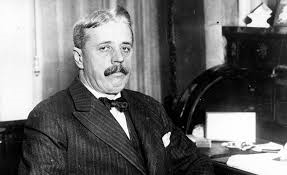
Ephraim Tellwright is no mere caricature, and despite his monstrous behavior towards the Prices, he is presented as a three-dimensional character:
Tellwright is a fascinating creation….He is a domestic tyrant and a miser, flinty, quickwitted but utterly insensitive….The impressive thing about Bennett’s handling of him, however, is that there is absolutely nothing of aricature in the study of Tellwright. Nor is he sentimentalized. Instead, Bennett sets himself to record the life of a man who is quite without music in his soul (Lucas 44).
This lack of “music in his soul” deprives him form enjoying many of the experiences which make life meaningful, such as fellowship, religion, laughter, romantic love, all of which Tellwright has chosen to shun. The collection of capital is his only form of solace.
Neither Henry Earlforward nor Ephraim Tellwright is a stock character—the heartless skinflint. But unlike Tellwright, Earlforward, though miserly in the extreme, is capable of human affection. He is very fond of Elsie and genuinely in love with his wife Violet. Also in contrast to Tellwright, Earlforward is equipped with “other qualities one rarely associates with greed for riches: kindness, patience, almost indolence, and also, in certain matters, a comparative innocence” (Lafour 192). Yet Earlforward and his beloved Violet are destroyed by his unwillingness to provide them with sufficient food and timely medical attention. Ultimately, his craving for money outweighs any other motivation. He is “a man of some delicacy and tact. But his passion for hoarding money overrules all other considerations in his life” (Lucas 195). Earlforward is “a miser, but he is not a monster”(Douglas 411). Nevertheless, his appetite for lucre is hideously irrational, “a secret passion [which] fought against love” (Steps 121).
Henry Earlforward’s love of money manifests itself in his irrational affection for cash. He keeps his money in a safe at home, forfeiting the interest and security he would receive from a bank because he likes to be near it. Currency has a carnal attraction for him. “He never kept a dirty note for more then a few days….And the cash was so beautiful to behold” (Steps 201). Cash is something that Earlforward “gazed at passionately”, and it is no coincidence that he dies in front of his “sublime safe” (Steps 227;362).
Earlforward has a powerful revulsion for both eating and sexual contact, and the hunger for money clearly serves as his only sensual pleasure. Earlforward “ate little, but he would seldom hurry over a meal” (Steps 161). His repugnance at the consumption of food is further exhibited by his practice of picking his teeth, as though compelled by a need to eliminate all remnants of the act of eating. “He loved to pick his teeth, even after a meal which was no meal” (Steps 161). As there is no evidence in the novel that his marriage is ever consummated, we are led to conclude that Earlforward’s craving for cash has supplanted his ordinary carnal appetites.
But Earlforward pays an enormous price for his inability to express his hunger in a more conventional manner. His love of money leads to ruin: “The story of miserly greed moves on like a Greek Tragedy, and eventually engulfs Earlforward and his wife” (Simons 266). Earlforward pays a far greater price for his tightfistedness than Tellwright. Tellwright forsakes intimate human contact, but he is allowed to live into old age. In Riceyman Steps Bennett is more explicit about the ultimate cost of miserliness which precipitates Earlforward’s annihilation:
Avarice is as a blight on his physical and moral life. It is the cause of ruin and death, not power and prosperity. It is a cancer in his mind as well as in his flesh eating into his very substance (Lafour 193).
In stark contrast to her employer, “Elsie possesses an instinct for savoring whatever experience unexpectedly comes her way” (Wright 153). Her hearty fondness for food and her lusty relationship with Joe demonstrate that she, like her author, knows how to appreciate life. “(S)he has indeed the appetite for life that her employers singularly lack” (Lucas 203). Elsie discovers considerable delight in the paltry accommodations which her position with the Earlforwards affords her. A salary of twenty pounds a year is, to her, “an enormous sum” (Steps 111). And she found even greater pleasure in the bedroom they provided her:
But do not suppose that the bedroom had no grand, exciting quality for Elsie. It had one. It was solely hers. The first bedroom she had ever in all her life had entirely to herself….It was a balm to her grief. It was a retreat into which undisturbed she could enjoy her grief (Steps 110).
Due to her ability to appreciate life’s simple pleasures, Elsie is freer than Anna Tellwright who has difficulty finding fulfillment despite, or more likely in some way because of, her substantial inheritance. If happiness is the art wanting what you have rather having what you want, then Elsie is undeniably wiser than Anna. Anna’s inheritance of 50,000 pounds brings her no real satisfaction:
…we are told that Anna “felt no elation of any kind (over the vastness of her new fortune)….For Anna is a person who experiences little elation, ever. Indeed, the novel is about how she more or less misses out on life. She has no way of realizing the possibilities love and money have to offer her (Lucas 40).
Although Anna and Elsie share a similar devotion to duty, one surmises that Anna is motivated more by the fear of her tyrannical father than by any inborn desire to serve others. She spends her life wondering why her choices are so complicated instead of simply acting upon the freedom which her fortune would allow her. She would have faced societal derision had she chosen Willie Price over Henry Mynors, but the only thing preventing it is her own sense of etiquette. Elsie knew no such inhibitions. When Joe is sick, she sneaks him into her employer’s household in order to nurse him back to health, risking public scorn. Elsie is immune to such social forces because her need to care for others cancels out all other factors. Instead of being bogged down by questions of propriety, Anna simply does what she feels is right. “Elsie never asked the meaning of life, for she was dominated by a tremendous desire to serve” (Steps 29).
Riceyman Steps was greeted with widespread critical acclaim, and Bennett was thrilled that it earned him his first literary award. His creation of Elsie in particular has been lauded over the years as one of his greatest triumphs. For example,
Bennett’s greatest and noblest characters are the simple, self-sacrificing and humble. Such is Elsie, the young war-widow who spends every day of her life in toil….Our author has made Elsie Spricket the noblest character in Riceyman Steps (Simons 260).
It is important, however, that we remain cognizant of the fact that Elsie’s greatness is not a function of her poverty; none of the other working class characters in the novel come close to approaching her heroism. Her boyfriend Joe, for example, is certainly no moral giant. And the household of the “french-polisher’s wife” where she rents a space on the floor next to one of the children is certainly not a representation of virtue. Except Elsie, the adult inhabitants of the house were always unhappy save when drinking alcohol or making love” (Steps 68).
Just as poverty is no guarantee of righteousness in Bennett’s novels, affluence does not necessarily exclude one from achieving worldly fulfillment. The Suttons in Anna of the Five Towns are in no way made to suffer for their wealth. On the contrary, they are a loving, well-adjusted family because, like their creator, they are happy to exploit the benefits of their wealth. As hosts, they offer a conspicuous contrast to the penurious Tellwright.
The board was richly spread with fancy bread and cakes, jams of Mrs. Sutton’s celebrated preserving, diverse sandwiches compiled by Beatrice, and one or two large examples of the famous Bursley pork-pie (Anna 87).
Like Arnold Bennett, the Suttons know that money is for spending.
Today Arnold Bennett and many of his “Edwardian” contemporaries have been relegated to the far reaches of the literary canon. They have been displaced not because their work is without quality, but because, in contrast to the “Modernists” who supplanted them, they seem to be lacking particular qualities. Bennett doesn’t give us Forster’s flair for pithy social observation, Lawrence’s monomaniacal obsession with the phallus, Mansfield’s subtlety, or Wolfe’s poetry. But he was a fine craftsman who knew how to develop character. He remains worthy of critical attention. Perhaps in a hundred years or so his work will again become fashionable.
by Richard W. Bray
REFERENCES
Barker, Dudley. Writer by Trade: A Portrait of Arnold Bennett. New York: Atheneum, 1966.
Bennett, Arnold. Anna of the Five Towns, 1902. Oxford: Oxford UP, 1995.
_____. Riceymen Steps. New York: George H. Doran, 1923.
Douglas, James. “The Miser and the Maid,” 1923. Arnold Bennett: The Critical Heritage. Ed. James Hepburn. London: Routledge & Kegan Paul, 1981.
Lafour, Georges. Arnold Bennett: A Study. New York: Haskell House, 1939.
Lucas, John. Arnold Bennett: A Study of His Fiction. London: Methuen, 1974.
Simons, J. B. Arnold Bennett and His Novels: A Critical Study, 1936. Folcroft, PA: Folcroft Press, 1969.
Wright, Walter F. Arnold Bennett: Romanitic Realist. Lincoln, NB: Nebraska UP, 1971.







 Laughter hope sock in the eye's Blog