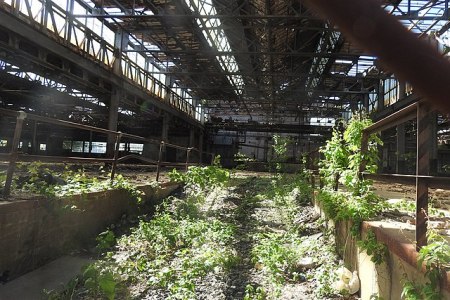
For twenty-seven years
I worked the ‘ssembly line
Till traders bought the company
And robbed my pension blind
They crated up the factory
And shipped it overseas
Left fifteen thousand workers
Blowing in the breeze
Been outta work so long
I don’t know what to do
Been double-dealt and curb-kicked
Till my hide is black and blue
Filthy politicians
Say they love the working man
Seeking bribes and kickbacks
From stockbroker hand
Thievin’ doublecrossers
Drove this country off a cliff
Ain’t no golden parachute
For the working stiff
Been outta work so long
I don’t know what to do
Been double-dealt and curb-kicked
Till my hide is black and blue
The folks who run this country
Would sell they mamas’ soul
For a thousand votes
Or thirty bits of gold
The Dream that was America
Is swirling down the drain
This country used to build things
Now we manufacture pain
Been outta work so long
I don’t know what to do
Been double-dealt and curb-kicked
Till my hide is black and blue
The Perils of Bardolatry: Harold Bloom’s Limited Perception of Hamlet
The activity of art is based on the fact that a man, receiving through his sense of hearing or sight another man’s expression of feeling, is capable of experiencing the emotion which moved the man who expressed it.
—Leo Tolstoy, What is Art? (178)
The essential function of art is moral. Not aesthetic, not decorative, not pastime and recreation. But moral.
—D.H. Lawrence, Studies in Classic American Literature (180)
When Kurt Vonnegut was working on Slaughterhouse-Five, he told movie-producer Harrison Starr that it was going to be an anti-war novel.
“Why don’t you write an anti-glacier book instead?” Starr quipped.
Vonnegut found the comment amusing, agreeing that wars are “as easy to stop as glaciers.” This knowledge did not dissuade Vonnegut from completing his masterpiece because he realized that no work of art could ever rectify the human situation, and only the silliest sort of fool creates a work of art hoping somehow to fix the world. (This is what logicians refer to as assigning an irrelevant goal.)
But literature has its uses. And W. H. Auden notwithstanding, poetry makes all sorts of things happen. Great works of art render our world a lot more beautiful and slightly less confusing.
Harold Bloom, one of America’s most acclaimed literary critics, has released a curious collection of musings on William Shakespeare’s Hamlet entitled Poem Unlimited. According to Bloom, “of all poems” Hamlet is the “most unlimited,” and, as a “meditation upon human fragility in confrontation with death,” the play “competes only with the world’s great scriptures” (3).
Bloom has long been an idiosyncratic critic, cocksure about his own brilliance and emphatic about the singular authenticity of his opinions. His general predisposition towards even the most revered literary figures is often miserly in terms of handing out approbation. For example, Bloom dismisses Matthew Arnold’s oeuvre in one sentence: “Arnold, long admired both for his poetry and for his literary criticism, was not particularly good at either” (The Best Poems of the English Language 684).
And like the notoriously fussy Mikey from the Life Cereal advertisement of my youth, when Bloom finally comes across something that pleases him, he really likes it.
Hamlet remains our world’s most advanced drama, imitated but scarcely transcended by Ibsen, Chekhov, Pirandello, and Beckett. You cannot get beyond Hamlet, which establishes the limits of theatricality. (7).
Of course, Bloom is hardly the first critic to gush over Hamlet.
It is perhaps not necessary to emphasize the quality of the prose in Hamlet. Here are passages which represent the highest point Shakespeare ever reached in this medium….it is the excellence and the importance of the prose which separates Hamlet from, and in many ways above, all the other plays (George H. W. Rylands, Words and Poetry 159).
So Bloom, a devout secularist who considers “Bardolatry” to be “only another name for authentic response to Shakespeare,” is ecstatic about Hamlet (7). This play’s the thing for Bloom, and its eponymous hero is the pinnacle of literary achievement, eliciting rapturous bellows of praise from the usually cantankerous critic:
[Hamlet] himself is a frontier of consciousness yet to be passed (7);
Hamlet always has had nothing in common with his father, his mother and his uncle. He is a kind of changeling…fathered by himself (9);
Hamlet becomes the freest artist of himself in all literature (51);
We cannot play upon him: he is cleverer than we are, and more dangerous (54);
[T]he likes of] whom we have scarcely encountered before (82);
[H]e is more intelligent than you are, whoever you are (88);
[H]e is a mortal god in an immortal play (90);
Hamlet is the truth, insofar as any hero of consciousness can be (96).
Thus inebriated in adoration, Bloom almost completely ignores the enigma at the core of Hamlet’s personality which has confounded and infuriated critics for centuries: Yes, Hamlet is a devilishly clever young man, full of all sorts of wonderful words. But he is also cruel, capricious, and ditheringly indecisive. Indeed, the very expression “playing Hamlet” is a synonym for indecisiveness.
No one could seriously question Bloom’s assertion that Hamlet is a font of fabulous words. But if, as D. H. Lawrence argues, the moral function of art is paramount, then there is no escaping the fact that Hamlet is an abject failure as a man. If Hamlet had simply killed Claudius (the man who murdered Hamlet’s father), so much senseless death and mayhem could have been avoided. The Polonius family—who, whatever their faults, were decent, loyal and loving human beings—is utterly destroyed due to Hamlet’s vacillating stupidity.
Unlike Hamlet, Laertes has no need to navigate a sea of words in order to determine the right course of action. Hamlet himself speaks of Laertes as a “great gentleman,” and Hamlet admires the “bravery of his grief.” Furthermore, the similarity of their plight is not lost on Hamlet, who says of Laertes, “by the image of my cause, I see/The portraiture of his.”
Yet Harold Bloom will have none of it: “Laertes is too absurdly slight to be Hamlet’s ‘second self,’ as many critics aver” (104).
Along with Laertes, the other heroic figure in Hamlet is Horatio. According to Hamlet, Horatio is
A man that fortune’s buffets and rewards
Hast ta’en with equal thanks: and blest are those
Whose blood and judgement are so well commedled
That they are not a pipe for fortune’s finger
To sound what stop she please. Give me that man
That is not passion’s slave, and I will wear him
In my heart’s core, ay, in my heart of heart,
As i do thee.
Again, Bloom is unwilling to listen, not even to Hamlet:
Though critics have asserted that Hamlet finds qualities in Horatio that are absent from himself, they are plainly mistaken. Hamlet is so various that he contains every quality, while Horatio, totally colorless, has none to speak of (15).
Alan Lerner jested that “The French don’t care what they do actually/As long as they pronounce it properly.” Similarly, Harold Bloom doesn’t care what Hamlet does, actually—whom he berates, whom he stabs, whom he has murdered, whom he brutishly badgers to the point of suicide, how many ways he contradicts himself, how many people die for his indecisiveness—as long as Hamlet collocates his lovely words better than anyone else.
Innocence always calls mutely for protection when we would be much wiser to guard ourselves against it: innocence is like a dumb leper who has lost his bell, wandering the world, meaning no harm.
—Graham Greene, The Quiet American (29)
The Muslims just need to be shown that it is possible to set themselves free.
Recently there has been a discussion on Andrew Sullivan’s blog about how Americans should go about thanking our combat veterans. Such spasms of guilt from a populace who mindlessly sent so many off to kill and die for no good reason are not surprising. But I think it would be a lot healthier for everyone involved to say this to our combat veterans: I’m sorry. I’m sorry that we made you experience horrific things for no good reason. I’m sorry that I only went to two anti-war rallies. I sorry that, lacking the courage of Henry David Thoreau, I continued to pay taxes in support of the bloodthirsty madness which consumed our nation after 9-11. I’m sorry that almost our entire leadership class chose to plunge its head up its collective keyster instead of exploring reasonable alternatives to war. I’m sorry that George W. Bush had Daddy Issues. I’m sorry that Thomas Friedman wanted to feel fellated.
But Americans, particularly our pundit class, aren’t about to start apologizing for our unjustified invasion of Iraq. Really, how hard would it be to say, “Oops. We accidentally conducted a war in Iraq which led to the death of over a hundred thousand people and the displacement of a few million more. Our bad. Can we get a mulligan on that?”
Our leaders, our institutions, our media, all of us—we failed miserably. And the people of Iraq were forced to pay for it. Yet we rarely even speak these days of the true ramifications of this monumental dereliction of duty. We prefer to exalt and fetishize our troops instead of facing up to ourselves and what we’ve done. If we just keep telling ourselves that the men and women who signed on to defend America did so with courage and purity in their hearts, and if we keep focusing on their sacrifice, we can magically shield ourselves from a horrible truth and regain that “famed American virtue“—our innocence.
This is certainly nothing new. Our Beloved Founders lectured the world on the Rights of Man while enslaving one group of humans and nearly exterminating another.
Lofty words about freedom and democracy notwithstanding, enabling repressive regimes in the Gulf Region has been the unofficial American policy for decades. That’s why we have propped up repressive regimes from Iran to Algeria. That’s why President Obama was so timid and vacillating in response to the recent popular uprising in Egypt.
Brent Scowcroft, a prudent paleoconservative from the Henry Kissinger School of International Realism and a trusted adviser to George H.W. Bush, bragged that American support for tyrannical dictatorships in the Middle East helped ensure “fifty years of peace” in the region and kept the precious oil flowing at reasonable prices. Notable examples this policy include the 1953 CIA–sponsored overthrow of the democratically elected Mossadegh government in Iran and our longstanding support of the Saudi Royal Family.
In light of this history, it was almost surrealistic to hear George W. Bush declare in 2002 with neo-Wilsonian zeal that it was now America’s duty to usher in a new age of Democracy across the Middle East by unleashing our cluster bombs upon Iraqi conscripts. There wasn’t “much regard for truth in our papers” in the wake of 9-11, as mass amnesia about the true history of America’s relationship with the region miraculously took root among our pundit class (88).
Graham Greene refers to the remarkable American ability to maintain our sense of innocence no matter what we do as “a kind of insanity” in The Quiet American, his 1955 novel about early American involvement in Indochina (155). This brilliant and prophetic book is the story of a world-weary English reporter named Thomas Fowler who is befriended by an idealistic young CIA operative with “pronounced and aggravating views on what the United states was doing for the world” named Alden Pyle (4).
Pyle is a dreamy youth “absorbed already in the dilemmas of Democracy and the responsibilities of the West” (10). Tumescent with high-minded ideas about bettering the lot of the world’s downtrodden, Pyle is haughty with book-learning. He brushes off Fowler’s hard-won wisdom with the brash certainty of true ignorance. If Pyle had been capable of listening, he might have heeded Fowler’s simple truth: “They don’t want our white skins around telling them what they want” (86). The United States might have spared itself the loss over sixty thousand lives and billions of dollars in Southeast Asia if our leaders had been willing to listen to such talk.
Instead, Pyle dismisses Fowler’s wisdom as the voice of a wicked and defeated continent: “You talk like a European, Thomas. These people aren’t complicated” (168). If only Pyle had paid more attention when Fowler wryly noted that the Vietnamese “know enough to turn your exhaust pipe into a mortar” (79).
Deaf to Fowler’s multiple warnings, Pyle is determined to heed Kipling’s call and Pick up the White Man’s Burden in Vietnam. Searching for a pro-American “third force” to shake things up in the region, Pyle ultimately mistakes renegade General Thé, “a bandit with a few thousand men,” for “a national democracy” (149). When Thé uses explosives provided by Pyle to murder several civilians, Folwer confronts Pyle and asks him how he can possibly “justify a child’s or a trishaw driver’s death”(155).
Undaunted, Pyle replies, “In a way you could say they died for democracy” (171).
It was easy for Alden Pyle to drift into support of Thé’s terrorism because Pyle “was determined…to do good, not to any individual person, but to a country, a continent, a world” (10).
America’s perpetual longing for a world that never was, that City on a Hill of our most perfervid imaginings, often has drastic consequences in the real world. When will we ever learn that it is impossible to absolve our own sins with the blood of others?
Paradox and irony perplex the mind of man
The latter happens when we seek a god who has a plan
And the former is the find of all who hope to understand
Our limited perceptions and our overactive brains
Leave us ill-equipped, yet so hungry to explain
It’s a wonder every one of us hasn’t gone insane
Our vices and our virtues correspond, you see
And the rightness of an action depends upon degree
When is cowardice mere prudence? Buddy, you tell me
Auden heard a Whisper, declaring it was sad
But vanities and envies were really all we had
And love was an illusion, or just a silly fad
Like so many questions that might occur to you
One could spend a lifetime trying to pursue
All the implications of whether this were true?
Years of contemplation that you could undergo
Ruminating endlessly until it’s time to go
Is folly for the answer is simply “yes and no”
Arnold Bennett wrote for money; he also wrote about money. It might seem incongruous that someone who earned and spent great sums of cash would suggest that the accumulation of wealth for its own sake is a symptom of human depravity, yet this is clearly the case. In Anna of the Five Towns and Riceyman Stepsthe soulless appetite for wealth leads to isolation, depression, poverty, hunger and death. For Ephraim Tellwright and Henry Earlforward, the compulsion to hoard money perverts their sensibilities and hampers their ability to connect with their fellow human beings. Furthermore, Tellwright’s daughter Anna suffers from her misbegotten notions about propriety and class and she is in some respects imprisoned by her wealth. Even Henry Mynors, the sole representative of the clergy in either of these two novels, is far more interested in the accumulation of riches than in the salvation of souls. Titus and Willie Price, moreover, are utterly destroyed by Tellwright’s lust for their property.
Are we to believe, then, that a man who lived as lavishly as Arnold Bennett hypocritically promoted the notion that the love of money was indeed a root cause of human misery and injustice? The answer is yes and no. For although Bennett believed that there was nothing innately wrong with acquiring money, he felt that it was indecent to stockpile it. For Bennett, money was for spending, and its true value lay in the worldly pleasures it might purchase.
The servant Elsie, by far the most sympathetic character in either Anna of the Five Towns or Riceyman Steps, represents a stark contrast to Tellwright and Earlforward in her attitudes about money. However, Bennett is not implying that working people are inherently superior to the wealthy because the rich are automatically corrupted by their money. This would contradict not only Bennett’s chosen lifestyle, but also his artistic instincts. He was no Marxist; there are immoral paupers and decent prosperous folks in both of these novels. But the reader can easily discern a relationship between goodness and one’s attitudes regarding money. Elsie exists on a higher moral plane than Tellwright and Earlforward because she is unafraid to spend what little money she has, which makes her capable of enjoying life in ways that they never will.
Arnold Bennett made no secret of the delight he took in the many blessings that money can provide. As a financially successful writer, he took full advantage of the benefits afforded to the wealthy in his day: He owned a yacht, traveled frequently, and took meals in the finest restaurants. For Bennett, the sin was not in the accumulation of wealth, but in the depraved desire to amass it for its own sake. Tellwright’s inability to express love for his daughters is a function of his miserliness. This is quite a contrast to the Suttons, who are magnanimous towards their children in the allocation of both love and money.
It is in the character of Elsie that Bennett best expresses his beliefs regarding the relationship between wealth and morality. She is loyal, humble, industrious, and almost preternaturally nurturing, and her lack of concern for money is displayed when she risks her livelihood by nursing Joe back to health inside Earlforward’s house. In contrast to Elsie, Anna Tellwright is unwilling to confirm the love she feels for Willie Price when she chooses to marry Mynors. Anna, who is just as tireless and faithful to her obligations as Elsie, is nevertheless handicapped socially and emotionally. It is clearly Anna’s relationship to her wealth which prevents her from acting upon her emotions the way Elsie does.
It was an appetite for riches rather than the love of words which originally motivated Arnold Bennett to write fiction, and during his lifetime, those who viewed Bennett as more mercenary than artist were particularly scornful of his work. One critic summed up his career as “a flagrant case of literary capitalism” (Lucas 9). Bennett, who in his own words, “wanted money in heaps,” began writing, and continued to write, “for an uncomplicated commercial motive” (Simons 16; Barker 41). This is not surprising; much of his childhood was spent in poverty. Yet it is absurd to suggest that this distinction makes his work less important than that of so many of his contemporaries who had the luxury of inherited wealth.
The important issue is not whether Bennett’s enjoyment of lucre somehow invalidates him as an artist, but how his feelings about money contributed to his artistic outlook. Materialism and the accumulation of money constitute one of the most prominent themes in his writing, and perhaps critics can justifiably accuse him of hypocrisy for not allowing certain of his wealthier characters to enjoy the blessings of riches as he did. But this does not negate his social commentary. “Arnold Bennett’s attitude to money and to mere material things is a criticism of life and of the modern materialistic age” (Simons 86).
Bennett’s revulsion for those who would simply hoard their money is elucidated in the form of two emotionally constipated men, Efraim Tellwright and Henry Earlforward. It is impossible to isolate the emotional detachment of these two rich misers from their need to accumulate wealth. Tellwright, who “belonged to the great and powerful class of house-tyrants,” is an overbearing presence who dominates the lives of his two daughters (Anna 112). Perhaps the most affluent man in town, he is nonetheless committed to a life of severe frugality: He does his own household masonry, denies Anna money for decent clothes, and serves his guests, his children and himself meager portions of food. “Mr. Tellwright carved the beef, giving each of them a small piece, and taking only cheese for himself” (Anna 67). Tellwright’s rigid asceticism is a manifestation of his misanthropy. This hard, unforgiving soul erupts when Anna forgets to buy him bacon, the only occasion when her conduct has been less than perfect.
The male creature’s terrible displeasure permeated the whole room like an ether, invisible but carrying vibrations to the heart. Then, when he had eaten one piece of bacon, and cut his envelopes, the miser began to empty himself of some of his anger in stormy tones that might have uprooted trees (Anna 67).
Tellwright’s outburst over this incident, entirely out of proportion to Anna’s oversight, demonstrates his lack of humanity. By referring to Anna as “the miser’s daughter” Bennett is emphasizing the connection between Tellwright’s hostility and his money-grubbing. Unfortunately for Tellwright, he is incapable of deep introspection:
If you had told him that he inflicted purposeless misery not only on others but on himself, he would have grinned again, vaguely aware that he had not tried to be happy, and rather despising happiness as a sort of childish gewgaw. (Anna 113)
The perversity of Tellwright’s lust for money is most evident in his treatment of Titus and Willie Price. He confides in Anna that the demise of their business is inevitable, yet he chooses to milk them for all they are worth in the meanwhile. Anna, who now owns the Price’s property, acquiesces to her father’s greed, but the episode exacts a grave emotional toll on her psyche:
Here were she and her father, rich, powerful, autocratic; and there were Willie Price and his father, commercial hares hunted by hounds of creditors, hares that turned in plaintive appeal to those greedy jaws for mercy (Anna 75).
The few pounds wrestled from the Prices before their imminent downfall is a pittance compared with Anna’s net worth. The mindless accumulation of wealth is Tellwright’s only source of gratification, and it is also, not coincidentally, the part of himself which he chooses to share with daughter.







 Laughter hope sock in the eye's Blog