Posts Tagged ‘Poetry’

Dreamsuckers

March 20, 2013

politician

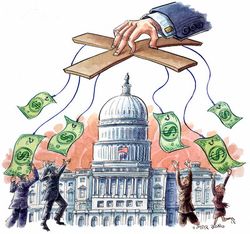
a politician is an arse upon
which everyone has sat except a man

—e.e.cummings

With greed that festers like a stinking flower
Every breath you suck promotes a scheme
The only thing you care about is power

Glory-seeking minions don’t see how you’re
Warping minds by tapping ageless themes
With greed that festers like a stinking flower

All you see are lambs to be devoured
With gluttony that feeds on hopes and dreams
The only thing you care about is power

If I were you I’d always need a shower
You curdle filth and throw away the cream
With greed that festers like a stinking flower

Lackeys sing your praises by the hour
Like starstruck fans support the local team
The only thing you care about is power

Piling up your lies, you build a tower
And live a life that’s nothing like it seems
With greed that festers like a stinking flower
The only thing you care about is power

Richard W. Bray

Myrtle Myers Redux

March 8, 2013

Shel-silverstein

A long time ago in a galaxy far, far away, I took an English class from a poet named Robert Pinsky. (Actually, it was at Berkeley in the mid 1980s, but many Northern Californians would argue that Orange County is about as far away from Berkeley as I could get.) Since that time, Mr. Pinsky has received a great deal of well-deserved acclaim. Thus I frequently see him on my tv promoting poetry. A few years back I heard Pinsky say that whenever someone asks him about when he started writing poetry, he responds by asking: “When did you stop?”

I stopped writing poetry in sixth grade and took it up again about twenty years later.

Here’s what happened: I was teaching at a boys home in a special education program for SED (Severely Emotionally Disturbed) students, which was quite an education for me. These kids were intimate with poverty, violence, addiction, rape and murder in ways I will never comprehend. (Actually, I do know a thing or two about addiction.)

Sometimes they would tease me by asking me if I were “street.”
“Of course I am.” I would reply.
“Where you from? Inglewood, Nickerson Gardens, South Central?”
“That’s it,” I’d say. “I’m from South Central Claremont.”

I’ll never know how much good I did working with those kids, and the only life I saved was my own. But it did lead me back to writing poetry. The most coveted book in our meager little school library was Where the Sidewalk Ends, a collection of funny poems by Shel Silverstein. It is a work of immense skill.

In a state of profound ignorance regarding what such a task would entail, I decided that I wanted to write a book like Where the Sidewalk Ends. So I went to the library and got some books on verse, meter, and rhyme. Some time thereafter, although I still barely even understood what poetry was, I somehow sat down at my EMachine and wrote “Myrtle Myers.”

I’ve read a bunch of poetry and thousands of pages of criticism since then. I even went out and got myself a Master’s Degree in Literature. But I don’t think I’ve ever written anything better than “Myrtle Myers.”

“Myrtle Myers” is, of course, a very conservative poem. (How did that happen?) It was not written as an allegory, but it sure reads like one. When I wrote it, however, I was mostly thinking about the power of denial, a major theme on this blog.

Myrtle Myers

Myrtle Myers bought some pliers
At the hardware store
She took them home and all alone
She broke down the door

The next day she found a way
To make the toilet flood
She took a wrench from daddy’s bench
And made a great big thud

Unperturbed, her mother purred
“Well, girls they will be girls
All this rage is just a stage
She has such darling curls”

Then Myrtle took an evil look
At her mother’s dress
It made her think and with some ink
She made a lovely mess

Yet with rage unassauged
She shaved her sister’s head
With kerosene and gasoline
She burned her brother’s bed

Undistressed, her father guessed
“It’s just a child at play
They’re just jealous, those who tell us
To have her put away”

Her parents planned a party grand
Just to celebrate
Her twelfth birthday, and by the way
Myrtle showed up late

No girls nor boys bearing toys
Decided to attend
Although assured the girl was cured
They feared their lives might end

As her family huddled, scared and befuddled
By her piercing stare
Myrtle growled and then she howled
“I publicly declare

“This can’t be true! What did you do
To make them stay away?
You’ll all be blue and live to rue
This catastrophic day!”

Myrtle made a bomb that day
Intending to destroy
Her own home town and miles around
And every girl and boy

But in her hurry, she forgot to scurry
Away from her invention
She’s gone away, I’m sad to say
Results of ill intention

Her parents pleaded all she needed
Was love and understanding
And though it’s true that we all do
Life is more demanding

It takes affection to give direction
And most kids do not mind
Those restrictions and prohibitions
Which seem to some unkind

Richard W. Bray

Dreamers of Dead

March 4, 2013

love among ruin

So many now have joined the hapless dead
As though a contest—how many can we kill
By sending others’ children off to war
The health of the state is unchecked power
Which feeds on frustration and unmet desire
This lust for blood that we confuse with love

Catenations bind us by our love
In webs of hate that recollect our dead
Murder machine fulfills the group desire
To locate people God wants us to kill
In fear a people shall relinquish power
To cowards who will always answer: War

The terrified succumb to endless war
It’s easier than proffering our love
In times of doubt the people will trust power
No matter if million end up dead
If you look and sound like those who kill
Killing you is what our dead desire

Humans have a basic born desire
To eliminate our enemies with war
Enemies exist for us to kill
Who’s the Fool who said they must be loved?
Enemies are only good when dead
Enemies embrace in lust for power

Millions murdered in pursuit of power
Pelf and power propagate desire
Desires undeterred beget more dead
The dead are mere ingredients of war
Death is all the tyrant knows of love
And Thanatos consummates the kill

Words enliven hearts we send to kill
Empty words engender frightful power
Some died for freedom, others died for love
Zombies march in cadence of desire
When unleashed the platitudes of war
Sing a dreary song of walking dead

Among the ruins, love decries our kill
Dreamers of dead are quick to kill for power
Unchecked desire is the seed of war

Richard W. Bray

The Terror of Suffix County

March 2, 2013

1-5

Annie’s destructful brother
Is a boogerypoopish mess.
Others have botherly brothers,
But Willie’s a vexsome pest.

Annie’s funtastic birthday
Was a jubilatious delight
Till Willie stealthed into her bedroom
Beneath the dimful light.

When the girls were finally sleepish
They detectified Willie’s disguise.
He was costumated in undies.
The girls were were horrorized.

Annie was fully rageistic.
Screamfully, she cried:
Abandonate this monster.
He must be porchified.”

Her parents wisefully noted
That though they were temptified,
They’d be keeping her boisterly brother.
Annie felt beastish inside.

Richard W. Bray

Under an Arch of the Railway: In Praise of W. H. Auden on his One Hundredth Birthday

February 21, 2013

railway arch

I’d like to read one of W. H. Auden’s best-known poems and one of the best-known poems, I suppose, modern poems of the last ten years. Probably someone will find that it was written in the last nine years, but it doesn’t matter…”As I walked Out One Evening.”

—Dylan Thomas (from the Caedmon Collection)

No poet consistently knocks me on my tailbone the way W.H. Auden does. Listening to Auden read Death’s Echo from the Voice of the Poet recordings makes me want to lie down in the fetal position and turn out all the lights.

As I Walked Out One Evening, depressing as it is, leaves me with some hope, however. At my lowest points, I try to remind myself that my life remains a blessing although I cannot bless.

Each stanza of “As I Walked out One Evening” is by itself a masterpiece, containing more literary merit than you will find on this entire blog.

The theme of the poem is certainly nothing new: Everything human beings do and feel is ephemeral. But a poet’s task is not to discover new themes. As Richard Wilbur notes, the “urge of poetry” is to bring its subject matter “into the felt world.”

The poem has many notable lines, but I’d like to focus on one that seems mundane at first reading, line seven:

“Under an arch of the railway”

There are, of course, many less lovely ways to express this particular image: Beneath the railroad line, below the arch which a train passes over, underneath the elevated train tracks, etc. But Auden’s construction magically sings itself off the page and into my brain where it will remain until such time as I am forced to surrender my smidge of nitrogen to the World Fund

Richard W. Bray

Dexter McTexter

February 10, 2013

mctexter

Dexter McTexter
Cooked some food to eat
He had to brag
So he sent his bros a tweet

Dexter McTexter
Heard a funny joke
Got out his thumbs
And told a thousand folk

Dexter McTexter
Stopped at a red light
Just long enough
To publicize his plight

Dexter McTexter
Scratched his derrière
It felt so good
He made his friends aware

Dexter is connected
Every second he’s awake
His overburdened brain
Never takes a break

Dexter needs the chatter
So he won’t feel alone
So damn helpless
Can’t do nothing on his own

Richard W. Bray

Some More Provocative Sentences

January 27, 2013

The power of grief to derange the mind has in fact been exhaustively noted.

*************************************************************

She did not use her poetry as prayer; she did not write to mollify God, to ward off evil; she wrote because she and she alone could find in religion the adventures of her utterly independent, endlessly speculative soul.

*************************************************************

The rich everyday exhort a part of their daily allowance from the poor not only by private fraud but by public law.

*************************************************************

The lesson in education was vital to these young men, who, within ten years, killed each other by scores in the act of testing their college conclusions.

*************************************************************

I conceive of poetry not so much as a matter of serene and disinterested choice but of action, and the very heat of choice, I think of the poem as a kind of action in which, if the poet can participate enough, other people cannot help participating as well.

*************************************************************

If you want to know what God thinks of money, just look at the people he gave it to.

*************************************************************

For, like every act man commits, the drama is a struggle against his mortality, and meaning is the ultimate reward for having lived.

*************************************************************

She hated her grandmother and had hidden it from herself all these years under a cloak of pity.

*************************************************************

The urge of poetry is not, of course, to whoop it up for the automobile, the plane, the computer, and the space-ship, but only to bring them and their like into the felt world, where they may be variously taken, and establish their names in the vocabulary of imagination.

*************************************************************

And I could cry for the time I’ve wasted, but that’s a waste of time and tears, and I know just what I’d change if went back in time somehow, but there’s nothing I can do about it now.

*************************************************************

In order for a ruling class to rule, there must be arbitrary prohibitions.

*************************************************************

We who are born into the world’s artificial system can never adequately know how little in our present state and circumstances is natural, and how much is merely the interpolation of the perverted mind and heart of man.

Compiled by Richard W. Bray

Drastic Measures

January 19, 2013

pebble in shoe

I got a pebble in my shoe
Don’t know what I’m gonna do
My tootsie cannot take the pain
My tender toes will go insane

It ouches every step I take
I cannot move, for goodness sake
Now I’m gonna sit a spell
And think of ways my pain to quell:

I could wait till it’s not sore
I could crawl forevermore

I could sit and never rise
I could fill the world with cries

I could look on the computer
I could hire a troubleshooter

I could call my family doctor
I could buy a helicopter

I could moan and wail and beg
I could amputate my leg

I just thought what I should do:
I could just remove my shoe
And pour that pebble on the floor…
Now my foot don’t hurt no more

Richard W. Bray

Drones Don’t

January 11, 2013

Matt Sestow

Drones don’t think
And drones don’t pray
Once released
They don’t delay

Drones don’t feel
And drones won’t snap
When they are told
To double tap

Drones don’t doubt
They can’t be swayed
Drones don’t read
UCMJ

Drones don’t hate
And drones don’t love
They rain down murder
From above

Robot bombs
Are nothing new
Adolph Hitler
Used them too

Richard W. Bray

Lost

January 2, 2013

images (3)

I checked the desk
I checked the drawer
I checked the chair
I checked the door
I checked my suit
I checked my coat
I checked my truck
I checked my boat

Where can they be
Those blasted keys?
Where would I be
If I were keys?

I looked here
And I looked there
I even said
A little prayer
I looked sooner
I looked later
I even checked
My ‘frigerator

Did I put them in my pants?
Or did I leave them in my car?
They can run and they can hide
But they will not get very far

Richard W. Bray