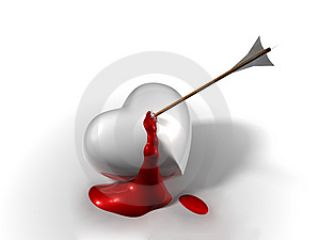
Heartbreak

August 24, 2010

I won’t be there
To watch you grow
And share your life with you
I’ve given up
The right to know
About everything you do
I lost my chance
To be with you
And see you every day
To see you smile
And hear you cry
And learn from what you say
The memory
The times we had
Feel like a missing limb
I can’t get back
To where we were
I never will again

by Richard W. Bray

The Birdman

August 21, 2010

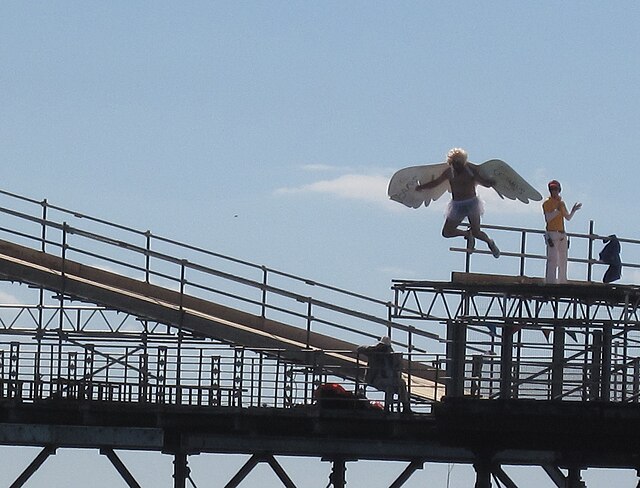
Bognor_Birdman_2010_07

The Birdman

Walter Wendel Whitebrow, the Third
Is fully convinced that he is a bird
This, of course, makes him seem quite absurd
And none of his doctors believe he is cured

With wet worms washed by Wilma, his wife
Walter had the great grub of his life
He caused a major domestic strife
By refusing to cut them up with a knife

Instead, he slurped them down like spaghetti
And all the folks in Freaksville said he
Was quite insane when he grabbed a machete
And chopped up his chairs till they looked like confetti

He gathered all the string he could find
Furiously, he started to bind
Till half his possessions were tightly twined
He couldn’t comprehend why his family would mind

Every time he would visit a house
Walter took something away in his mouth
He dove off the porch while hunting a mouse
As winter approached he began to head south

Today you can seem him up in the sky
For somehow he taught himself how to fly
Whenever a gaggle of geese passes by
Poor Wilma looks up and asks herself, “Why?”

by Richard W. Bray

Peripatetic Paul

August 19, 2010

images (5)

Peripatetic Paul

Peripatetic Paul went to the mall
He went to the beach and the zoo
He went near and far in his very own car
Still he found nothing to do

by Richard W. Bray

Ode to My Feet

August 18, 2010

Considered alone they’re simply two foots
But together they make up my feet
They endure wherever I take them
This pair is hard to beat

Daily I pound them with pressure
And each time I walk down the street
The entire weight of my body
Comes crashing down on my feet

Cruelly I encase them
In sandals or stockings and shoes
At home I keep them in slippers
Protecting from fixtures that bruise

I wasn’t designed to walk upright
But you won’t see me swinging in trees
I’m resisting all primeval yearnings
To return to the salty old seas

Supporting my frame for a lifetime
They’re loyal and faithful and strong
Through corns and fungus and bunions
My friends keeps moving along

I’m planning on keeping my tootsies
I’ll treat them with kindness and care
Publicly now I salute them
This most deserving pair

by  Richard W. Bray

Some Thoughts on Washington Rules

August 17, 2010

John Quincy Adams

Some Thoughts on Washington Rules

[America] is the well-wisher to the freedom and independence of all. She is the champion and vindicator only to her own.

–President John Quincy Adam (232)

The Muslim masses just need to be shown that it’s possible to set themselves free.

–President George W. Bush Max Boot(184)

We did not choose to be the guardians at the gate, but there is no one else.

–President Lyndon Baines Johnson (247)

What’s the point of having this superb military that you’re always talking about if we can’t use it?

–Secretary of State Madeleine Albright to General Colin Powell (142)

We have to be forward deployed in Europe and in Asia in order to shape people’s opinions about us in ways that are favorable to us. To shape events that will affect our livelihood and our security. And we can do that when people see us, they see our power, they see our professionalism, they see our patriotism, and they say that’s a country we want to be with. So we are shaping events on a daily basis in ways that are favorable to our interests. You can only do that if you’re forward deployed.

–Secretary of Defense William S. Cohen (148)

Every gun that is made, every warship launched, every rocket fired signifies, in the final sense, a theft from those who hunger and are not fed, those who are cold and are not clothed.

–President Dwight David Eisenhower (225)

Power tends to confuse itself with virtue and a great nation is peculiarly susceptible to the idea that its power is a sign of God’s favor, conferring upon it a special responsibility for other nations–to make them richer and happier and wiser, to make them, that is, in its own shining image.

–Senator J. William Fulbright (111)

Words uttered in Washington command less respect than once was the case. Americans can ill afford to indulge any longer in dreams of saving the world, much less remaking it in our own image. The curtain is now falling on the American Century

–Soldier and Historian Andrew J. Bacevich (16)

In the wake of the events of September 11, 2001, the few thinking Americans who refused to submit to War Fever were prone to feeling the effects of Marilyn Munster Syndrome (MMS). Everyone around us was acting weird, yet we were the ones who were generally regarded as freaks. People who should have known better were saying all kinds of ridiculous things on television. For example, the absurd proposition that Saddam Hussein (or anyone else, for that matter) would go to all of the trouble of developing nuclear weapons and then just give them away to people who thought he was a heretic (thereby relinquishing all the advantages of having such weapons while receiving no strategic advantage) was rarely challenged in world of Serious Washington Punditry.

Enter Andrew Bacevich, paleoconservative soldier and historian who had the wit, wherewithal and wisdom to see through George W. Bush’s harebrained scheme designed to usher in a NeoWilsonian age of perpetual paradise on earth.

Unlike so many commenters, however, Bacevich refuses to pretend that the belligerent foreign policy conducted by the Bush administration represents a substantial departure from policies of every president since Truman. Yes, Bush’s absurdly named and pitifully executed Global War on Terror has become a punchline, “redolent with deception, stupidity, and monumental waste,” but the predilection to seek simple military fixes to complex diplomatic problems has been a feature of every postwar administration (166). (Ford had the Mayaguez Incident and Carter had the failed hostage rescue mission.)

According to Bacevich, America finds herself caught up in two wars without any palatable exit strategy not simply because “the Bush administration had blundered into an immense cul-de-sac, from which it could not extricate itself” (180-181). Rather, a postwar political consensus (which Bacevich dubs the Washington Rules) has created a climate wherein the use of force is our first and favored response to conducting international relations. Thus we find ourselves in a situation where our

reliance on military might creates excuses for the United States to avoid serious engagement: Confidence in American arms has made it unnecessary to attend to what others might think or to consider how their aspirations might differ from our own (17).

Although the “standard story line, promulgated by journalists and indulged by scholars, depicts that history as a succession of presidential administrations,” Bacevich believes that “when it comes to assessing reality, slicing the past into neat four- or eight- year-long intervals conceals and distorts at least as much as it illuminates” (30, 31). The colossal stupidity and incompetence of the most recent Bush administration notwithstanding, there is overwhelming continuity in the conduct of American foreign policy. Bacevich’s Washington Rules represent a “consensus [which] has remained in tact” for almost the entire postwar era, spanning “[f]rom the era of Harry Truman to the age of Barack Obama” (15).

For most of our history, America has validated our founders’ distrust of Standing Armies by quickly demobilizing after war. But since Harry Truman decided that he needed to “scare hell out of the American people” in order to justify the creation of a permanent military establishment which would be large enough to challenge the Soviet Union for global domination, presidents have demanded a greater and greater arsenal in order to project American power. (Alleged doves like Carter and Kennedy actually expanded military budgets. Kennedy’s military outlays rose 15 during his first year in office (63). This departure from the sensible American tendency to eschew excessive foreign entanglements does not bode well for the future of the American Experiment. This new American ethos is a tradition which

has emphasized activism over example, hard power over soft, and coercion (often styled “negotiation from a place of strength”) over suasion. Above all, the exercise of global leadership as prescribed by the credo obliges the United States to maintain military capabilities staggeringly in excess of those required for self-defense. Prior to WWII, Americans by and large viewed military power and institutions with skepticism, if not outright hostility. In the wake of WWII, that changed. An affinity for military might emerged as central to the American identity (13).

Today America finds herself in a truly distressing situation. Embroiled in two major wars, our soldiers are pursuing a “pipe dream” as they are forced to attempt “social work with guns,” a misbegotten undertaking under any circumstances (204, 201). In Iraq our senseless quest for security has led to the deaths of hundreds of thousands of noncombatants and the displacement of millions more. And we continue to charge headlong into a quagmire in Afghanistan, ten years of war in search of a justification. Yet,

Whether or not Afghans wished to be saved and exactly how they viewed salvation were matters that attracted scant attention (183).

The greatest and most enduring culprit in this sad, sad, sordid tale is the American defense establishment, a suppurating wound on the body politic which has already spewed trillions of corrupt dollars like so much pus.

This money lubricates American politics, filling campaign coffers and providing a source of largess–jobs and contracts–for distribution to constituents (228).

Sadly, there is little hope that America is prepared confront reality any time soon. Despite promising hope and change, President Obama “forfeited his opportunity to undertake a serious reassessment of the basic approach to national security formulated of the course of the preceding six decades” (220).

America is going down the tubes yet no one has been able to explain “why fixing Helmand Province should take precedence over fixing Cleveland and Detroit” (220).

by Richard W. Bray
What’s a Guy to Do?

August 10, 2010

What’s a Guy to Do?

I took Tammy’s twinkie while she was at a play
Then I made a stinky and discreetly walked away
“What they don’t know won’t hurt them” is what I like to say
Besides, I’ll make it up to them on some future day

I switched Scotty’s toothpaste with some super glue
Though he’s in the hospital, he has a lovely view
If some folks cannot take a joke, what’s a guy to do?
I’m not about to miss such fun just so others won’t be blue

Alex likes to brag about the lunches his mom makes
So I replaced his lunch bag with one full of snakes
You might think that I am mean, but I say, “Them’s the breaks.”
He should learn to be more careful about which bag he takes

Walter wrote a paper that my teacher gave an “A”
Then I filled his desk with dog doo when he went out to play
We all got extra recess so it was a perfect day
It’s really all his fault, you know, for showing off that way

I hate to brag about my brilliance, but it’s simply true
I’ve never gotten caught for all the things I do
People make me angry, so what’s a guy to do?
It’s not my fault that they’re all liars and mean and stupid, too

by Richard W. Bray

Decent Wholesome People

August 7, 2010

Decent Wholesome People

Eating tofu sandwiches
And playing tambourines
A hippie dippy scoundrel
In your tie-dye blouse and jeans
Shaggy hair and sandals
And a peace sign on your shirt
Just another sissy weirdo
Making free love in the dirt
Go find a tree to hug
Like all those other hairy clones
You don’t love nature
You’re just stoned

You hardly qualify as human
Should be locked up in a zoo
So decent wholesome people
Won’t be exposed to what you do
Only true Americans
Who look and act like me
Should be allowed to walk around
Or seen on the teevee

A long beard and a trench-coat
And a silly red beret
Don’t make an intellectual
I’m thinking you look pretty gay
Your existential posturing
Don’t score no cred with me
You’ve toured fifty-seven colleges
But you ain’t go no degree
Just an over-read degenerate
With too many student loans
You ain’t no genius
You’re just stoned

You hardly qualify as human
Should be locked up in a zoo
So decent wholesome people
Won’t be exposed to what you do
Only true Americans
Who look and act like me
Should be allowed to walk around
Or seen on the teevee

You got a creepy congregation
Full of lunatics and fools
To follow you around
And let you make up all the rules
You’re a phony and a faker
And a huckster and a fraud
Just going on and on ’bout
Your relationship with God
You couldn’t quote two words of scripture
From a book you never owned
You ain’t no prophet
You’re just stoned

You hardly qualify as human
Should be locked up in a zoo
So decent wholesome people
Won’t be exposed to what you do
Only true Americans
Who look and act like me
Should be allowed to walk around
Or seen on the teevee

by Richard W. Bray

Friendly Frank

August 4, 2010

Friendly Frank

Friendly Frank went to the bank
And took out all his money
He gave it away, all in one day
And his wife didn’t think it was funny

He gave some to Becky and more to Steve
And a greater amount to Hank
And some to the teller, and more to the guard
Who worked in that neighborhood bank

“Thank you” he said, “for watching my fortune
When I wasn’t even around
The least I can do is gladly tip you
For keeping it safe and sound”

Frank went on a spree as he happily
Handed out millions of dollars
He felt such glee as he giddily
Made people do yelps and hollers

But when he was done he ran out of fun
And the crowd just withered away
All his new chums decided to run
Finding new places to play

Today Frank lives in an old brown shack
Down at the far end of town
His only friend is a hound named Huck
Nobody else is around

by Richard W. Bray

Some Thoughts on The Glass House

August 2, 2010

Allan Seager

Theodore Roethke

Some Thoughts on The Glass House

I’m naked to the bone,
With nakedness my shield.
Myself is what I wear:
I keep the spirit spare.

–from Open House by Theodore Roethke, Collected Poems (3)

Theodore Roethke and his biographer Allan Seager had a lot in common. Although they were not particularly close, the two writers were one year apart as undergraduates at the University of Michigan and they were later colleagues at Bennington College and sometime drinking buddies. Their respective literary reputations, however, are far from equal: Despite achieving a certain amount of critical acclaim during his lifetime, Allan Seager’s fiction is rarely read today; Theodore Roethke, a poet who garnered a copious collection of prizes and honors in his time, is one of the titans of American Letters. But Seager was uniquely qualified to chronicle Roethke’s life in The Glass House, as fine a biography of a literary figure as one is likely to encounter.

Allan Seager was a heavy drinker who suffered with tuberculosis and finally succumbed to lung cancer in 1968. He had just completed The Glass House, which turned out to be his most enduring work. A Rhodes Scholar and champion swimmer in his early years, Seager wrote novels and short fiction which “never won general recognition,” yet his work was “highly praised ” by such esteemed critics as Hugh Kenner, James Dickey, and Robert Penn Warren (x). In his illuminating introduction to The Glass House, Donald Hall asserts that Seager’s real strength was constructing “stories and sentences–maybe sentences more than stories,” which is confirmed by the book’s many marvelous words, beautifully collocated (xii).

Any book tells us at least as much about its creator as it does about its subject. And The Glass House is particularly revealing when it comes to Seager’s feelings about what it felt like for a young man with an artistic temperament to grow up in a small-town Michigan about a century ago. (Seager was born in Adrian which is near Lansing; Roethke was reared in the more rural and remote city of Saginaw.) Seager’s Michigan was hardly a hotbed of artistic activity:

It is hard to convey how strange, how foreign the willful making of a poem would have been in a society like his, the inert weight of custom that not only did not have room for any original work in the arts but feared and hated it (46).

And we can only wonder to what extent Seager is speaking about himself when he notes how a poetic temperament was evident in Roethke from an early age:

his despair seems to prove that he already had the prime requisites of a poet, a tingling sensitivity as if he lacked an outer layer of skin, and some sort of compulsion to elevate his life, his emotions into words (28).

As any reader of Roethke would immediately surmise, the glass house of the title refers to his family’s floral farm in Saginaw as well as the poet’s delicate ego. When Ted was fourteen, feuding between his father Otto and his Uncle Charlie, Otto’s brother, led to breakup of the family business and the sale of the beloved greenhouse. Soon thereafter, Uncle Charlie committed suicide. And then Otto, a monumental figure in young Ted’s world, died from intestinal disease. “In the space of three months, the greenhouse was gone, his uncle was gone, his father was gone” (43).

This fateful period in Roethke’s life “must have been a hell of bright awareness” because “he had suffered deprivations greater and keener than he was going to suffer again” (55). Thus, the first fourteen years of his life were “burned into his memory” and, as a poet, Roethke would continue to revisit his bucolic childhood for the rest of his life:

what he writes about are always himself, his father, his mother, more rarely his sister, the greenhouse and its flowers and its working people, the field behind it, the fishing trips with his father, and his own rambles in the game preserve and along the rivers. Instinctively he remembers the period and the area that has been charged with his deepest emotions (163).

Forever collapsing back into his early years, Roethke built one of the most remarkable careers in American Literature. According to the poet Stanley Kunitz, a great friend and supporter of Roethke, “[t]his florist’s son never really departed from the moist, fecund world of his father’s greenhouse in Saginaw” (New York Review, 1963). Ultimately, a writer has only himself to work with, and he must “use himself as a mine, to dig out, to identify, and make images of his emotions” (105). Roethke’s keen reflections of a lost youth stoked his artistic furnace for decades.

Although he would later travel extensively throughout Europe, the greatest journey for Roethke was always inward. He had little interest in sightseeing.

“Churches, galleries, the Colosseum meant nothing to him and he simply refused to see them. It was people he liked to see”(211).

Seager relates that “Stanley Kunitz says he was not a really close observer, and, of course, he did not need to be since everything around him was useful to him only as signatures of himself” (123).

Roethke, who told his students that he never voted, was not someone who kept up with current affairs (50). He read voraciously but not systematically. As Roethke’s good friend W. H. Auden explains, “Ted had hardly any general ideas at all” (67). Seager explains that Roethke was “always reading–and it was not to acquire a fund of general knowledge. Rather, like most writers, he abstracted and kept only what concerned him and let the rest slide out of his memory” (110). At any rate, somehow the multitude of words that went into his head would later recombine in marvelous combinations in his poems.

Seager concedes that Roethke’s greatest artistic asset, a near total disregard for what was happening outside his own psyche, has been seen as a liability by some critics:

Ted’s work has been criticized for the narrowness of its range, for his constant concentration on the fluctuation of the state of his own soul, with the implication that he either selfishly or helplessly limited his vision or deliberately turned it inward, using his images of the nature outside himself merely as barometric signals of internal pressures, as if he found nothing worth writing about in the world around him or was blindly unaware of it (222).

At this point, however, Roethke’s high rank in the literary cannon is very secure.

In Allan Seager’s estimation, Theodore Roethke’s life was a smashing success:

It takes determination and luck for an artist to surmount the variety of obstacles which society–and he himself with unwitting inadvertence–can throw in the way of a period when he can work effectively, eat well enough, have friends to drink with, and be bothered by only petty everyday worries. But Ted managed it (189).

(An entire post about Theodore Roethke that doesn’t mention his renowned prowess as a teacher, his mental illness, the University of Washington, the incessant self-aggrandizing lies he would tell, nor his relationships with women. Wow.)

by Richard W. Bray

Maybe

July 31, 2010

Maybe

Maybe I will clean the house
Maybe I will make my bed
Maybe I will write a book
Maybe I will bake some bread

Maybe I will lie around
Maybe I will watch tv
Maybe I’ll go back to bed
Maybe I’ll just let things be

Maybe I will paint the house
Maybe I will do my chores
Maybe I’ll take out the trash
Maybe I will scrub the floor

Maybe I will eat some cake
Maybe I will smell some flowers
Maybe I will play some tunes
Maybe I will dream for hours

Time is all we have to spend
We never get it back
I’m ready for this poem to end
Because I’m late to take my nap

by Richard W. Bray