The Steaming Complaint of the Resting Beast

March 11, 2012

aaaaaaawest-somerset_1981531b

The Steaming Complaint of the Resting Beast


The anthropomorphic train in Nadine Gordimer’s “The Train from Rhodesia” is not a single, neat, easily-envisioned metaphor
. But by utilizing contradictory symbols and images, Gordimer gives birth to a beast like none that ever lived, a creature which embodies human frailties and longings through the collision of beastly, anthropomorphic, and inanimate qualities.

Gordimer’s beast has many human attributes: It is ambulatory, vocal, sighted, blind, lonely, animated, rebellious, respiratory, contentious, melancholy and tragic. Ironically, the totality of these images forge a humanity which by far surpasses that of all but one of the white characters in the story.

Despite its numerous human qualities, Gordimer’s train can also be viewed as a beast of burden. The image of its “blind end pulled helplessly” would be familiar to any farmer who has led an oxen and plough. Also typical of a beast of burden, the train is not a silent, complacent victim. It “grunts”, “jerks” and brays out “the steaming complaint of the resting beast”. As the metaphor becomes less coherent, the train transforms into something at once animal, mechanical, and human.

Both men and beasts cry out when they feel pain, but only humans are capable of comprehending their fate. A train’s whistle is an eerie sound evocative of a howling wolf. And like our Hunting Fathers, the wolf is a carnivore which lives and hunts in small packs. So it is natural for people to associate the wolf’s cry with feelings of existential angst. But whatever the howling wolf may be feeling, its howl is not an existential lament because a wolf is not cognizant of its own mortality. When the train calls out “I’m coming” Gordimer’s metaphor is expanding into something exceeding the images of a train, a beast, or a person.

The train cries out “and again there was no answer” because its whistle echoes the inherent loneliness of self awareness. Just as humans have been calling out to the cosmos through prayers and radio antennae for millennia, the train’s cry is a prayer. Thus the man-made device mocks our craving for an omnipotent creator.

Like the trajectory of a human life, Gordimer’s train travels in one direction “over the single straight track” of time.” And the manner in which human existence is connected to an inescapable fate is captured by the complexity of the metaphor.

Ultimately, we must accept the messiness of the metaphor in order to appreciate its multiple meanings.

Richard W. Bray

Stream

February 25, 2012

aaaaaaaaaaaaimages

naggin little
melancholy
nibblin at my day
left a hole
that slit my soul
and drained my
hope away

heaven knows
joy comes and goes
who could tell me why?
heaven knows
the river flows
and sometimes
it ebbs dry

day by day
waves slap shore
earth spins round the sun
fill your cup
when joy erupts
soon it will
be gone

Richard W. Bray

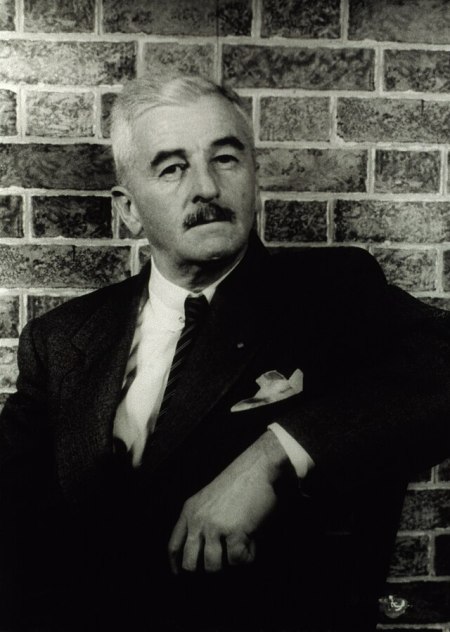
William Faulkner and the English Language

February 11, 2012

Carl_Van_Vechten_-_William_Faulkner

(Below are notes from a presentation I gave in graduate school.)

Question: Some people say they can’t understand your writing, even when they’ve read it two or three times. What approach would you suggest for them?

Faulkner: Read it four times.

—Interview with Jean Stein vanden Heuvel 1955 (Meriwether 250)

William Faulkner’s flamboyant use of language is a widely-discussed topic which includes a variety of subjects, including his use of part of speech, punctuation, long sentences, stream of consciousness, redundancy, visual imagery, metaphors, dialect, word clusters, coinages, paradox and poetics (particularly meter).

This presentation will cover some of these topics, particularly

1. Faulkner’s often playful use of parts of speech
2. The significance of sentence structure (in a historical perspective)
3. Word clusters (including redundancy)
4. Coinages (particularly with prefixes and suffixes)

Faulkner’s style is still controversial. Even those who acknowledge his greatness are often annoyed by it. According to Warren Beck:

No other contemporary American novelist of comparable stature has been as frequently or severely criticized for his style as William Faulkner. Yet he is a brilliantly original and versatile stylist. The condemnations of his way of writing have been in part just; all but the most idolatrous of Faulkner’s admirers must have wished he had blotted a thousand infelicities (142).

Placed in its historical context, Faulkner’s style can be seen as a stark contrast to the “muscular” or “masculine” style of prose utilized by many of his contemporaries, particularly Hemingway, Stevens and Cummings. During the fist part of the twentieth century, a lean style (labelled nominalism by Panthea Reid Broughton) was hailed for its commitment to Truth

Wallace Stevens’ dictum: Not Ideas about the Thing, but the Thing Itself

And Cummings and his entire generation seem to have developed an almost paranoid fear of the abstract phrase. (Broughton 12)

Earnest Hemingway, Faulkner’s obvious rival, argued that writing should strip the language clean, lay it bare down to the bone. (Broughton 14)

But nomalism has its limitations. According to Broughton,

Nominalism is reductionist first of all because it ignores the complexity of reality, the evasiveness of truth. It is grounded in the assumption that truth objectively knowable, that perception is entirely accurate (16).

Faulkner took the opposite approach. Because words are so inadequate to capture reality, Faulkner piles words upon words in order to depict a variety of images and ideas which might at least add up to a fragmented picture of reality.

Faulkner on Hemingway:

I thought that he found out early what he could do and he stayed inside of that. He never did try to get outside the boundary of what he really could do and risk failure. He did what he could do marvelously well, first rate, but to me that is not success but failure….failure to me is the best to try something you can’t do, because it’s too much (to hope for) but still try and fail, then try it again. That to me is success (Meriwether 88).

And, He did it fine, but he didn’t try for the impossible. (Slatoff 185)

So we can begin to understand the method in Faulkner’s madness by appreciating that he was trying for the impossible. He did this by experimenting with language and the convention of the novel in a variety of ways. One method was the use of paradox in the form of oxymoron. According to Walter J. Slatoff

The oxymoron, on the one hand, achieves a kind of order, definiteness, and coherence by virtue of the clear antithesis it involves. On the other, it moves towards disorder and incoherence by virtue of its qualities of irresolution and self-contradiction….Traditionally it has often been used to reflect desperately divided states of mind (Slatoff 177)

So Faulkner attempts to achieve clarity by means of depicting confusion. (That’s a paradox.)

Hightower’s face is at once gaunt and flabby
the church has a stern and formal fury
Singing from a church is a sound at once austere and rich, abject and proud
Joe Christmas’ feet move in a deliberate random manner
Armstid’s eye’s at once vague and intense
Abe Snopes’ homestead is a cluttered isolation
Eula Varner seems to exist in a teeming vacuum
Houston and the girl he is to marry: Up to this point their struggle, or all its deadly seriousness…had retained something of childhood, something both illogical and consistent, both reasonable and bizarre

Faulkner’s use of redundancy to clarify meaning is a practice which Edwin R. Hunter has labeled “word hunting.” This involves the author searching for the appropriate word not only in his mind, but on the page as well. Hunter has described eight different types of “word hunting” in the work of Faulkner. (130-132)

1. Questions the exactness of a word.
2. Comments openly about the rightness of a word.
3. Searches for a word only to come back to original.
4. Seeks openly for a word.
5. Records progress, step by step.
6. Corrects word on the spot.
7. Acquiesces in inexact word.
8. Sets down and repeats in.

Faulkner also uses the redundancy of adjective clusters to create a kind of depth in his depiction of reality. Hunter has painstakingly discovered 1416 examples of three-, four-, five-, six-, seven-, eight-, nine-, ten-, and even a thirteen-adjective clusters. (See chart).

Examples: (Hunter 136-139)

Three Adjectives–1009 examples
‘Pa stands over the bed, dangle-armed, humped, motionless
she advanced in identical and anonymous and deliberate wagons…
‘Houston, followed by the big, quiet regal dog’

Four-Adjectives –268 examples
the wealcolored, the strong pallid, Iowacorncolored hair
In the glare its eyes roll with soft, fleet, wild opaline fire

Five-adjective–84 (136)
the last old sapless indomitable unavanquished widow or maid had died’
the big rambling multigalleried multistoried steamboat-gothic hotel

Six-adjective–30 examples (136-7)
a lean, loose-jointed, cotton-socked, shrew, ruthless old man
with his little high hard round intractable canon-ball head

Seven-adjective–16 examples (137)
a brawling lean fierce mangy durable imperishable old lion

Eight-adjective–4 examples (137-8)
the youth fleeing, the forsaken aging yet indomitable betrothed perusing, abject, constant, undismayed, undeflectable, terrifying not in effect but in fidelity
“These may be nine or or even ten adjective clusters. One cannot be sure.”

Nine or more adjective
he approached, chop-striding, bull-chested, virile, in appearance impervious and indestructible, starred and exalted and, within this particular eye-range of Earth, supreme and omnipotent still

Faulkner also utilizes redundancy through a process which Hunter calls “Repeated Cluster Patterns” (139-40).

Examples:

a bell tinkled…high and clear and small

a belltinkled…to make that clear small sound

The little bell tinkled once, faint and clear and invisible

She just looked at me, serene and secret and chewing

She looked at me, chewing, her eyes black and unwinking and friendly

She stood in the road…her eyes still and black and unwinking

She looked at me, black and secret and friendly

We see a good indication of Faulkner’s playfulness in his uncommon use of parts of speech. One example of this is what Hunter calls Adjective Clusters.
Examples:

Stem Adverb Clusters (Hunter 152)

his uncle told it, rapid and condensed and succinct
He shook hands with him, Charles, quick and brief and hard too

-ly-ended Adverb Clusters (Hunter 152)

he was mentally and spiritually, and with only an occasional aberration, physically faithful to her
the group commander was listening…quietly and courteously and inattentively

Faulkner’s coinages are also often amusing and playful. One way he did this was by creating negatives by adding prefixes and suffixes to a variety of words. (Hunter 176-8)

Some examples of Faulkner’s wordplay from The Sound and The Fury

Parts of speech
Jason snuffled (68)

wind chill and raw (290)

anticked (297)

he loaded himself mountainously (268)

Coinages via prefixes and suffixes:

unimpatient (87)

peacefullest (174)

unsecret (177)

unhurriedly (288)

unmindful (297)

paintless (299)

Paradox:

clairvoyant yet obtuse (280)

Conclusion:

Maybe William Faulkner was greatest American novelist of the twentieth century; maybe he was an unreadable buffoon. What cannot be argued is that he continues to exert a tremendous influence upon the conventions of modern fiction.

Endnotes

Beck, Warren. William Faulkner’s Style, William Faulkner: Three Decades of Criticism

Ed. Frederick J. Hoffman and Olga W. Vickery. Lansing: Michigan State UP, 1960.

Broughton, Panthea Reid. William Faulkner: The Abstract and the Actual. Baton Rouge:

Louisiana State UP, 1974.

Faulkner, William. The Sound and the Fury New York: Random House, 1990.

Hunter, Edwin R. William Faulkner: Narrative Practice and Prose Style. Washington,

DC: Windhover Press, 1973.

Meriwether, James B. and Michael Millgate. Lion in the Garden: Interviews with

William Faulkner, 1926-1962. New York: Random House, 1962.

Slatoff, Walter J. “The Edge of Order: The Pattern of Faulkner’s Rhetoric.” William

Faulkner: Three Decades of Criticism Ed. Frederick J. Hoffman and Olga W.

Vickery. Lansing: Michigan State UP, 1960.

Richard W. Bray

shift

January 31, 2012

640px-Broken_vase_on_a_grave_J1


i broke the vase
you gave me
the vase that
had survived
i sat down
for a minute
i thought that
i would cry
i just thought
about you
didn’t hurt so much
as before
the vase was
not our love
i didn’t need it
any more

by Richard W. Bray

Men and Sports

January 22, 2012

Men have an innate desire to celebrate athletic achievement. This is probably because Our Hunting Fathers relied upon their athletic prowess for survival, and it is no surprise that the best hunters and warriors are revered and rewarded in nomadic societies and lionized in folklore. Anthropology is the field which best explains why modern men are hardwired to want to be like Mike.

Professional sports–grown men playing children’s games in public for money—is a multibillion dollar obsession in this country. (Of course, this includes Division One college football and basketball—a malignant growth on our system of higher education, but that article has already been written.) Millions of American males (myself included) spend an absurd amount of time not merely witnessing this grand spectacle, but talking about it, reading about it, and digesting hours of sports radio and television shows.

Sports media is ultimately a discussion about morality. This is acutely apparent on sports talk radio, a large and growing presence in radio markets large and small. And sports talk radio is largely a debate about what constitutes manhood. (The overwhelming majority of the hosts and callers are male, and on the rare occasions when women’s sports are discussed, they are often held up for ridicule.) No matter what the subject, high salaries, steroids, what it takes to be a champion—it’s about what type of men these athletes are. The hosts and callers argue endlessly about whether particular athletes are winners, whiners, losers, or stand up guys.

But athletic competitions are not morality plays. Despite our inherent tendency to assign virtue to the victors, when one team defeats another on the sporting green, it signifies little about the actual character of the men involved. But something inside us wants to believe that the winners are more virtuous, or that they practiced harder, or that they are simply better people who deserved to win.

Sadly, however, grace under pressure in the athletic realm has no correlation to one’s behavior in real life. This is confirmed by a cursory look at the Jurisprudence section of the local sports page. The NFL is our favorite sport by far despite the frequency with which the exalted men who play professional football are being arrested for all manner of malfeasance, including rape, murder, assault, and drunken driving. (For a literary example of this phenomenon, see John Updike’s novel Rabbit Run. Like so many real life jocks, Rabbit Angstrom is a winner on the basketball court but a louse and a loser in his personal life who abandons his pregnant young wife and calls her a mutt).

When it comes to sports, people are inclined to ignore one of life’s basic lessons: an unexplainable alchemy of talent, luck, and preparation add up to worldly success. The winners are not necessarily superior to the losers, and Jesus doesn’t love them any better than He loves anyone else.

Hollywood understands all this
. Witness the perpetual onslaught of tedious formulaic movies where our hard-working and virtuous hero almost always wins. Movies like Rocky and The Karate Kid are more cliche than storytelling, where lovable underdogs prevail against opponents who are simply depraved monsters.

There are many outstanding sports movies which defy and often even ridicule our expectations, including Dodgeball, Happy Gilmore, CaddyShack, Raging Bull, White Men Can’t Jump, Eight Men Out, Moneyball, North Dallas Forty, Million Dollar Baby and Friday Night Lights.

by Richard W. Bray

Some Provocative Sentences

January 7, 2012

The most lively thought is still inferior to the dullest sensation.

*******************************************************************

By the time I was done with the car it looked worse than any typical Indian car that had been driven all its life on reservation roads, which they always say are like government promises—full of holes.

*******************************************************************

I tell you his mind bled almost visibly.

******************************************************************

Why should so much poetry be written about sexual love and so little about eating—which is just as pleasurable and never lets you down—or about family affection, or about the love of mathematics.

******************************************************************

In the morning there was a big wind blowing and the waves were running high up on the beach and he was awake a long time before he remembered that his heart was broken.

******************************************************************

Well, then, says I, what’s the use you learning to do right, when it’s troublesome to do right and ain’t no trouble to do wrong, and the wages is just the same?

******************************************************************

Perhaps, when we remember wars, we should paint ourselves blue and go on all fours all day long and grunt like pigs. That would surely be more appropriate than noble oratory and shows of flags and well-oiled guns.

******************************************************************

“Keep your pores open.”

******************************************************************

“But, by what I have gathered from your own Relation, and the Answers I have with much pain wringed from you; I cannot but conclude the Bulk of your Natives, to be the most pernicious Race of little odious Vermin that Nature ever suffered to crawl upon the Surface of the Earth.”

******************************************************************

“There is special providence in the fall of a sparrow.”

******************************************************************

It is only when our appointed activities seem by a lucky accident to obey the particular earnestness of our temperament that we can taste the comfort of complete self-deception.

******************************************************************

“If you could look deep enough into anyone’s character, even perhaps your own, you would find a sense of machismo.”

Compiled by Richard W. Bray

Some Thoughts on Streetball

December 28, 2011

So it is in life—from sun, to moon, to earth, to night, to day, to you getting up in the morning and going out to play a game of ball. All the rhythms of life are in some way related, one to another.

The First Book of Rhythm by Langston Hughes

So you know, that you’re over the hill
When your mind makes a promise that your body can’t fill

Old Folks Boogie by Little Feat

I love to drive past Brea Junior High School on Lambert Road on warm nights when guys are playing basketball under the lights even though I had to quit over a decade ago. I played regularly in the same pickup game for over twenty years (roughly 1980-2000) until my body said, “No mas.” At some point we all must accept that the beat goes on without us.

On Saturdays and Sundays we would meet on the dirty asphalt: Kenny, Mitch, Oscar, Bob, Tony, Carl, Dave, Robert, Michell, Regan, Jeff, Rob, Brian, Don, Andy, Steve, me and whoever else decided to show. Some showed up sporadically; others were there every Saturday and Sunday. Year round unless it was raining, we almost always had enough guys to play five on five full court basketball. Sometimes so many guys showed up that when you lost you’d have to watch three or four games before you could play again.

Streetball has no constitution, but there are rules which vary somewhat from court to court. Two nearly universal rules make it possible for a guy to show up and play almost anywhere.

(Warning: Although I’ve shown up by myself and played at ballcourts in various locals without serious incident, it is always advisable to bring backup when playing with guys you don’t know. And some games should probably be avoided outright. I stopped playing at a particular court in Pomona when a buddy told me that disputes there sometimes involved firearms.)

Rule One: Players call their own fouls and all calls are respected. Play stops any time a player yells “foul,” and his team gets the ball back without any arguing or complaining–well, that’s how it works in theory. But if someone abuses this rule by calling a foul every time he misses a layup, that player will eventually face a barrage of verbal reprimands, sometimes from his own teammates. This is how the game regulates itself.

Rule Two:
The winning team keeps playing while the losers go to the back of the line. At our court next game always went to the five guys who had been waiting the longest, which is a good way to maintain tranquility and keep the games flowing. (At many streetball venues, players are able to call “next” and then choose whomever they want to be on their team–for example, one player might call next and then wait to choose the best players from the team that just lost, ignoring guys who have been waiting for several games.)

Streetball is an institution which functions as a building block of our civil society. Each week we chose to freely associate with one another in order to exercise our appetites for conflict, competition, and fellowship. All sorts of good and bad things can happen when grown men attempt to maintain comity and civility while fiercely chasing a round little ball. Over the years there was often much shouting and bluster, but we were usually able to settle disputes without assaulting one another.


I don’t want to frighten any of my younger readers, but in the age before smartphones, human beings who desired fellowship actually had to talk to the people around them
. And that’s what we did between games, we talked about everything. Sports. Life. The weather. We even talked about the onomatopoetic ramifications of Chick Hearn’s expression, “in-n-out heart BUH-RAKE.” That’s why I miss the guys as much as I miss the game.

Drivers, teachers, lawyers, students, contractors, forklift operators, electricians, surgeons, linemen, entrepreneurs, computer programmers, waiters, painters, carpenters, college professors, air conditioner repairmen. I miss the guys.

by Richard W. Bray

Max y Arroz Picoso (by richard)

December 22, 2011

Ingredients:

1 400 gram can of Zanahorias en Escabeche (Sliced Pickled Carrots with Jalapenos)
1 1/2 cups white rice (or brown rice if that’s what you’re into)
3 cups chicken broth
1 chopped bell pepper (or half a stalk chopped celery)
2 teaspoons olive oil

Directions:
Combine rice, vegetables and broth. Add oil and salt and pepper to taste. Bring to a boil and reduce to simmer until liquid disappears (approximately 20 minutes).

Thinking v. Feeling

December 17, 2011

Theodore_Roethke_as_an_infant,_Saginaw,_Michigan,_ca_1909_(PORTRAITS_699)

Thinking v. Feeling

Poet said We think by feeling
A thought that echoes Hume
No logic-minded being
Would genuflect at tombs

We feel therefore we think
Is what they’re finding out
This unappealing link
Is Descartes turned inside out

With a touch of intervention
From our modern frontal lobe
My breed maintains ascension
On our lovely little globe

Toughest on the block
With more appetite than smarts
Condemned to rule this rock
For the cravings of the heart

by Richard W. Bray

Rough Draft Peer Review WorkSheet and an Amusing Teacher Story

December 9, 2011

STW-UniversityPark-Teaching20Group20Work_NoMusicNoGFX.00_01_06_20.Still003_v2

I have students bring two copies of their rough drafts. While the students are doing their peer reviews, I scan the other copy, looking at the structure of the essays rather than proofreading them. The students are free to proofread one another’s essays.

Directions

1. Turn in one copy of paper to instructor.
2. Take two Peer Review Worksheets.
3. Get into groups of 3-4 Students.
4. Take turns reading papers ALOUD to group.
5. Pass paper clockwise (or counterclockwise if you’re feeling rebellious).
6. Silently read another student’s paper and fill out worksheet.
7. Repeat steps 5 & 6.

Rough Draft Peer Review Sheet

Author: __________________________________________________

Reader:__________________________________________________

Paper Title:_______________________________________________

This paper is ______pages long (excluding Works Cited page)

This paper includes a Works Cited page in MLA format: Yes No

Thesis statement is in paragraph # _____

Copy thesis statement verbatim.

Two enlightening quotations from sources that the author utilized are:

and

Two notable sentences that the author composed are:

and

What is the paper’s strongest feature?

An Amusing Teacher Story

During a discussion about ESP, a student informed the class that he possessed a “sixth scent.” Miraculously, I resisted the temptation to say, “You’re telling me, buddy.” (Life rarely provides such a perfect straight line.)

by Richard W. Bray