
Tonight
In every bar
Drunken alcoholics speak
Of friends who really have
A drinking problem.
by Richard W. Bray
Tonight
In every bar
Drunken alcoholics speak
Of friends who really have
A drinking problem.
by Richard W. Bray

Bleary Blob of Blue
Time is just a concept
And I am just a fool
And the last fourteen hours
Are just a bleary blob of blue
I think I lost my girlfriend
I think I lost my mind
I know I lost my dinner
I can’t find my behind
I think I lost employment
I know they took my car
I lost everything that matters
When I stepped inside that bar
I’m overcome with sickness
My brain’s a filthy stew
I cannot stop these tremors
And my body feels like goo
I think I lost my girlfriend
I think I lost my mind
I know I lost my dinner
I can’t find my behind
I think I lost employment
I know they took my car
I lost everything that matters
When I stepped inside that bar
This county holding pen is
Just as cold as I am dry
Right now I need to rally
Just to find the strength to die
I think I lost my girlfriend
I think I lost my mind
I know I lost my dinner
I can’t find my behind
I think I lost employment
I know they took my car
I lost everything that matters
When I stepped inside that bar
by Richard W. Bray
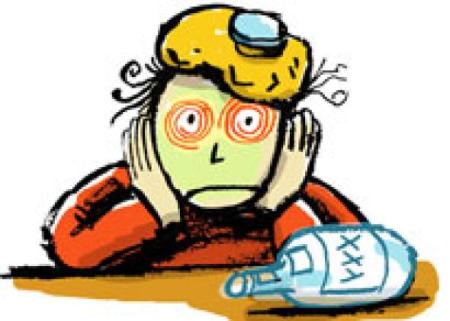
My life’s in shambles
Brass tacks and brambles
Rumblin’ around in my heart
I’m losing my balance
And drinking up gallons
Since you and me been apart
I’m stuck in my bed
I done lost my head
My get-up-and-go fell apart
I’m hazy and dazy
Wayward and crazy
I really ain’t actin’ too smart
I’m busting up bars
And crashing my car
It’s time for rehab to start
My life’s in shambles
Brass tacks and brambles
Rumblin’ around in my heart
by Richard W. Bray

Some Thoughts on American on Purpose
There are only about five million Scots, which is amazing when we stop to consider Scotland’s capacious record of supplying the world with brilliant and industrious citizens. This minuscule divisor makes Scotland, on a per capita basis, the second greatest contributor to what is often referred to as Western Civilization.* (I figured this all out with a slide rule. It was actually a statistical dead heat between Scotland and Greece, but Scotland won the tiebreaker–fashion. Kilts beat togas.)
But despite the fact that they have provided us with so many outstanding writers, thinkers, engineers, industrialists and explorers, the Scottish people are often portrayed as a bunch of brassy, belligerent, bibulous, bargain-hunters.
In his memoir American on Purpose, the immensely gifted actor, comedian, writer and late-night talk show host Craig Ferguson asserts that, Scrooge McDuck notwithstanding, the inhabitants of his native land “are very generous” (46). Otherwise, he does little to dispel the dominant stereotypes about Scottish people.
For Ferguson, the most dreary and oppressive institution in Scotland was the public school system where teachers were extremely liberal with the lash. Ferguson realized that he wanted out of the “redbrick gulag” on his first day (31). And strap-happy teachers weren’t the only threat. Ferguson soon discovered that “what was especially perilous to do at school was to stand out in any way” (22). School was a scalding hot cauldron of anger and resentment where “if you were noticed, you got hit” (67). (Ferguson recalls his brief teenage sojourn to America with this stunning observation: “And nobody wanted a fight. Not once.”) (40)
But this is not a bitter memoir, and Ferguson isn’t one to blame others for his problems. He is extremely honest and reflective about how his innate sense of seclusion contributed not only to his profound feelings of alienation at school but also provided a fertile ground for his burgeoning addictions:
it seems to me that this profound sense of isolation, resentment, misanthropy, and fear in a prepubescent child is an extraordinarily ominous portent. I should have put my name down for rehab then (23).
Ferguson first tried marijuana at a concert when he was just thirteen-years-old, and it was love at first puff:
From this moment on I would dedicate my life to rock and roll and take as many drugs as possible.
What could possibly go wrong? (42)
Despite blacking out the first time he drank as a teenager, Ferguson was soon off and running on a binge that lasted for over a decade. His motto is, “Between safety and adventure, I choose adventure” (196). And Ferguson was a true daredevil in pursuit of a buzz, eventually adding cocaine (the “wonder drug”) and even heroin to his repertoire (114). But this adventure story eventually transmogrified in a horror show: “More shame brought on by behavior instigated by alcohol, which only fueled the need for more alcohol, and on and fucking on” (160). The vicious downward cycle eventually led Ferguson to contemplate suicide. In a fit of total desperation Ferguson contacted his friend Jimmy Mulville, a television producer and recovering alcoholic, and confessed, “I can’t drink and I can’t not drink. I’m too sick to live and too chickenshit to die” (174)
I’m a sucker for a story with a happy ending, and American on Purpose is full of them, particularly the birth of Ferguson’s son Milo, his successful endeavor to become American citizen and his third marriage to Megan Wallace Cunningham:
She makes me feel like I’m lucky, and I know because I have her that I am. I’m happy to be her husband, and I can absolutely positively categorically swear that this marriage is definitely-and-without-doubt-I’m-not-kidding-you-I-really-mean-it the last one for me (262)
Despite being hard on his homeland at times, Ferguson acknowledges that “Scotland made me what I am and America let me be it” (268).
American on Purpose is an enlightening and entertaining memoir.
* You’re not necessarily an anti-Semite if you have to ask which group has made the greatest per capita contribution to Western Civilization, but the answer is pretty freaking obvious.
by Richard W. Bray
(Editor’s Note: The novel Lucky Jim by Kingsley Amis is often compared to the works of Evelyn Waugh for its alleged hilarity. Sadly, I found the book to be mean-spirited and stupid and not that funny at all. Maybe I just like people too much.)
Ten Things I Learned from Reading
Lucky Jim which aren’t Actually True
1. Drinking solves more problems than it causes.
2. Most academics are pathetic dweebs.
3. Post-WWII colleges in England admitted way too many of the wrong type of people.
4. Most academic writing is worthless drivel.
5. Women tend to become less sexually attractive as you get to know them.
6. History shouldn’t be wasted on the unwashed masses.
7. Most people are ridiculous clowns.
8. Classical music is for losers.
9. Life is a sick, sad joke without a punch line.
10. You will be rescued by a rich benefactor so long as you don’t give too much of a damn about anything.
by Richard W. Bray

An Excellent Place to Meet Losers
Somehow the blue and the bluer
Straggled on in from the street
This place might not look like a sewer
But it reeks with the stench of defeat
Such an
Excellent place to meet losers
And guys who abandoned their wives
And staggering babbling bruisers
And people who screwed up their lives
There’s plenty of cursin’ and fussin’
But at least we all can agree
The most suitable barroom discussion:
The drunk who’s more worse off than me
Such an
Excellent place to meet losers
And guys who abandoned their wives
And staggering babbling bruisers
And people who screwed up their lives
Don’t ask me just how I got here
I don’t like to live in the past
I’m happy so long as I got beer
I’m certain this won’t be my last
Such an
Excellent place to meet losers
And guys who abandoned their wives
And staggering babbling bruisers
And people who screwed up their lives
So if you are looking for sinners
Grasping at bottles and straws
Or hopelessly gossiping grinners
And people who broke every law
Check out this
Excellent place to meet losers
And guys who abandoned their wives
And staggering babbling bruisers
And people who screwed up their lives
by Richard W. Bray

A friend is the old old tale of Narcissus
–W.H. Auden
I Liked You so much Better when You didn’t have a Clue
Seen ya’ ‘round town these days—I confess you’re looking good
You eat right and sleep at night like a feller should
Who’da ever guessed that such a loser could
Turn it all around—I recommend you knock on wood
I liked you so much better when you didn’t have a clue
Since you’ve pulled yourself together I don’t know what to do
It’s painful to consider but I must admit it’s true
It gave me so much comfort when I looked down on you
I heard that you quit drinkin’ and stayin’ out till dawn
I saw you Sunday morning mowin’ your own lawn
I seen you with a brunette and a redhead and a blonde
And every indication is you got it goin’ on
I liked you so much better when you didn’t have a clue
Since you’ve pulled yourself together I don’t know what to do
It’s painful to consider but I must admit it’s true
It gave me so much comfort when I looked down on you
Well I’ll go out tonight and probably drink until I puke
If I don’t get arrested I’ll endure severe rebuke
I never thought I’d say this, but why can’t I be you?
Whole world’s turnin’ upside down, what’s a guy t’do?
I liked you so much better when you didn’t have a clue
Since you’ve pulled yourself together I don’t know what to do
It’s painful to consider but I must admit it’s true
It gave me so much comfort when I looked down on you
by Richard W. Bray
A good athlete must have that harmony of movements or rhythm, which is called “form”….From pitch, to swing, to ball, a whole series of rhythms are set off, one rhythm, or one motion, starting another. So it is in life—from sun, to moon, to earth, to night, to day, to you getting up in the morning and going out to play a game of ball. All the rhythms of life are in some way related, one to another. You, your baseball, and the universe are brothers through rhythms.
—Langston Hughes, The First Book of Rhythm
It is impossible to sever language from poetry. All written and spoken language is rhythmic and metrical. Even the phonebook read aloud would contain the unmistakable cadences of the English tongue. All barkers, salesmen, teachers, DJs and sportscasters, and anyone else who makes her living with her voice, are constantly interpreting poetry, whether they realize it or not.
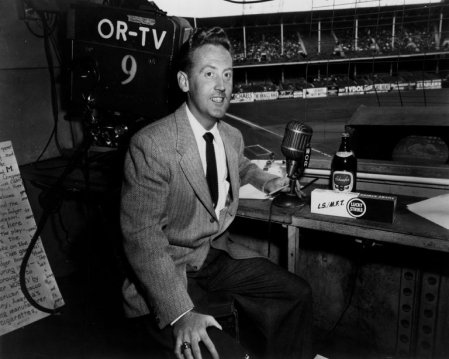
Two of the people who have breathed life into our language for me are sportscasters Chick Hearn and Vin Scully. Although they are quite different in style and temperament, their respective talents almost perfectly match the games upon which they report(ed).
Linguists refer to English as an accentual-syllabic language because the rhythms of our language are based upon the natural stresses which occur with accented syllables. A particular form of genius which interpreters of language like Hearn and Scully possess is the ability to unconsciously make thousands of decisions about which syllables to stress and how to stress them during the course of a single sporting event.
The late Chick Hearn, who announced Los Angeles Lakers’ basketball games for thirty-seven years, was a brash, boisterous, irrepressible motor-mouth with an inventive mind for language and metaphor. He originated many phrases which are now embedded in the nomenclature of the game: SLAM DUNK, CHARity STRIPE (free throw line), YO-YOing UP and DOWN (dribbling) and TICKy TACK FOUL (an infraction that wasn’t). When a player on offense had made a move which caused his defender to lurch in the wrong direction, Hearn would say the player had faked his opponent “INto the POPCORN maCHINE.” Hearn’s machinegun delivery was apposite not only for the action-packed, rapid-fire sport he covered, but for modern age in which we live.
By way of contrast, Vin Scully, who has been covering Los Angeles Dodger baseball games since the team was in Brooklyn (now going on sixty years), seems in many ways better-suited for an earlier, simpler, more agrarian age. This is not to say that Scully talks like a hick. Far from it, he is an erudite man who seasons his commentary with literary allusions and historical references. Scully’s calm, leisurely parlance is perfect for the one major American team sport which is not governed by a clock. (As George Carlin remarked in his legendary baseball/football routine, while football is “rigidly timed,” in baseball, “you don’t know when it’s going to end.”) Like the game of baseball itself, Scully’s languid delivery reminds us of an age (whether it actually existed or not) when time was less of a commodity.
The pastoral rhythms of a bygone time live on in baseball, which was invented sometime in the early to mid-nineteenth century. The innumerable pauses in action allow a good baseball announcer to weave several narratives into the story of the game he is broadcasting. Like a nineteenth century cracker barrel bard, Scully is above all a storyteller [This is a hypothetical example]:
“Two and one, the young pitcher Davis comes from PENSaCOLa FLORida. His grandfather was a FULL BLOODed CHOCKtaw INdian who once EARNED a LIVing HUNTting BEARS. SWINGANDaMISS. Two and two.”
When a player hits a ball deep into the outfield and Scully refers to it as a HIIIIIGH FLYYY BAAALL, he is creating poetry. (If you close your eyes, you can almost feel the arc of the ball in his words.) Like Hearn, Scully instinctively knows which syllables to stress and how long to stretch out the vowel sound.
Vin Scully feels like a friend to millions of people who have never met him. His pleasant, mellifluous voice was a tremendous comfort to my grandmother who never missed a game on the radio, particularly during her final, bedridden years. (And there were certainly times during my drinking days when Vin Scully and a twelve-pack seemed like my two best friends in the world, though not necessarily in that order.)
Poetry is everywhere that people talk. Once, when I was teaching seventh graders, as I walked up to my classroom door and stuck a key in the lock, the group of three or four students standing there immediately ceased the conversation they were having:
I joked, “You guys don’t have to stop talking because of me. I’m down.” (Down in this context meaning, cool, alright, one of the gang.)
One of the students, a girl named Janelle, replied, “MISter BRAY you are SOOO NOOOT DOOOWN.” (“DAVEy LOPES hit a HIIIIGH FLYYYY BAAAALL”)
by Richard W. Bray
 Laughter hope sock in the eye's Blog