Archive for the ‘W.H. Auden’ Category

Wystan and Emily

May 11, 2024


life comes at me in rhythm
words come at me in rhyme
toil teaching wisdom
the only place is time

walk along the seashore
frolicking in the snow
tasting all the sunshine
existing as i go

Wystan and Emily
sang a sonnet just for me
silently throughout the years
it danced a journey to my ears


by Richard W. Bray


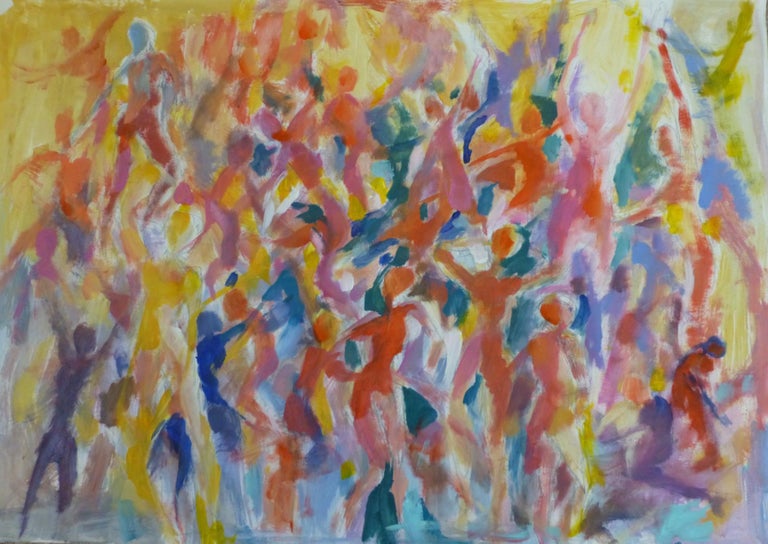
Dance, Dance, Dance

November 11, 2023


Dance, dance, for the figure is easy,
   The tune is catching and will not stop;
Dance till the stars come down from the rafters;
   Dance, dance, dance till you drop.
W. H. Auden, Death’s Echo

Laughing in the face of evil
What else can you do? 
Hold on real tight 
To what’s good and close and true

You can only forgive
What was done to you
Everything else
Is left to You Know Who

The mind makes hell from heaven
It makes heaven out of hell
Own the space inside your head
And keep yourself well

A lot of things will happen
You don't always have to tell
Live your own story
It's not a thing to sell

Wish everyone the best
Play your own part
And dance every moment
To the song in your heart

by Richard W. Bray

space and time

October 15, 2022

The world is made of frozen light
Everything connects
Nothing in the universe
Works like you expect

Does a tree know it exists?
Does a star know how to love?
Look at thirteen blackbirds
Listen to a dove

Make some room for kindness
As you straddle space and time
The world is charged with grandeur
Everybody shines

by Richard W. Bray


Reason’s Gift

February 26, 2021

From thought and love and rhyme
To frontiers of space and time

From a mosque in Timbuktu
To the Dome of Xanadu

From protecting son and daughter
To industrialized slaughter

From a monkey standing tall
To the beast that wants it all

By Richard W. Bray

Granite to Grass

December 17, 2020

‘Tis sweet to know that stocks will stand
When we with Daisies lie—

Emily Dickinson, If I Should Die

Darker nights than ever
Hearts of shattered glass
Hefting laden caskets
Setting granite in the grass

They will come for all the bodies
Then they’ll come and take our homes
The machine keeps right on turning
And grinding up the bones

When disaster makes you richer
What could ever make you whole?
Is it just the love of Mammon?
Or the absence of a soul?

They will come for all the bodies
Then they’ll come and take our homes
The machine keeps right on turning
And grinding up the bones

by Richard W. Bray

how many children did you kill today?

September 21, 2019

Washing out the spot
That never goes away
How many children
Did you kill today?

Staring at the basin
In all your distress
What happens in your head
Is anybody’s guess

Now you’re making speeches
Reciting practiced lies
I wonder what’s behind
The empty in your eyes

Where does it come from?
The hunger that devours
Destroying whole countries
For a little taste of Power

by Richard W. Bray

This Crazy Old World

April 27, 2019

.
It’s time to have another drink
Might even take a little toke
Look for some women and some song
Until my sorry ass is broke

Life’s a second hand store
It’s a box of loose ends
I’m gonna feed my bloody heart
Dance like it’s never gonna end

The numbers don’t add up
And the figures don’t compute
This crazy old world
Is just a big crap shoot

Life’s a second hand store
It’s a box of loose ends
I’m gonna feed my bloody heart
Dance like it’s never gonna end

by Richard W. Bray

Judgement Machines

February 4, 2018

From natural selection’s point of view, the whole point of perception is to process information that has relevance to the organism’s Darwinian interests — that is, to its chances of getting its genes spread. And organisms register this relevance by assigning positive or negative values to the perceived information. We are designed to judge things and to encode those judgements in feeling.

Robert Wright, Why Buddhism is True: The Science and Philosophy of Enlightenment

Like any paradigm, evolutionary psychology is an extreme oversimplification of our multifarious existence. Even if we accept the premise that human beings are shaped by evolutionary pressure, which I do, it does not automatically follow that everything we are is the direct result of “natural selection.” Many mutations and alterations in our genes are merely coincidental.

If, for example, a parrot with an efficient nutshell-crushing beak happens also to be blue, its descendants are likely to be blue despite the fact that their blueness does not foster their success like that marvelous beak does.

Human beings are not “designed” by evolution; we’re the product of happenstance. And nobody can say for certain what the “whole point of perception” is. But you needn’t be a natural selection determinist to appreciate Wright’s picture of human consciousness.

The Difference Between a Berry and a Toadstool

Wright is certainly correct to say that human beings automatically assign “positive or negative values” to “perceived information.” Every thought we have is wrapped inside a feeling. These feelings often had the benefit of keeping our Hunting Fathers alive long enough to pass along their DNA. That’s how we got here.

Determining the difference between berry and toadstool, lamb and lion, or friend and foe is an essential survival skill. Our ancestors survived and prospered thanks to the happy associations they made with the delicious berries that sustained them and the painful associations they made with frightening beasts that killed their friends and relatives.

The Old, Old Tale of Narcicussus

It’s natural for human beings to constantly analyze and reevaluate the world we live in. And, as social organisms, we evaluate ourselves in relation to others. That’s why we’re forever recalibrating our opinions of one another.

How we feel about others is a function of how they make us feel about ourselves. The world is our mirror, as W.H. Auden notes:

A friend is the old, old tale of narcissus.

Severing how we feel about others from how we feel about ourselves is not possible  we don’t exist in a vacuum. But we can examine our natural tendency to “judge things and to encode those judgement in feeling.”

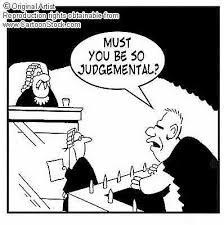
Jesus commands: “Judge not.” But judgement-free perception simply isn’t possible. What we can do is listen to our thoughts and examine the feelings that ignite them.

Avoiding Misery and Masochism

Don’t squander your precious time on Earth trying to figure out who deserves to be happy. There’s always going to be people you can point to as undeserving of the gifts life has bestowed upon them. Should it really be your task in life to figure out who’s to bless and who’s to blame? By fixating on the unfairness of it all, you’re setting yourself up for a lifetime of misery and masochism.

I’m not suggesting that we should accept the world the way it is. On the contrary, fighting injustice and trying to make the world a better place is one of the best ways to find meaning in this crazy old world.

by Richard W. Bray

crooked crooked world

November 22, 2017

You shall love your crooked neighbour
      With your crooked heart

W.H Auden, As I Walked Out One Evening

Anger and resentment
Will fill your heart with sand
Allow yourself to care about
Somebody you can’t stand

There’s a part of you that tries to love
Everyone you see
Pretending that it doesn’t
Makes you angry sad and mean

It’s a crooked crooked world
Filled with crooked souls
Love can make it meaningful
But nothing makes us whole

By Richard W. Bray

Seven Ways of Looking at a Line of Poetry

November 6, 2016

zzwaking

Anthropologists tell us* that “some time between 75 thousand and 60 thousand years ago” homo sapiens underwent a remarkable change (194). This event occurred “somewhere on the African continent (most likely somewhere in its eastern or southwestern regions)” (193). Suddenly, our already impressive brains developed the capacity for symbolic thought. Our ancestors, who heretofore merely consisted of roving bands of precocious carnivorous weapon-wielding bipeds, were transformed into artists, shamans, scientists, and engineers. World-domination was now only a matter of time.

These new-and-improved brains rendered representational art, handicraft, metaphor, music, dance, language and poetry essential to our existence.

As Kurt Vonnegut notes, this spectacular transformation gave us not only the capacity and the inclination to produce Beethoven’s Ninth Symphony; it also gave us the capacity and the inclination to

burn people alive in the public square for holding opinions which were locally unpopular, or build factories whose only purpose was to kill people in industrial quantities.

I’m seriously into words. I have argued that it’s ultimately impossible to separate language from poetry because our ancestors began playing with words as soon as they began to invent them. Uttered phonemes are automatically poetic just like every basket and every arrowhead homo sapiens produce is a work of art.

Death and disruption at an early age hurt Theodore Roethke into poetry, as W. H. Auden suggests “mad Ireland” hurt W.B. Yeats into poetry. And oh what prodigious poetry Roethke did make! I’m going to spend a little bit of time talking about how to say the third line of a villanelle Roethke wrote called “The Waking” because my brain spends a lot of time thinking about such things.

A villanelle is a nineteen-line Italian form in which the first and third lines are each repeated three times. (I’ve written a few of them myself.) (A smartass once wrote on this blog that “the cool thing about villanelles is that once you’ve written the first three lines, you’re 42% finished.”)

Here’s the first stanza of Roethke’s “The Waking.”

I wake to sleep, and take my waking slow.
I feel my fate in what I cannot fear.
I learn by going where I have to go.

I told you the dude was prodigious, right? Anyhow, the first and third lines of a good villanelle must be firm and flexible as much heavy lifting is expected of them. Here are some examples:

Time will say nothing but I told you so.

(First line of Auden’s “If I Could tell You”)

(I think I made you up inside my head.)
(Third Line of Sylvia Plath’s “Mad Girl’s Love Song”)

Rage, rage against the dying of the light.

(Third Line of Dylan Thomas’s “Do Not Go Gentle Into That Good Night”)

Now back to “The Waking.” If a reader must read the same lines four times in a nineteen-line poem, the poet should provide her with options about which words to stress. Here are seven ways to say line three of “The Waking”:

#1 I learn by going where I have to go

Learning is about destination rather than free will.

#2 I learn by going where I have to go

The essential lesson is in the destination

#3 I learn by going (pause) where I have to go

The journey, so to speak, is the destination.

#4 I learn by going where I have to go

The lesson is in the doing.

#5 I learn by going where I have to go

The important thing is that the experience is educational.

#6 I learn by going where I have to go.

It’s imperative to take a certain route that is nonetheless educational.

#7 I learn by going where I have to go.

I find out what I’m supposed to do only by doing it.

by Richard W. Bray

*Ian Tattersall, Masters of the Planet