Posts Tagged ‘Language’

On Redundancy, Oxymora, and Grammatical Correctness

November 19, 2011

640px-Adobo_shrimp_on_potato_galettes

It would be redundant to say that Dave was “completely devastated” when his hamster died because there cannot be degrees of devastation. I can be extremely scared by radio reports of zombies in my neighborhood, but it would be inexact to say that I am extremely terrified. Conversely, it would be oxymoronic* to declare that Dave was only “slightly devastated” by the news of his hamster’s untimely demise.

For the poet (by which I also of course mean the novelist) the phrases completely devastated and slightly devastated have all sorts of wonderful possibilities. However, writers seeking precision with their words (students enrolled in a Freshman Composition class, for example) should avoid such phrases.

* George Carlin has helpful lists of redundancies and oxymora in his book Braindroppings

Evaluation

State whether the highlighted portions of the following sentences are redundant, oxymoronic, or grammatically acceptable.

1. I was a tad heartbroken when my wife left me for my younger brother.

2. My aunt is a little bit pregnant.

3. Dresden was totally incinerated by the Allied bombing.

4. Pizza is extremely overrated.

5. My cat was completely dead after the accident.

6. Gertrude was a little bit exhausted after studying six straight hours for her English exam.

7. Osvaldo was completely miserable after he lost the tiddlywinks tournament.

8. The traffic around here is somewhat slow after jai alai matches.

9. Pham was extremely furious when I told her the results from Dancing with the Stars.

10. Ted overdosed slightly on pain medication.

by Richard W. Bray

Application #6

July 1, 2011

Matthew Arnold

Application # 6
(Something I wrote in graduate school)

The “interpoetic relationship” between Matthew Arnold’s Dover Beach and Anthony Hecht’s The Dover Bitch could hardly be less subtle. Hecht “clears poetic space” for himself by means of a “purposeful misreading” of Arnold in which Hecht inserts himself as a peripheral character in “Dover Beach”. This playful approach belies Harold Bloom’s contention that poets inevitably grapple with the “anxiety of influence” of prior works.

“Dover Bitch” is a lighthearted parody which mocks the sincerity and the seriousness of the original text. Hetch does this by transforming the object of desire in “Dover Beach” into a “girl” who is quite unworthy of her lofty stature. The woman spoken to in “Dover Beach” is the recipient of a protestation of a love which is meant to replace all the shattered Victorian certitudes which no longer exist:

Ah, love, let us be true
To one another! for the world ….
Hath really neither joy, nor love, nor light
Nor certitude, nor peace, nor help for pain

This is quite a tall order to fill: Make my life meaningful in a world without God. Hecht slyly deflates Arnold’s heroic affirmation of devotion by turning its recipient into a woman far more interested in having a good time than resolving Arnold’s spiritual devastation. Hecht does not merely remove her from her pedestal, but makes her scornful of Arnold’s attempt to recreate her “(A)s a sort of mournful cosmic last resort”.

Hecht’s attempt to supplant his predecessor offers a rich vein to be tapped by those who would extract psychoanalytical deposits from the rivalries which exist between authors. When Hecht proclaims “I knew this girl”, he means it in the biblical sense. It is hard to resist the Oedipal interpretation in which Hecht not only seduces the fictional object of Arnold’s desire, but has his way with his poem as well.

Hecht’s reduction of Arnold’s contemplation on the meaning of life into a tawdry one night stand is possible because Arnold permits him the space to do so. Arnold’s failure to consider how the poem plays to its internal audience makes it possible for the reader to accept her as seeing him as an insufferable blowhard.

by Richard W. Bray

Thin Ice

September 7, 2010

My teacher got annoyed and said,
“You’re skating on thin ice”
I said, “Let’s make some snow cones”
And I got detention twice

The skeleton in my closet
Cannot come out to play
It’s not that I have secrets
I’m scared he’ll run away

If the fork in the road
Had been a spoon
My piano would be
Out of tune

We can cross that bridge
If we actually get to it
Or we could swim the moat
I’m not afraid to do it

Did you pull my leg?
Or did you really lose my keys?
I can no longer walk
You dislocated both my knees

I threw my watch off the cliff
To see if time would fly
My daddy sent me after it
I’m not a happy guy

“Do you want to wet your whistle
With pop or tea?”
“Can I please have a drink?
I’m not a referee”

“If you don’t do your chores
You’ll be in hot water”
“I really can’t believe
That you’d boil your only daughter”

by Richard W. Bray

nuh-NUH, nuh-NUH, nuh-NUH, nuh-NUH

May 27, 2010

Archibald MacLeish

nuh-NUH, nuh-NUH, nuh-NUH, nuh-NUH

The poem’s meaning is evoked by the structure of words-as-sounds rather than by the structure of words-as-meanings. And the enhanced meaning, which we feel in any true poems, is a product, therefore, of the structure of the sounds.

–Poetry and Experience
by Archibald MacLeish (23)

Scansion records units of rhythm, not units of sense

–All the Fun’s in How You Say a Thing by Timothy Steele (530)

Vocabulary

Meter: The basic rhythmic structure of written and uttered words (not simply poetry)

Iamb: A unit of language consisting of an unstressed syllable and a stressed syllable, in that order.

I once began a lesson on meter to a group of eighth-graders by exaggerating (both verbally and bodily) the inherent iambic rhythms of the following lines of poetry:

“I cannot go to school today,”
Said little Pegg-y Ann McKay
I have the measles and the mumps
A gash, a rash and purple bumps*

A girl in the class looked at me in utter recognition and blurted out,
“I get it:

nuh-NUH, nuh-NUH, nuh-NUH, nuh-NUH

I was happy that this student immediately picked up on the main point of my lesson, but I was really thrilled because her description of iambic poetry was, in my opinion, superior to the one that is commonly offered in textbooks, a depiction with a musical correlation which mimics a snare drum:

ti-tum ti-tum ti-tum ti-tum

Here are some examples of iambic meter:

Iambic Monometer–One Beat (nuh-NUH)

Upon His Departure Hence by Robert Herrick

Thus I
Passe by
And die:
As one,
Unknown,
And gone:
I’m made
A shade,
And laid
I’th’grave:
There have
My cave.
Where tell
I dwell,
Farewell.

Iambic Dimeter–Two Beats (nuh-NUH, nuh-NUH)

The Robin by Thomas Hardy

When up aloft
I fly and fly,
I see in pools
The shining sky

Iambic Trimeter–Three Beats (nuh-NUH, nuh-NUH, nuh-NUH)

Touring a Past by Dick Davis

There is no boat to cross
From that ill-favored shore
To where the clashing reeds
Complete the works of war
Together with the grass,
And nesting birds, and weeds.

Iambic Tetrameter–Four Beats (nuh-NUH, nuh-NUH, nuh-NUH,
nuh-NUH)

Now I lay me Down to Sleep

If I should die before I wake
I pray the Lord my soul to take

Iambic Pentameter–Five Beats (nuh-NUH, nuh-NUH, nuh-NUH,
nuh-NUH, nuh-NUH)

Mad Girl’s Love Song by Sylvia Plath

“I shut my eyes and all the world drops dead;
I lift my lids and all is born a-gain
(I think I made you up inside my head.)

One Final Thought


…”scanning” a line is not a dramatic, or poetic reading of a line. Scanning a line is reading it in a special, more or less forced, way, to bring out the meter and any definite derivations or substitutions. Scanning will not bring out the other parts of the tension; it will tend to iron them out. On the other hand, a good dramatic, or poetic, reading will tend to bring out the tensions–but note well that in order to do this it must be careful not to override and completely kill the meter. When that is done, the tensions vanish. (Another reason why the meter must be observed is, of course, that if a line is truly metrical, a reading which actually destroys the meter can only be an incorrect reading–by dictionary and rhetorical standards.) A good dramatic reading is a much more delicate, difficult, and rewarding than a mere scanning. Yet the scanning has its justification, its use. We would argue that a good dramatic reading is possible only by a person who can also perform a scansion.


The Concept of Meter by W.K. Wimsatt and Monroe C. Beardsley
from The Structure of Verse, Edited by Harvey Gross (163-164)

Suggested Further Reading:

The Ode Less Travelled: Unlocking the Poet Within by Stephen Fry

The Sounds of Poetry: A Brief Guide by Robert Pinsky

Versification: A Short Introduction by James McAuley

by Richard W. Bray

* Sick by Shel Silverstein

The Island of Misused and Abused Words

March 16, 2010

Alan Sokal

Misused Words–Dastardly, Dilemma, Prodigal, Abominable

Dastardly (it means cowardly, not detestable)

I think we all know who the culprit is on this one: Daffy Duck has been alternating this term of disparagement with the word despicable for phonetic effect for years, confusing generations of American youngsters.

Dilemma (it means a situation requiring a decision between two equally undesirable alternatives, not merely a situation requiring a painful resolution)

As with so many other ills that afflict our society, I blame Dr. Laura for this one. The McTherapy Maven and her callers abuse this word on a daily basis.

Prodigal (it means profligate, not reckless or rebellious)

We tend to think of the biblical Prodigal Son in terms of his wayward foolishness rather than his extravagance, which is probably why the word is often incorrectly used to describe a rogue rather than a spendthrift.

Abominable (it means loathsome or disagreeable, not monstrous)

We can trace this common linguistic blunder to an unlikely perpetrator, the avuncular actor and folksinger Burl Ives. That’s right, his masterful annual narration of Rudolph the Red-Nosed Reindeer conditioned millions of Americans to forever link the words abominable and snowman.

Abused Words–Heuristic, Ontological, Semiotic

Thanks to the heroic efforts of Alan Sokal, Katha Pollitt, Stephen Katz and other brave souls, the Emperor’s Clothes are now visible and the literary abomination know as postmodernism (or post-structuralism) is finally being driven from the halls of academia. But I’m afraid that the many casualties of this wretched interregnum include three undeserving victims: Heuristic (serving to point out, stimulating further investigation), Ontological (relating to the branch of metaphysics that studies the nature of existence or being as such) and semiotic (pertaining to signs/symbols).

Sadly, these three fine words have been reduced to mere markers indicating oncoming highfalutin literary gibberish like this absurd sentence by Roy Bhaskar that Stephen Katz discovered:


Indeed dialectical critical realism may be seen under the aspect of Foucauldian strategic reversal—of the unholy trinity of Parmenidean/Platonic/Aristotelean provenance; of the Cartesian-Lockean-Humean-Kantian paradigm, of foundationalisms (in practice, fideisticfoundationalisms) and irrationalisms (in practice, capricious exercises of will-to-power or some other ideologically and/or psychosomatically buried source) new and old alike; of the primordial failing of western philosophy, ontological monovalence, and its close ally, the epistemic fallacywithin its ontic dual; of the analytic….

Katz humorously points out that, “The sentence contains 55 more words, but is harder to follow after this point.”

by Richard W. Bray

Poetic License: Seger, Gershwin, Dylan and Dickinson

September 28, 2009
Emily Dickinson

Emily Dickinson

Poetic License (Seger, Gershwin, Dylan and Dickinson)

So you’re a little bit older and a lot less bolder
Than you used to be

Bob Seger, Rock and Roll Never Forgets

Of course, it should read a lot less BOLD. But by assaulting our sense of grammar, the two-syllable rhyme sticks in our heads.

Oh Jonah, he lived in de whale,
Fo he made his home in
Dat fish’s abDOUGHmen–
Oh Jonah, he lived in de whale.

Ira Gershwin, It Ain’t Necessarily So

By converting the word abdomen from a dactyl (three-syllable word, first syllable accented) to an amphibrach (three-syllable word, second syllable accented) and giving the second syllable a long “o” sound, Gershwin creates a clever, memorable and amusing two-syllable rhyme with the words home and in.

It ain’t no use in turning on your light babe
That light I never knowed
And it ain’t no use in turning on your light babe
I’m on the dark side of the road

Bob Dylan, Don’t Think Twice, It’s Alright

I’m pretty sure Bob Dylan knows that knowed isn’t a word you will find in a dictionary. But the choice is a beautiful abomination.

If I should die,
And you should live,
And time should gurgle on,
And morn should beam,
And noon should burn,
As it has usual done;

Emily Dickinson, If I should Die

I could talk all day about the choice of the word gurgle in line three, but usual in line six is equally compelling. Adjectives aren’t supposed to modify verbs, that’s an adverb’s job. (Of course, this is putting it rather crudely. A word is not a part of speech, a word acts as a part of speech, and usual usually acts as an adjective.) Curiously, the poem would not have suffered metrically if she had used the word usually because both usual and usually can be pronounced as trochees (two-syllable words with an accented first syllable.) Usually can be enunciated as a two-, three- or four-syllable word. However, using the word usual suggests that beaming is the sun’s quotidian task whereas usually would have implied that beaming was the sun’s normal condition. Great art is the result of such apparently minor distinctions.

by Richard W. Bray

Cool is a cool word

September 3, 2009

cool word

Cool is a cool word. It is extremely elastic (twenty-eight definitions in dictionary.com), but I’m more impressed with its staying power.

The Urban Dictionary has 128 definitions for the word cool, including:

#5. An adjective referring to something that is very good, stylish, or otherwise positive. It is among the most common slang terms used in today’s world.

#16. Perhaps the ultimate slang word.

#32. [A] word that can be used by everyone, young and old and not sound weird, too modern or used [exclusively] by any certain race.

The amazing thing about the word cool is its linguistic longevity. Synonyms for cool (definition #5, very good, stylish, or otherwise positive) have come upon the scene with great speed and regularity over the last fifty plus years. This is probably because coolness has a strong element of exclusivity. As soon as the old and uninitiated latch onto the latest word for cool, it’s not cool anymore, and a new word will quickly emerge to take its place. Here is a partial list of words for cool which have come and gone over the last several decades (in no particular order):

Groovy, neat, hip, def, phat, heavy, bitchin, awesome, swell, sick, wicked, fresh, radical, gnarly, hunky dory, stupid, keen, radical, dope, sweet, fly, key, live, chill, tight, excellent, boss, dandy, hunky dory…

All of these words, usually sooner rather than later, have fallen by the wayside. But not so for cool, which inexplicably lives on and on.

by Richard W. Bray

A Few of my Favorite Similes

August 27, 2009

The walls here are as thin as a hoofer’s wallet.

Raymond Chandler, Playback

What is an individual thing? They roll
Like a drunken fingerprint across the sky!

Richard Wilbur, describing [a] landscape of small black birds in the poem An Event

After two months were gone and my classes were done, and although I still had not forgiven my mother, I decided to go home. I wasn’t crazy about the thought of seeing her, but our relationship was like a file we both sharpened on, and necessary in that way.

Louise Erdrich, Love Medicine

(Note: Now, for those of you thinking, “What’s a liberal humanist like you doing offering up a quote from a racist, misogynistic, anti-Semite like Raymond Chandler?” Well, that’s not an easy question to answer. It really won’t do to simply say that such prejudices were common in Chandler’s day. The glib answer would be that a great simile is a great simile, no matter who wrote it. (Even glibber answer, Hey, nobody’s perfect.) But the best I can offer are these words from one of my egg-headed heroes, the estimable Alfred Kazin discussing his ambivalent feelings for T.S. Elliot:

So it goes in a world where forever, it seems, Jews are regularly abominated and even demonized in works they cannot help admiring and whose authors they are proud to call friends. After a lecture I gave to a college audience, a non-Jewish professor gently reproached me for quoting with evident pleasure lines from Four Quartets. “How can you admire such an enemy of the Jews?” I replied that if I had to exclude anti-Semites, I would have little enough to read.)

by Richard W. Bray

Poets at the Microphone

August 22, 2009

Vin_Scully


A good athlete must have that harmony of movements or rhythm, which is called “form”….From pitch, to swing, to ball, a whole series of rhythms are set off, one rhythm, or one motion, starting another.  So it is in life—from sun, to moon, to earth, to night, to day, to you getting up in the morning and going out to play a game of ball.  All the rhythms of life are in some way related, one to another.  You, your baseball, and the universe are brothers through rhythms.

Langston Hughes, The First Book of Rhythm

It is impossible to sever language from poetry.  All written and spoken language is rhythmic and metrical.  Even the phonebook read aloud would contain the unmistakable cadences of the English tongue.   All barkers, salesmen, teachers, DJs and sportscasters, and anyone else who makes her living with her voice, are constantly interpreting poetry, whether they realize it or not.

Two of the people who have breathed life into our language for me are sportscasters Chick Hearn and Vin Scully.  Although they are quite different in style and temperament, their respective talents almost perfectly match the games upon which they report(ed).

Linguists refer to English as an accentual-syllabic language because the rhythms of our language are based upon the natural stresses which occur with accented syllables.  A particular form of genius which interpreters of language like Hearn and Scully possess is the ability to unconsciously make thousands of decisions about which syllables to stress and how to stress them during the course of a single sporting event.

The late Chick Hearn, who announced Los Angeles Lakers’ basketball games for thirty-seven years, was a brash, boisterous, irrepressible motor-mouth with an inventive mind for language and metaphor.  He originated many phrases which are now embedded in the nomenclature of the game:  SLAM DUNK, CHARity STRIPE (free throw line), YO-YOing UP and DOWN (dribbling) and TICKy TACK FOUL (an infraction that wasn’t).  When a player on offense had made a move which caused his defender to lurch in the wrong direction, Hearn would say the player had faked his opponent “INto the POPCORN maCHINE.”  Hearn’s machinegun delivery was apposite not only for the action-packed, rapid-fire sport he covered, but for modern age in which we live.

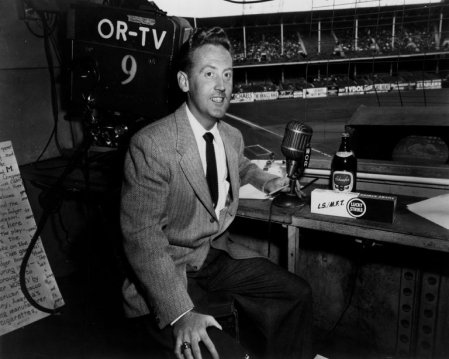
By way of contrast, Vin Scully, who has been covering Los Angeles Dodger baseball games since the team was in Brooklyn (now going on sixty years), seems in many ways better-suited for an earlier, simpler, more agrarian age.  This is not to say that Scully talks like a hick.  Far from it, he is an erudite man who seasons his commentary with literary allusions and historical references.  Scully’s calm, leisurely parlance is perfect for the one major American team sport which is not governed by a clock.  (As George Carlin remarked in his legendary baseball/football routine, while football is “rigidly timed,” in baseball, “you don’t know when it’s going to end.”)   Like the game of baseball itself, Scully’s languid delivery reminds us of an age (whether it actually existed or not) when time was less of a commodity.

The pastoral rhythms of a bygone time live on in baseball, which was invented sometime in the early to mid-nineteenth century.  The innumerable pauses in action allow a good baseball announcer to weave several narratives into the story of the game he is broadcasting.  Like a nineteenth century cracker barrel bard, Scully is above all a storyteller [This is a hypothetical example]:

“Two and one, the young pitcher Davis comes from PENSaCOLa FLORida.  His grandfather was a FULL BLOODed  CHOCKtaw INdian who once EARNED a LIVing HUNTting BEARS.    SWINGANDaMISS.  Two and two.”

When a player hits a ball deep into the outfield and Scully refers to it as a HIIIIIGH FLYYY BAAALL, he is creating poetry.  (If you close your eyes, you can almost feel the arc of the ball in his words.)   Like Hearn, Scully instinctively knows which syllables to stress and how long to stretch out the vowel sound.

Vin Scully feels like a friend to millions of people who have never met him.  His pleasant, mellifluous voice was a tremendous comfort to my grandmother who never missed a game on the radio, particularly during her final, bedridden years.  (And there were certainly times during my drinking days when Vin Scully and a twelve-pack seemed like my two best friends in the world, though not necessarily in that order.)

Poetry is everywhere that people talk.  Once, when I was teaching seventh graders, as I walked up to my classroom door and stuck a key in the lock, the group of three or four students standing there immediately ceased the conversation they were having:

I joked, “You guys don’t have to stop talking because of me.  I’m down.” (Down in this context meaning, cool, alright, one of the gang.)

One of the students, a girl named Janelle, replied, “MISter BRAY you are SOOO NOOOT DOOOWN.”  (“DAVEy LOPES hit a HIIIIGH FLYYYY BAAAALL”)

by Richard W. Bray