Archive for the ‘Morsel’ Category

The Existential Implications of “Unready to Wear”

December 4, 2013

Kurt Vonnegut

Now it is part of the Cartesian mode to think of consciousness as something peculiar to the head.  This is the organ originating consciousness.  It isn’t.  It’s an organ that inflects consciousness to a certain direction, a certain set of purposes, but there’s a whole consciousness here, in the body

Joseph Campbell from The Power of Myth (A PBS Documentary)

Sentience and consciousness are inseparable; thinking is a function of feeling.  The brain is not separate from the body; rather, the brain is part of the central nervous system, which runs throughout the body. In 1952 Kurt Vonnegut wrote a Science Fiction short story called “Unready to Wear” which pokes fun at the Cartesian notion of mind/body separation.

The unnamed narrator of “Unready to Wear” describes how people have become “amphibious” by liberating themselves from “parasite bodies” which “were a lot more trouble than they were worth.” The author notes that when an amphibian vacates the body, anger, greed, jealousy and vanity evaporate.

Although they are content to exist merely as souls, the amphibians maintain warehouses full of bodies which they reenter from time to time for reasons of nostalgia.  For example, the narrator’s wife Madge likes to occasionally visit her former house, so she

borrows a body once a month and dusts the place, though the only thing a house is good for now is keeping termites and mice from getting pneumonia.

As soon as an amphibious person enters body, however, “chemistry takes over” and the person become slave to his “glands”, rendering him

excitable or ready to fight or hungry or mad or affectionate, or—well, you never know what’s going to happen next.

Thus, reunited with a body, the amphibians are immediately overwhelmed by the body’s various appetites.  The narrator notes that he has never

met an amphibian yet who wasn’t easy to get along with, and cheerful and interesting –as long as he was outside a body. And I haven’t met one yet who didn’t turn a little sour when he got into one.

Our protagonist laments that

Nobody but a saint could be really sympathetic or intelligent for more than a few minutes at a time in a body–or happy, either, except in short spurts.

Unfortunately for humanity, our “bodies bring out the worst in us no matter how good our psyches are.” Of course, “Unready to Wear” is a silly story, but satire has its uses. Our narrator complains that “the mind is the only thing about human beings that’s worth anything.  Why does it have to be tied to a bag of skin, blood, hair, bones, and tubes?”  This question practically answer itself.  For human beings, the possibility of consciousness minus a physical body is an absurdity.  As the poet Theodore Roethke astutely explains, We think by feeling. And we have no alternative existential choice. We could never be happy or sad or angry or proud or anything else without the physical sensations that ignite thinking.* Whether we like it or not, human beings are animals.  However, we can take slight solace in the following observation from David Hume:

there is some benevolence, however small, infused into our bosom; some spark of friendship for human kind; some particle of dove kneaded into our frame, along with elements of the wolf and the serpent.

*I’m borrowing that term from Marc D. Hauser

by Richard W. Bray

Kids Outside Playing

November 15, 2013

kids playing

Warning: nostalgia alert. When I was a kid we had three networks and about seven local television stations to watch on TV, and that was it. That’s right, there was no satellite television and cable TV was only available for the rich folks in Malibu Canyon. The local stations played the same insipid reruns over and over on a perpetual loop. (When I read Dante’s Inferno, I was surprised to find no mention of The Flintstones, I love Lucy, and Gilligan’s Island.)  It was a big deal when the networks played a classic movie like The Sound of Music, Fiddler on the Roof, or The Wizard of Oz.  And it only happened about once a year, so if your car broke down or you had to work late, that was just too darn bad. No VCRs. (Please forgive me if I’m frightening any of my younger readers.)

One Saturday morning when I was about nine years old, my sister Laura and I watched a strange and captivating movie, and then we did something kids used to do with great frequency—we went outside to play. Almost immediately our neighbors Stan and Scott Quackenbos emerged from their house. They had also just finished watching the strange movie.  Then Jason and John Powers joined us. (John was old; he was in high school.) Yes, we had all seen the same movie on tv, and we were talking about it face to face without the aid of electronic gadgets. A short while later, Dwayne Norwood, another high schooler, entered our cul-de-sac. He had trekked all the way down from Lynoak Drive to visit John.

“Man, I just saw the weirdest movie,” he said, and we all laughed.

The movie was Roger Corman’s Little Shop of Horrors. And since we couldn’t google it, we just talked about it, outside on a beautiful sunny Southern California day.

(Yes, younger readers, believe it or not:  Before ratings-driven local news stations convinced parents that there was a pervert hiding behind every tree waiting to abduct us, suburban children were actually allowed to go outside and play all by themselves so long as we made it home before the streetlights came on.)

by Richard W. Bray

The Morality of the whole Capitol punishment thing (A hastily composed paper using the first three sources I found on the google the night before its do that i wrote super quickly but it still turned out pretty awesome)

November 8, 2013

badwriting

Since the beginning of time society as a whole has tangled with the notion of weather or not capitol punishment is acceptable. Some people say it’s right; other’s say its wrong. (Why is life so confusing?) Anyhow, my answer to this timely dilemma would have to be that capitol punishment is usually wrong unless the person did something totally heinous, like brutally murdering babies in front of his parents. On the other hand, Jesus said we should learn to forgive, but on another hand, Jesus’s dad wasn’t quite so forgiving. (He was seriously into “smoting” the bad guys in the olden days.)

Andrew Taylor, Phd candidate (he’s got my vote) in ethics at Boston College agrees. Andrew (who, if you don’t mind my saying so is sort of cute in a nerdy sort of a way) thinks that people who are against capital punishment are a bunch of mamby-pamby sissies. And the Catholic Bible also agrees, too. Furthermore, its way ethical to kill cold-blooded baby killers because “The fact that it is possible not to execute killers doesn’t establish that that it is morally obligatory to do so.” According Andy’s quote, theirs no question that the death penalty is moral. How could anybody even possibly disagree with that?

Even so, the death penalty is kinda harsh, if u get my point. And sometimes the dudes aren’t even guilty. As a guy wrongly convicted of murder, America as a nation needs to be more careful than that. “Retesting of evidence from the case indicated that, contrary to earlier tests, a chemical found in semen was not present on the victim, suggesting that she was not sexually assaulted before the murder.” How does stuff like that even happen? As people, we need to be a lot more careful. I completely see why it sucks to be wrongfully abused of horrifical crimes that you didn’t even commit.

Lastly, check out this quote from the Guys at the American Civil Liberties Union. “The capital punishment system is discriminatory and arbitrary and inherently violates the Constitutional ban against cruel and unusual punishment.” Whoa. I know that my dad says that their just a bunch of terrorist-loving communists, but hey, nobody’s perfect. Besides, the death penalty does sometimes seam like it’s a little bit of an overreaction. I mean, live and let live and all. Why can’t we all just get along, right?

In conclusion, as I mentioned before, both sides have some pretty ritecheous arguments on the morality of the whole capital punishment thing. And statistically speaking, the numbers don’t lie. If I had to come down on one side of the arguments, I would pick one because capitol punishment is like killing someone for killing somebody else, and that’s pretty serious business. Why can’t all of the humanity in the history of the universe just deal with these issues on a more humanistic level?

Sources Sighted in this paper

http://ethikapolitika.org/2013/05/16/capital-punishment-and-public-safety/
http://www.deathpenaltyinfo.org/
https://www.aclu.org/capital-punishment

by Richard W. Bray

Some Thoughts on Rosemary Agonito’s History of Ideas on Women

October 5, 2013

VVVVagonito


All classes must be deemed to have their special attributes; as the poet says of women, “Silence is a woman’s glory,” but it is not equally the glory of man.

Aristotle (54)

It is only the man whose intellect is clouded by his sexual impulses that could give the name of the fair sex to that under-sized, narrow shouldered, broad-hipped, and short-legged race.

Arthur Schopenhauer (199)

Emily Dickinson’s parents would have preferred her to read less. In a letter to Thomas Wentworth Higginson, our greatest poet notes:

My Mother does not care for thought—and Father, too busy with his Briefs—to notice what we do—He buys me many Books—but begs me not to read them—because he fears they joggle the Mind.

Although this sounds barbarous today, Mr. and Mrs. Dickinson were in alignment with over two thousand years of Western thought regarding the wisdom and feasibility of educating women.

As Rosemary Agonito demonstrates in her invaluable sourcebook History of Ideas on Women, the dominant perspective in Western philosophy from Aristotle to Freud is that women are childlike, feebleminded creatures, unsuited to function in the man’s world of action and ideas.

Nineteenth century German philosopher Georg Wilhelm Friedrich Hegel argued that women are inherently unfit for anything beyond the domestic sphere:

Women can, of course, be educated, but their minds are not adapted to the higher sciences….Women may have happy inspirations, taste, elegance, but they have not the ideal. The difference between man and woman is the same as that between animal and plant….If women were to control the government, the state would be in danger, for they do not act according to the dictates of universality, but are influenced by accidental inclinations and opinions (167).

Another German philosopher, Arthur Schopenhauer (1788-1860), tells us that women are basically children. By infantilizing women and feminizing childhood, male philosophers invent false polarities that preserve the status of men:

Women are directly fitted for acting as the nurses and teachers of our early childhood by the fact that they are themselves childish, frivolous and short-sighted; in a word, they are big children all their life long—a kind of intermediate stage between the child and the full-grown man. (194)

Unlike so many of the men who have shaped Western thought, Immanuel Kant (Prussia, 1724-1804) genuinely liked women. (There is much misogyny in the suppression of women, but misogyny is not a crucial ingredient.) Kant loves women just the way they are so much that he worries about what will happen if women endeavor to worry their pretty little heads over the affairs of men. (Some might argue that this is itself a form of misogyny.)

Laborious learning or painful pondering, even if the woman should greatly succeed in it, destroy the merits that are proper to her sex, and because of their rarity they can make of her an object of cold admiration; but at the same time they will weaken the charms with which she exercises her great power over the other sex (131).

The three ugliest villains in History of Ideas on Women are Paul the Apostle, Augustine of Hippo, and Thomas Aquinas.

Here’s Agonito on Paul:

There is evidence, consistent with Jesus’ example, that women played an important part in the earliest days of the new church, even engaging in such evangelical work as teaching the faith and converting large numbers to Christianity. Whatever the reason, Paul explicitly objected this new turn, and his reactionary efforts in the matter of women succeeded in setting the tone for thinking about women that would be continually reinforced in the intellectual and practical tradition in the West for the next two thousand years (68).

Paul thought women were pretty icky, and it was best to stay away from them:

Now concerning the things whereof ye wrote unto me: It is good for a man not to touch a woman.
Nevertheless, to avoid fornication, let every man have his own wife, and let every woman have her own husband.

(1 Corinthians 7:1-2)

Like many contemporary Muslims, Paul felt that women should cover their heads in public in order to emphasize the greater glory of men:

For a man indeed ought not to cover his head, forasmuch as he is the image and glory of God: but the woman is the glory of the man
.
(1 Corinthians 11:7)

According to Augustine, man derives his superior status over women directly from God. (See Genesis, Adam and Eve).

And indeed He did not even create the woman that was to be given to him as his wife, as he created the man, but created her out of the man, that the whole human race might derive from one man (75).

Like many influential Western male thinkers including Sigmund Freud, Aquinas sees women as an inherently defective, naturally subordinate creatures.

As regards to the individual nature, woman is defective and misbegotten, for the active force in the male seed tends to the production of a perfect likeness in the masculine sex; while the production of woman comes from defect in the active force or from some material disposition, or even from some external influence; such as the south wind, which is moist….woman is naturally subject to man, because in man the discretion of reason predominates (85).

John Stuart Mill, David Hume, Ashley Montagu, and Herbert Marcuse are the only male thinkers in History of Ideas on Women whose ideas on women are not appalling by today’s standards. History of Ideas on Women is mostly a dismal read. But it’s an indispensable book.

by Richard W. Bray

Stanzas in My Head: Hayden, Raleigh, and Browning

August 18, 2013

640px-WalterRaleigh2

Thy gowns, thy shoes, thy beds of roses,
Thy cap, thy kirtle, and thy posies
Soon break, soon wither, soon forgotten–
In folly ripe, in reason rotten.

(In other words, “I’ll choose my own life, Mister.” Marlowe’s shepherd painted a lovely portrait of a life for two, but he didn’t ask the nymph for her input until he was finished. That’s why I find the feminism of Raleigh’s nymph so appealing.)

No one has ever asked me to recite the fourth stanza of “The Nymph’s Reply to the Shepherd” by Sir Walter Raleigh. But my brain is constantly preparing itself for the task. Often I’m riding my bicycle when those twenty-seven marvelously collocated words decide to flow across my consciousness.

How long do I stretch out the three soons? (Listen to how Nancy Wickwire does it) How long do I pause after break and wither? How much sarcasm can I pack into the first syllable of reason? How long do I pause after reason and how hard do I hit the first syllable of rotten?

In one year they sent a million fighters forth
South and North,

And they built their gods a brazen pillar high
As the sky,

Yet reserved a thousand chariots in full force–
Gold, of course.

Oh HEART! oh blood that freezes, blood that BURNS!
Earth’s returns

For whole centuries of folly, noise and sin!
Shut them in,

With their triumphs and their glories and the rest!
Love is best.

Love or war, which is better? It seems like such an easy question. So why do we waste so much of ourselves making war when we could be making love? The final stanza of Robert Browning’s “Love Among the Ruins” reminds us how absurd our priorities can be.

I love the way Steven Pacey reads “Love Among the Ruins.” He emphasizes the word heart as a hinge upon which the entire poem turns. He also emphasizes burns at the end of the line. Browning’s exclamation points suggests this reading is correct.

Speaking indifferently to him,
who had driven out the cold
and polished my good shoes as well.
WHAT did I know, what did I KNOW
of love’s AUStere and LONEly offices?

So e.e.cummings isn’t the only poet whose father moved through dooms of love.

In marked contrast to Pacey’s reading of “Love Among the Ruins,” Robert Hayden’s rendition of “Those Winter Sundays” is subtle. In the penultimate line he emphasizes What a little bit and know even less. Hayden also breathes a little extra heart into the first syllables of austere and lonely in the last line.

by Richard W. Bray

Vanity: The Mother of all Noble and Vile Illusions

July 7, 2013
Joseph Conrad

Joseph Conrad

It’s usually more fun to think about other people’s problems, but we can never get away from ourselves. And our fixations on others can teach us a lot about ourselves. For example, if you often hear yourself saying, “Dave is such a jerk for always talking about how much money he has,” you are probably more than a little bit jealous. Or, if you are constantly telling yourself, “It’s a good thing I don’t drink as much as Larry. He really has a problem,” well, you might just be an alcoholic.

I have found that a great opportunity for reflection is the moment after the flood of hostility and righteous indignation has passed. But first I have to remind myself that it’s not my task in life to figure out what’s wrong with everybody else.

But in order for human beings to function as social organisms, some level of interest in others is necessary. A perfectly solipsistic person who spends all his psychic energy focused upon his inner world would be incapable of social interaction in addition to being a tedious bore. (Think Sheldon Cooper minus the modicum of concern he has for the rest of humanity.)

Our view of the world is filtered through the prism of our thoughts and feelings; the trick is to maintain some level of sanity by achieving a workable harmony between our inner and outer worlds. People who are unable to reconcile the pain and frustrations of this world with their need to assert some level of dignity often resort to drastic solutions. As Joseph Conrad notes of the hapless, ragtag lot of would-be world-fixers in The Secret Agent:

in their own way the most ardent of revolutionaries are perhaps doing no more but seeking for peace in common with the rest of mankind—the peace of soothed vanity, of satisfied appetites, or perhaps of appeased conscience.

Broken on the inside but lacking the requisite courage and self-understanding to confront their pain, Conrad’s misbegotten idealists endeavor vainly to incite a revolution that will obliterate their woes.

There are two types of revolutionaries in The Secret Agent: The fanatics (The Professor and Karl Yundt) and the ineffectual justice-seekers (Michaelis, Comrade Ossipan, and Stevie.) (Verloc, the paid informant of an unidentified foreign power, is, of course, no sort of revolutionary at all.) Conrad sums up theses two sects:

the majority of revolutionists are the enemies of discipline and fatigue mostly. There are natures too, to whose sense of justice the price exacted looms up monstrously enormous, odious, oppressive, worrying, humiliating, extortionate, intolerable. Those are the fanatics. The remaining portion of social rebels is accounted for by vanity, the mother of all noble and vile illusions, the companion of poets, reformers, charlatans, prophets, and incendiaries.

For the two fanatics in The Secret Agent, this monstrously enormous sense of justice is crammed inside their feeble little egos. The ghoulish Karl Yundt (The Terrorist) is obsessed with manly violence and self-glorifying violence. In his twisted, misanthropic mind, destruction is the highest form of benevolence:

I have always dreamed,” he mouthed, fiercely, “of a band of men absolute in their resolve to discard all scruples in the choice of means, strong enough to give themselves frankly the name of destroyers, and free from the taint of that resigned pessimism which rots the world. No pity for anything on earth, including themselves, and death enlisted for good and all in the service of humanity–that’s what I would have liked to see.”

In striking contrast to Yundt, the Professor doesn’t require any followers. This man actually is an island. He lives, works, and plots his destruction alone. As he brags to Ossipan: “I’ve the grit to work alone, quite alone, absolutely alone. I’ve worked alone for years.” The professor’s gargantuan vanity feeds his acute need for isolation. It’s not his fault that humanity refuses to bow in obeisance to his manifest greatness.

His struggles, his privations, his hard work to raise himself in the social scale, had filled him with such an exalted conviction of his merits that it was extremely difficult for the world to treat him with justice— the standard of that notion depending so much upon the patience of the individual. The Professor had genius, but lacked the great social virtue of resignation.

And no one, not even the Professor, deserves to live in a world where the Professor is not adequately appreciated: “What happens to us as individuals is not of the least consequence,” he tells Ossipon.

The Professor is ready to blow himself up at any moment as a means of “affirming his superiority over all the multitude of mankind.” Like the petulant child who constantly threatens to take his ball and go home, the Professor is perpetually prepared to obliterate himself in order to prevent anyone from ever getting the best of him.

In order to preserve this illusion of strength, the Professor has convinced himself that his utter fear of humanity is a mark of virtue: “There are very few people in the world whose character is as well established as mine.”

Too vain, too pure, and too weak to scrutinize his inability to engage in the quotidian give-and-take of human interaction, the Professor’s fear of intimacy manifests itself as a twisted death wish which is only heroic in his own mind.

They depend on life, which, in this connection, is a historical fact surrounded by all sorts of restraints and considerations, a complex organised fact to attack at every point; whereas I depend on death, which knows no restraint and cannot be attacked. My superiority is evident.

Conrad notes that an appetite for intrigue and action is a prerequisite for the constable as well as the revolutionary: “The terrorist and the policeman both come form the same basket.” In contrast to the would-be revolutionists in The Secret Agent, however, Chief Inspector Heat and the Assisstant Commissioner possess sufficient self-awareness to maintain their sanity. (This is no small achievement. As Joseph Wambaugh notes, police work involves “a daily drop of corrosion.”) The Assistant Commissioner finds police work messy and unpleasant, but an honest self-appraisal allows him to keep his psyche intact.

No man engaged in a work he does not like can preserve many saving illusions about himself. The distaste, the absence of glamour, extend from the occupation to the personality. It is only when our appointed activities seem by a lucky accident to obey the particular earnestness of our temperament that we can taste the comfort of complete self-deception

Idealists have brought us, among other things, the abolition of slavery, child labor laws, and universal suffrage. The world is a better place for their efforts. But Joseph Conrad reminds us that “the way of even the most justifiable revolutions is prepared by personal impulses disguised into creeds.”

Richard W. Bray

Choosing Isolation: Edna Pontillier and Lewis Lambert Strether

June 22, 2013

fear intimacy

At first consideration, Lewis Lambert Strether of Henry James’s The Ambassadors and Kate Chopin’s Edna Pontellier of The Awakening could hardly appear more dissimilar: Strether is a timid older bachelor of modest means whose every decision is tempered by social mores; Mrs. Pontellier is a bold, young married woman in a financially comfortable position who is invulnerable to societal constraints. But they both ultimately choose to turn their backs on life. Pontellier’s suicide is only slightly more drastic than Strether’s decision to flee a woman who loves him in order to return to a world where nothing awaits him. They are both running away from human contact.

Kris Kristofferson’s observation that, “Freedom’s just another word for nothing left to lose,” is an accurate description of the prospects facing Strether and Edna Pontellier at the conclusion of their respective novels. Edna Pontellier decides to end her life whereas Strether eschews the possibility of love in order to return to Boston where his social and professional prospects are nil. Their respective choices demonstrate that Edna Pontellier and Strether do not need anyone but themselves. Some reviewers have praised the existential courage which allows Edna to shun all human connections in her pursuit of freedom; Strether’s return to Boston has been cast by critics in a similar, heroic light. However, it is a fear of intimacy rather than a quest for freedom which epitomizes their decisions.

Edna Pontellier has no empathy. She is not concerned with how her actions will affect others. She is consumed with her appetites to the extent that she views personal and filial relations merely as barrier to her sexual liberation. She will infuriate her father and sister, disgrace her husband, break Robert’s heart, and abandon her children in pursuit of sexual gratification without a hint of regret. Edna Pontellier does not comprehend the forces which will eventually lead her to forsake earthly existence, but her inexplicable depression makes her life unbearable:

An indescribable oppression, which seemed to generate in some unfamiliar part of her consciousness, filled her whole being with anguish (574).

Edna Pontellier yearns for a type of fulfillment which was largely unachievable for a married woman of her day, and the fact that many of her contemporaries might have found her situation enviable is of no comfort to her.

Edna Pontellier’s inability to find contentment living comfortably with her beautiful children and perfect husband (“all declared that Léonce Pontellier was the best husband in the world. Mrs. Pontellier was forced to admit that she knew none better”) is the result of a spiritual malaise which leads her to seek her salvation via sexual expression (574). (In this respect, Edna Pontellier is a forerunner of Erica Jong’s Isadora Wing who unabashedly promotes female liberation by means of the so-called “zipless fuck.”) Edna Pontellier does not comprehend the nature of her longings, but she never doubts that their fulfillment is the preeminent purpose of her existence. Despite the mysterious origin of her malady, Edna Pontellier is convinced that the pursuit of sexual freedom is her highest calling, of much greater importance than any relationship with another human being:

She had all her life been accustomed to harbor thoughts and emotions which never voiced themselves. They had never taken the form of struggles. They belonged to her and were her own, and she entertained the conviction that she had a right to them and they concerned no one but herself. Edna had once told Madame Ratignolle that she would never sacrifice herself for her children, or for any one (605-606).

When Strether Lambert decides to return to Boston, he is motivated by a fear of intimacy no less profound than the inability to make meaningful human contact which afflicts Edna Pontellier. The difference between the two characters is that while Edna Pontellier evades meaningful contact by immersing herself in loveless sexual liaisons, Stretcher avoids both emotional and physical intimacy. Despite his extreme immediate attraction to Maria Gostrey, Strether never seriously considers pursuing a relationship with her, even after Mrs. Newsome breaks off their potential engagement.

Strether is able to acknowledge to Miss Gostrey that he is utterly smitten by her upon their first meeting, but he is constitutionally incapable of achieving a physical relationship with her. He is, however, able to admit how this attraction both frightens and astounds him. When Maria asks Strether if he trusts her, he responds:

I think I do!–but that’s exactly what I’m afraid of. I shouldn’t mind if I didn’t. It’s falling thus, in twenty minutes, so utterly into your hands. I daresay, Strether continued, it’s a sort of thing you’re thoroughly familiar with; but nothing more extraordinary has ever happened to me (14).

And later in the novel we see the intensity of his attraction to her:

He was extraordinarily glad to see her….She was the blessing that had now become his need, and what could prove it better than without her he had lost himself? (74-75)

In his fifty-five years on Earth, Strether has never known an attraction to another human being comparable to what he feels for Miss Gostrey. Yet he is unable to act upon it. His inexplicable declaration that he is returning to Boston “To be right” is perplexing even when we take his overdeveloped sense of propriety into account (375). What could possibly be right about a man leaving a city and a woman he loves in order to return to a world where no one and nothing awaits him?

Edna Pontellier and Strether Lambert both lack whatever it is which allows human beings to attempt to reach across the divide which separates us. And although their depravity manifests itself in contrasting manners—she submerges herself in loveless affairs while he shuns intimacy entirely—they are more alike than different. Ultimately, they both choose isolation over love.

Richard W. Bray

Every Picture Tells a Story About Someone Who is Happier Than You Are

March 30, 2013

no like

Photographs alter and enlarge our notions of what is worth looking at and what we have a right to observe.

—Susan Sontag
On Photography (3)

Life is not a movie. A life is made up of a million mundane moments; a movie is a carefully constructed sequence of images leading to a climax. Thus watching movies conditions us to believe that an entire life can pivot on one fateful defining moment. Movies tell us that all of our lives could be radically altered if only… For example, the explicit message of the movie Back to the Future is that a struggling, insecure, and miserable man named George McFly and his family could be living rich and happy lives if only George had socked Biff Tannen in the head one time.

My objective here is not to point out that this particular movie, like so many other movies, is predicated on the redemptive power of violence. (Although that’s certainly an essay worth writing.) But it is important to remember that movies are not designed to remind us that existence is a constant struggle, and growth and achievement are painstaking processes, achieved little by little, if achieved at all.

Of course, movies are not meant to prepare us for life (that’s what parents, teachers, coaches, and drill sergeants are for). And watching movies provides all sorts of wonderful benefits. But it is dangerous to allow cinematic sentiments to bleed into our conscious appraisal of the real world. Much life is wasted by people who expect the cavalry to come riding in to save the day at the last moment.

Although still photography lacks the narrative lure of motion pictures, “Photographs are more memorable than moving images, because they are a neat slice of time, not a flow” (17). But this is also an illusion. As Susan Sontag notes in her groundbreaking 1973 book On Photography, “Life is not about significant details, illuminated by a flash, fixed forever. Photographs are” (81).

And the fact that almost all of us are photographers ourselves further obscures the unreality of the photograph: “Photographic images do not seem to be statements about the world so much as pieces of it, miniatures of reality that anyone can make or acquire” (4).

This blurring of memory and memento allow photographs to seduce us in ways that motion pictures cannot; the photographs we treasure seem like authentic pieces of reality. Compared to actual memories, the penumbra of existence, photographs offer an eerie phantasm of lived experience. The contrast between nostalgia and actual physical images that are “fixed forever” is disconcerting: “Precisely by slicing out this moment and freezing it, all photographs testify to time’s relentless melt” (15).

Much has changed in the forty years since Susan Sontag first published On Photography. And although there is no way that she could have anticipated the current explosion of photographic images across the internet, the following observation is more apt than ever: “By furnishing this already crowded world with a duplicate one of images, photography makes us feel that the world is more available than it really is” (24).

Today users share “30 billion pieces of content each month” on Facebook, a phenomenon which “represents the largest database of social information the world has ever witnessed.” Much of this content is made up of photographic images.

According to a recent study, when “experienced over a long time period” the “effects of passive following” of Facebook “can lead to frustration and exhaustion, damaging individual life satisfaction.” For many people, every picture on Facebook tells a story about someone who is happier than they are. For these people, “To possess the world in the form of images is, precisely, to re-experience the unreality and remoteness of the real” (160).

Richard W. Bray

My Monkey Makes my Mother Mad

March 16, 2013

I had no idea what I was doing when I began the project that eventually culminated in this blog. Looking back on it, I’m reminded of the character played by Richard Dreyfuss in the movie Close Encounters of the Third Kind who was compelled to mindlessly build that miniature mountain inside his house. I just had to do something, but I really didn’t know what or why.

So I kept writing and reading about writing. And I took some English classes at Cal Poly Pomona. Then one of my professors, Dr. Carola Kaplan, suggested I apply for their MA program. (She advised that if I continued to take classes, sooner or later I would “accumulate” a Master’s Degree.) Many of the longer articles on this blog began as academic papers.

I continued to write until my computer was constipated. So I read the books on how to write the perfect cover letter and I sent out queries and more queries. And all that ever got me was shoe-boxes full of rejection letters.

After more than a decade of unrequited querying, I finally went on an Open Thread at Ta-Nehisi Coates’ blog and asked the nice people there how much it would cost to start my own blog. When they told me it was free I said, “Thank you so much. If I had known that, I would have gotten myself a blog years ago.”

Sometimes I begin writing a poem knowing exactly what I want to say and it turns out just like I planned. Sometimes. Other times I set out to write something, but I end up writing something else. And sometimes I think I have a long way to go when the poem suddenly informs me that I’m finished.

And sometimes I start with an idea that’s bugging me or just a single word. (I began this poem thinking about how much I like the word notion.) Other times an entire line will pop into my head. Once a line zipped across my brain, but I ignored it. A few days later it returned—louder. It wasn’t until I sat down at my computer and typed it up that I realized that the line was entirely alliterative: My monkey makes my mother mad. But I didn’t know what the poem was going to be about until I had finished writing the first stanza.

My Funny Farm

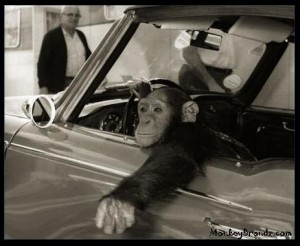
My monkey makes my mother mad
He also aggravates my dad
He took his car the other day
And drove it to the Hudson Bay

My kitty cat is kooky too
He likes to strut down to the zoo
And tell the tigers to all stand back
If they don’t want to get attacked

I have a hamster named Houdini
And though he is rather teeny
He’ll quickly pick a thousand locks
You could not hold him in Fort Knox

My kangaroo’s a real joker
Up all night playing poker
His friends come to destroy the house
I think I shoulda’ got a mouse

I got a hippo last July
He really is one swell guy
Everything he does is super
I got a giant pooper scooper

Living on this funny farm
I know my pets don’t mean no harm
But both my parents moved away
And no one wants to come and play

Richard W. Bray

Myrtle Myers Redux

March 8, 2013

Shel-silverstein

A long time ago in a galaxy far, far away, I took an English class from a poet named Robert Pinsky. (Actually, it was at Berkeley in the mid 1980s, but many Northern Californians would argue that Orange County is about as far away from Berkeley as I could get.) Since that time, Mr. Pinsky has received a great deal of well-deserved acclaim. Thus I frequently see him on my tv promoting poetry. A few years back I heard Pinsky say that whenever someone asks him about when he started writing poetry, he responds by asking: “When did you stop?”

I stopped writing poetry in sixth grade and took it up again about twenty years later.

Here’s what happened: I was teaching at a boys home in a special education program for SED (Severely Emotionally Disturbed) students, which was quite an education for me. These kids were intimate with poverty, violence, addiction, rape and murder in ways I will never comprehend. (Actually, I do know a thing or two about addiction.)

Sometimes they would tease me by asking me if I were “street.”
“Of course I am.” I would reply.
“Where you from? Inglewood, Nickerson Gardens, South Central?”
“That’s it,” I’d say. “I’m from South Central Claremont.”

I’ll never know how much good I did working with those kids, and the only life I saved was my own. But it did lead me back to writing poetry. The most coveted book in our meager little school library was Where the Sidewalk Ends, a collection of funny poems by Shel Silverstein. It is a work of immense skill.

In a state of profound ignorance regarding what such a task would entail, I decided that I wanted to write a book like Where the Sidewalk Ends. So I went to the library and got some books on verse, meter, and rhyme. Some time thereafter, although I still barely even understood what poetry was, I somehow sat down at my EMachine and wrote “Myrtle Myers.”

I’ve read a bunch of poetry and thousands of pages of criticism since then. I even went out and got myself a Master’s Degree in Literature. But I don’t think I’ve ever written anything better than “Myrtle Myers.”

“Myrtle Myers” is, of course, a very conservative poem. (How did that happen?) It was not written as an allegory, but it sure reads like one. When I wrote it, however, I was mostly thinking about the power of denial, a major theme on this blog.

Myrtle Myers

Myrtle Myers bought some pliers
At the hardware store
She took them home and all alone
She broke down the door

The next day she found a way
To make the toilet flood
She took a wrench from daddy’s bench
And made a great big thud

Unperturbed, her mother purred
“Well, girls they will be girls
All this rage is just a stage
She has such darling curls”

Then Myrtle took an evil look
At her mother’s dress
It made her think and with some ink
She made a lovely mess

Yet with rage unassauged
She shaved her sister’s head
With kerosene and gasoline
She burned her brother’s bed

Undistressed, her father guessed
“It’s just a child at play
They’re just jealous, those who tell us
To have her put away”

Her parents planned a party grand
Just to celebrate
Her twelfth birthday, and by the way
Myrtle showed up late

No girls nor boys bearing toys
Decided to attend
Although assured the girl was cured
They feared their lives might end

As her family huddled, scared and befuddled
By her piercing stare
Myrtle growled and then she howled
“I publicly declare

“This can’t be true! What did you do
To make them stay away?
You’ll all be blue and live to rue
This catastrophic day!”

Myrtle made a bomb that day
Intending to destroy
Her own home town and miles around
And every girl and boy

But in her hurry, she forgot to scurry
Away from her invention
She’s gone away, I’m sad to say
Results of ill intention

Her parents pleaded all she needed
Was love and understanding
And though it’s true that we all do
Life is more demanding

It takes affection to give direction
And most kids do not mind
Those restrictions and prohibitions
Which seem to some unkind

Richard W. Bray