Posts Tagged ‘Essay’

Negatory on the Neg

August 26, 2009

A few years ago, while waiting in a supermarket checkout line, I spotted an irresistible article on the cover of Cosmopolitan Magazine: 20 Great Ways to Spice up your Sex Life and Drive a Guy Wild. It was a pretty long line and I was able to scan the entire article, which spared me the expense and indignity of actually having to buy it. As a guy, I would say that the most striking thing about the article was that only three of the twenty hints had anything to do with sex per se. As I recall, one recommended a particular position (reverse cowgirl) and another described a fellating technique. The rest of the suggestions were all ridiculous things that would never make any guy horny. My favorite Tip for Spicing up your Sex Life was for a woman to go out and buy some really expensive sheets with a high thread count. Contrary to what we learn from watching the movies, a bed with nice sheets is the ideal place for sex, but you will never hear me, and you are very unlikely to hear any other straight guy, use the expression “thread count.” (And I’ve never heard a guy complain about the condition of his girlfriend’s sheets.)

But the final Hint for Spicing up your Sex Life left me completely baffled. It recommended that a woman should dress to kill, go out with her boyfriend, and “flirt with every guy you see.” Now I know from watching female-oriented talk shows, as well as from painful personal experience, that few things rile a woman as much as when she thinks her man is looking at (much less flirting with) other women.

I have no explanation for why Cosmo would offer women such advice. However, this would certainly confirm Bill Maher’s contention that he reads Cosmo in order to “find out how the enemy thinks.”

So the good people at Cosmopolitan magazine want to exacerbate the tensions between men and women for fun and profit.

What brings this article to mind is Conor Friedersdorf’s recent articles rejecting the Neg, the idea that insulting women is a great way to get them into bed. Friedersdorf valiantly takes issue with a charming young blogger who insists that gently insulting women is not only a good way to get them to have sex with you, but it’s really ok because “some women secretly like being insulted.”

by Richard W. Bray

Poets at the Microphone

August 22, 2009

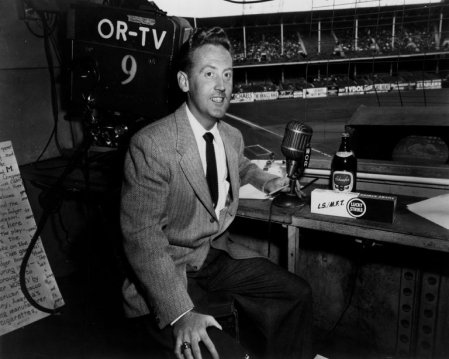
Vin_Scully


A good athlete must have that harmony of movements or rhythm, which is called “form”….From pitch, to swing, to ball, a whole series of rhythms are set off, one rhythm, or one motion, starting another.  So it is in life—from sun, to moon, to earth, to night, to day, to you getting up in the morning and going out to play a game of ball.  All the rhythms of life are in some way related, one to another.  You, your baseball, and the universe are brothers through rhythms.

Langston Hughes, The First Book of Rhythm

It is impossible to sever language from poetry.  All written and spoken language is rhythmic and metrical.  Even the phonebook read aloud would contain the unmistakable cadences of the English tongue.   All barkers, salesmen, teachers, DJs and sportscasters, and anyone else who makes her living with her voice, are constantly interpreting poetry, whether they realize it or not.

Two of the people who have breathed life into our language for me are sportscasters Chick Hearn and Vin Scully.  Although they are quite different in style and temperament, their respective talents almost perfectly match the games upon which they report(ed).

Linguists refer to English as an accentual-syllabic language because the rhythms of our language are based upon the natural stresses which occur with accented syllables.  A particular form of genius which interpreters of language like Hearn and Scully possess is the ability to unconsciously make thousands of decisions about which syllables to stress and how to stress them during the course of a single sporting event.

The late Chick Hearn, who announced Los Angeles Lakers’ basketball games for thirty-seven years, was a brash, boisterous, irrepressible motor-mouth with an inventive mind for language and metaphor.  He originated many phrases which are now embedded in the nomenclature of the game:  SLAM DUNK, CHARity STRIPE (free throw line), YO-YOing UP and DOWN (dribbling) and TICKy TACK FOUL (an infraction that wasn’t).  When a player on offense had made a move which caused his defender to lurch in the wrong direction, Hearn would say the player had faked his opponent “INto the POPCORN maCHINE.”  Hearn’s machinegun delivery was apposite not only for the action-packed, rapid-fire sport he covered, but for modern age in which we live.

By way of contrast, Vin Scully, who has been covering Los Angeles Dodger baseball games since the team was in Brooklyn (now going on sixty years), seems in many ways better-suited for an earlier, simpler, more agrarian age.  This is not to say that Scully talks like a hick.  Far from it, he is an erudite man who seasons his commentary with literary allusions and historical references.  Scully’s calm, leisurely parlance is perfect for the one major American team sport which is not governed by a clock.  (As George Carlin remarked in his legendary baseball/football routine, while football is “rigidly timed,” in baseball, “you don’t know when it’s going to end.”)   Like the game of baseball itself, Scully’s languid delivery reminds us of an age (whether it actually existed or not) when time was less of a commodity.

The pastoral rhythms of a bygone time live on in baseball, which was invented sometime in the early to mid-nineteenth century.  The innumerable pauses in action allow a good baseball announcer to weave several narratives into the story of the game he is broadcasting.  Like a nineteenth century cracker barrel bard, Scully is above all a storyteller [This is a hypothetical example]:

“Two and one, the young pitcher Davis comes from PENSaCOLa FLORida.  His grandfather was a FULL BLOODed  CHOCKtaw INdian who once EARNED a LIVing HUNTting BEARS.    SWINGANDaMISS.  Two and two.”

When a player hits a ball deep into the outfield and Scully refers to it as a HIIIIIGH FLYYY BAAALL, he is creating poetry.  (If you close your eyes, you can almost feel the arc of the ball in his words.)   Like Hearn, Scully instinctively knows which syllables to stress and how long to stretch out the vowel sound.

Vin Scully feels like a friend to millions of people who have never met him.  His pleasant, mellifluous voice was a tremendous comfort to my grandmother who never missed a game on the radio, particularly during her final, bedridden years.  (And there were certainly times during my drinking days when Vin Scully and a twelve-pack seemed like my two best friends in the world, though not necessarily in that order.)

Poetry is everywhere that people talk.  Once, when I was teaching seventh graders, as I walked up to my classroom door and stuck a key in the lock, the group of three or four students standing there immediately ceased the conversation they were having:

I joked, “You guys don’t have to stop talking because of me.  I’m down.” (Down in this context meaning, cool, alright, one of the gang.)

One of the students, a girl named Janelle, replied, “MISter BRAY you are SOOO NOOOT DOOOWN.”  (“DAVEy LOPES hit a HIIIIGH FLYYYY BAAAALL”)

by Richard W. Bray

Fantasy Christians

August 21, 2009

Fantasy Christians

Much has been made of the notion that Americans tend to be “Cafeteria Christians” who accept the strictures that aren’t too onerous (Murder is wrong—unless it is done by our government), and ignore or revise the ones which are more difficult to live with.  For example, what percent of churchgoing Americans do you suppose actually remain virgins until they get married?  I would bet that even the majority of evangelical Christians would ultimately agree with the following assertion, whether they’re willing to admit it or not:

“Premarital sex is usually immoral (unless, of course, you really love the person and you are definitely planning on getting married.)”

And how many Americans who attend church regularly, even the most legalistic among them, actually believe that God sends people to hell for working on Sundays?  (That would include, of course, everyone in the NFL)  So really, the majority of people who go to church feel that some Commandments are more important than others, and most Christians, again even including self-identified evangelicals, would consider someone who actually attempts to live by all the strictures laid out in the Book of Leviticus to be somewhat fanatical.  (It’s interesting how conservative Christians get so worked up about the prohibitions on homosexuality, but when it comes to eating shellfish, not so much.  And Jesus never said anything about homosexuality, but He went on and on about the evils of divorce, another point of hypocrisy for so many conservative Christians.)

The essential point here is that the overwhelming majority of the people you will find in church on any giving Sunday are indeed Cafeteria Christians because they choose to ignore several aspects of His teachings which they find inconvenient.  As a devout deist, I have no dog in this particular fight, but I do find it amusing.  However, this essay isn’t really about Cafeteria Christians.

So I will now turn my attention to a situation which I find much more compelling, a peculiarly American phenomenon which I will henceforth refer to as “Fantasy Christians.”  My working definition of a Fantasy Christian is someone who attends church rarely, if ever, has only the most rudimentary understanding of the major tenets of the faith, yet insists on thinking of himself as a Christian primarily because he is a decent human being who lives in a “Christian Nation” (as if the God of the entire universe recognizes manmade borders on this puny little planet located out in the boonies of His universe.)

As a proud egghead who spends way too much time thinking about such things, I am dismayed how it rarely occurs to the Fantasy Christian that religion is ultimately an “all or nothing at all” proposition.  Being “sort of” Christian is akin to being “somewhat” pregnant.  Christianity is a creed based on a specific book.   If you haven’t actually read what’s in the Bible, then your “Christianity” is a tabula rasa, becoming whatever you want it to be.  This is why we often come across such airheaded statements as “God is love” (that would be news to the residents of Sodom and Gomorrah, the people who perished in the Great Flood, and so many other people whom God brags about smiting).

If I were to stop eating meat, it wouldn’t automatically make me a Buddhist, but this is how so many Fantasy Christians think.  They believe that if they’re basically nice people who do the right thing at least fifty-one percent of the time, their slot in heaven is reserved.  When they really want something, like a promotion with a corner office, they will probably silently invoke the name of Jesus, not realizing that begging God for stuff is actually a rather pagan approach to religion.  (Colman McCarthy, a very serious Catholic who has devoted his life to working for peace and conflict resolution, says that he prays in order to ask what God wants from him, rather than asking God for particular favors.)

Of course, there are myriad ways to interpret the Bible, but it really helps when you actually know what’s in the book.  If your belief in God is not firmly rooted in the actual teachings of an established religion, then what you call belief is nothing more than “imaginary friendism.”  He can be whatever you want Him (or Her) to be.  The Fantasy Christians really don’t offend me.  (Hell, you can worship your Teddy Bear for all I care.) But I imagine this whole phenomenon must really irk sincere Christians who take their religion seriously.

by Richard W. Bray