Posts Tagged ‘Emily Dickinson’

The Circumference of the Heart

October 25, 2014

Perhaps you laugh at me! Perhaps the whole United States are laughing at me too! I can’t stop for that! My business is to love.

—Emily Dickinson

Can’t weight it on a scale
Can’t plot it on a graph
The tremors won’t be measured
On a seismograph

You can do a million surveys
You can fill in all the bubbles
But you’ll never find a theory
To eliminate your troubles

Sooner if not later
Every statistician found
You can process all the data
But the variables confound

It can’t be quantified
It won’t fit on your chart
Your methods cannot measure
The circumference of the heart

by Richard W. Bray

Many Medicines: The Devil’s Delight

May 11, 2014

Sorrow seems more general than it did, and not the estate of a few persons, since the war began; and if the anguish of others helped one with one’s own, now would be many medicines.


Devil-307138.svg

Suffer, squirm, and die
I hope your life is hell
Your hurt is my elixir
I’m doing pretty well

Your torment is my tonic
Your pain is my success
I pray for mass affliction
I feed on your distress

Your agony refreshes
And fills my world with joy
The cure for all that ails
Is to damage and destroy

Misery rejuvenates
It whitens every stain
All of my misfortune
Is abolished in your pain

by Richard W. Bray

The Little Toil of Love

April 13, 2014

new-zeland-zealand-the-free-spring-meadow

I had no time to Hate—
Because
The Grave would hinder Me—
And Life was not so
Ample I
Could finish—Enmity—

Emily Dickinson

The human mind is capable of generating rational thoughts, but thinking is not a rational process. Our thoughts are the fruit of our emotions. The poet Theodore Roethke points out

We Think by Feeling

Our perceptions are limited and transcendence is an illusion. Wallace Stevens reminds us

Your world is you. I am my world

It’s not my task in life to figure out who the good people are
. There are people that I admire; there are people that I enjoy being around; there are people who annoy me; there are people that I don’t enjoy being around. But people are not what I think about them. And whatever fraction of my life I spend evaluating the overall worth of particular human beings is a waste of my precious time on earth. Life is not a contest, and even if it were, no one appointed me judge.

We see others through the prism of how we wish to perceive ourselves. W.H. Auden explains

A friend is the old, old tale of Narcissus.

It is easier to feel compassion for others when I am feeling good about myself. And forgiving myself for my imperfections makes it easier to accept the imperfections of others.

My cruel and petty and spiteful impulses are the excrescence of my inadequacies. I cannot make these impulses go away. But I can endeavor to check myself whenever I fantasize about seeing bad things happen to other people. It’s a perpetual struggle.

by Richard W. Bray

Some Thoughts on Rosemary Agonito’s History of Ideas on Women

October 5, 2013

VVVVagonito


All classes must be deemed to have their special attributes; as the poet says of women, “Silence is a woman’s glory,” but it is not equally the glory of man.

Aristotle (54)

It is only the man whose intellect is clouded by his sexual impulses that could give the name of the fair sex to that under-sized, narrow shouldered, broad-hipped, and short-legged race.

Arthur Schopenhauer (199)

Emily Dickinson’s parents would have preferred her to read less. In a letter to Thomas Wentworth Higginson, our greatest poet notes:

My Mother does not care for thought—and Father, too busy with his Briefs—to notice what we do—He buys me many Books—but begs me not to read them—because he fears they joggle the Mind.

Although this sounds barbarous today, Mr. and Mrs. Dickinson were in alignment with over two thousand years of Western thought regarding the wisdom and feasibility of educating women.

As Rosemary Agonito demonstrates in her invaluable sourcebook History of Ideas on Women, the dominant perspective in Western philosophy from Aristotle to Freud is that women are childlike, feebleminded creatures, unsuited to function in the man’s world of action and ideas.

Nineteenth century German philosopher Georg Wilhelm Friedrich Hegel argued that women are inherently unfit for anything beyond the domestic sphere:

Women can, of course, be educated, but their minds are not adapted to the higher sciences….Women may have happy inspirations, taste, elegance, but they have not the ideal. The difference between man and woman is the same as that between animal and plant….If women were to control the government, the state would be in danger, for they do not act according to the dictates of universality, but are influenced by accidental inclinations and opinions (167).

Another German philosopher, Arthur Schopenhauer (1788-1860), tells us that women are basically children. By infantilizing women and feminizing childhood, male philosophers invent false polarities that preserve the status of men:

Women are directly fitted for acting as the nurses and teachers of our early childhood by the fact that they are themselves childish, frivolous and short-sighted; in a word, they are big children all their life long—a kind of intermediate stage between the child and the full-grown man. (194)

Unlike so many of the men who have shaped Western thought, Immanuel Kant (Prussia, 1724-1804) genuinely liked women. (There is much misogyny in the suppression of women, but misogyny is not a crucial ingredient.) Kant loves women just the way they are so much that he worries about what will happen if women endeavor to worry their pretty little heads over the affairs of men. (Some might argue that this is itself a form of misogyny.)

Laborious learning or painful pondering, even if the woman should greatly succeed in it, destroy the merits that are proper to her sex, and because of their rarity they can make of her an object of cold admiration; but at the same time they will weaken the charms with which she exercises her great power over the other sex (131).

The three ugliest villains in History of Ideas on Women are Paul the Apostle, Augustine of Hippo, and Thomas Aquinas.

Here’s Agonito on Paul:

There is evidence, consistent with Jesus’ example, that women played an important part in the earliest days of the new church, even engaging in such evangelical work as teaching the faith and converting large numbers to Christianity. Whatever the reason, Paul explicitly objected this new turn, and his reactionary efforts in the matter of women succeeded in setting the tone for thinking about women that would be continually reinforced in the intellectual and practical tradition in the West for the next two thousand years (68).

Paul thought women were pretty icky, and it was best to stay away from them:

Now concerning the things whereof ye wrote unto me: It is good for a man not to touch a woman.
Nevertheless, to avoid fornication, let every man have his own wife, and let every woman have her own husband.

(1 Corinthians 7:1-2)

Like many contemporary Muslims, Paul felt that women should cover their heads in public in order to emphasize the greater glory of men:

For a man indeed ought not to cover his head, forasmuch as he is the image and glory of God: but the woman is the glory of the man
.
(1 Corinthians 11:7)

According to Augustine, man derives his superior status over women directly from God. (See Genesis, Adam and Eve).

And indeed He did not even create the woman that was to be given to him as his wife, as he created the man, but created her out of the man, that the whole human race might derive from one man (75).

Like many influential Western male thinkers including Sigmund Freud, Aquinas sees women as an inherently defective, naturally subordinate creatures.

As regards to the individual nature, woman is defective and misbegotten, for the active force in the male seed tends to the production of a perfect likeness in the masculine sex; while the production of woman comes from defect in the active force or from some material disposition, or even from some external influence; such as the south wind, which is moist….woman is naturally subject to man, because in man the discretion of reason predominates (85).

John Stuart Mill, David Hume, Ashley Montagu, and Herbert Marcuse are the only male thinkers in History of Ideas on Women whose ideas on women are not appalling by today’s standards. History of Ideas on Women is mostly a dismal read. But it’s an indispensable book.

by Richard W. Bray

The Vaster Economy of Desire: Richard Wilbur on the Sumptuous Destitution of Emily Dickinson

November 16, 2012

brook

Philosophers are bound to paradigms and past pronouncements. But no paradigm comes close to capturing our multifarious world. That’s why my favorite philosophers are mostly poets. Poets are less likely to get boxed in by theory or even worry too much about what they were saying a week ago.

Richard Wilbur notes that Emily Dickinson (“not a philosopher”) was “consistent in her concerns but inconsistent in her attitudes” (10; 5). One of Miss Dickinson’s major concerns is the limited capacity of human beings to absorb even a fraction of what we crave. Our gargantuan appetites are ill-fitted to our frail, finite, and terminable bodies. But instead of lamenting this unsuitable arrangement, Emily Dickinson celebrates privation for its own sake:

Heaven is what I cannot reach!

In his 1959 article “Sumptuous Destitution,” Wilbur explores Dickinson’s “huge world of delectable distances,” where desire trumps actual possession (11). As Wilbur explains Dickinson (“Linnaeus to the phenomena of her own consciousness”) the poetess finds anticipation far more enticing than actual possession because “once an object has been magnified by desire, it cannot be wholly possessed by appetite” (4; 8). Employing physical hunger as a metaphor for all human desire, Dickinson explains in “I had been Hungry All the Years” how she “found”

That hunger was a way
Of persons outside windows,
The entering takes away.

Frustration is the inevitable consequence in Dickinson’s world of perpetual want where itching vanquishes scratching. The vigor of Dickinson’s yearnings are “magnified” by elusive wants:

[N]ot only are the objects of her desire distant; they are also very often moving away, their sweetness increasing in proportion to their remoteness. “To disappear enhances” one of the poems begins (11-12).

When Dickinson asserts that

Success is counted sweetest
By those that ne’er succeed

she is “arguing the superiority of defeat to victory, of frustration to satisfaction, and of anguished comprehension to mere possession” (9). Wilbur posits convincingly that, for Dickinson, the dead soldier in “Success is Counted Sweetest” made “the better bargain” than his compatriots who survived the victorious battle because his “defeat and death are attended by an increase of awareness, and material loss has led to a spiritual gain” (10).

Emily Dickinson chose her seclusion, and “At times it seems that there is nothing in her world but her own soul, with its attendant abstractions, and, at a vast remove, the inscrutable Heaven” (12). The God of Emily Dickinson’s capacious consciousness is immense and mysterious. We can spend our lives contemplating Him, but He can only be ingested in small bites.

The creature of appetite (whether insect or human) pursues satisfaction, and strives to possess the object in itself; it cannot imagine the vaster economy of desire, in which the pain of abstinence is justified by moments of infinite joy, and the object is spiritually possessed, not merely for itself, but more truly as an index of the All (11).

In his poem “Hamlen Brook,” Richard Wilbur discovers sumptuous destitution when he is nonplussed by overwhelming natural beauty.

How shall I drink all this?

Joy’s trick is to supply
Dry lips with what can cool and slake,
Leaving them dumbstruck also with an ache
Nothing can satisfy.

by Richard W. Bray

Pain

August 15, 2012

Narcotics cannot still the Tooth
That nibbles at the soul—

—Emily Dickinson


Pain’s not something I should fear
From feel to think there is no line
Pain got me from there to here

I try to keep my feelings near
What else is completely mine?
Pain’s not something I should fear

My troubles aren’t for you to hear
I’m not the type to sit and whine
Pain got me from there to here

Pain is something I hold dear
Bounty from a winding vine
Pain’s not something I should fear

I think I’ll have another beer
I won’t stop till I’m feeling fine
Pain got me from there to here

My shaking hands must be a sign
All night long my teeth will grind
Pain’s not something I should fear
Pain got me from there to here

by Richard W. Bray

Genius Knows Itself: The Wonderful Words of Emily Dickinson

August 11, 2012

Emily Dickinson

There is no professionalism, in the worst sense, here; and it is interesting to note that, although she sought out Higginson’s advice and named herself his “scholar,” she never altered a poem of hers according to any suggestion of his. She had, at one time, perhaps been willing to be published, but, later, she could do without print.

Louise Bogan on the “pleasure” of reading the poetry of Emily Dickinson “from beginning to end” from Twentieth Century Views: Emily Dickinson (141)

I have a notion that genius knows itself; that Dickinson chose her seclusion, knowing she was exceptional and knowing what she needed.

Adrienne Rich from On Lies, Secrets, and Silence (160)

Emily Dickinson’s idiosyncratic relationship to words enables her to find the perfect phrase to many thoughts.

At first reading, Miss Dickinson’s word choices can jar the reader’s expectations. Her unconventional grammatical constructions often feel like typos and many of her word choices seem bizarre. But there is much sense in her method; she wrote the poems she wanted to write.

Consider the following lines:

To fight aloud is very brave—
But gallanter, I know,
Who charge within the bosom
The Cavalry of Woe—

She’s saying, of course, that active, probing reflection and contemplation are a far greater indication of courage than boisterous displays of belligerence. And the words “very brave” are delivered with verbal irony that cuts deeply into our preferred notions of “gallantry.”

But I am also interested in her choice of the word “who” at the beginning of the third line. Grammatically speaking, the word “to” is the more obvious choice. However, because “who” stands for “all those who would,” the compacted might of this syllable is delivered with considerable heft.

Dickinson’s poem If I Should Die is about the silliness of human cupidity and acquisitiveness contemplated against the backdrop of eternity:

’Tis sweet to know that stocks will stand
When we with Daisies lie—

Here’s some more caustic verbal irony: There’s nothing “sweet,” or comforting about this knowledge; it doesn’t render anyone any less dead; it doesn’t tell us that we shall be remembered fondly by loved ones.

(Note: Like many poems by Dickinson, If I Should Die is in common meter, which means it consists of alternating iambic lines of four and three feet. Here’s a quick common meter test: try singing the poem to the tune of Amazing Grace.)

The conventional metaphor about time “marching” conditions us to think of it as an unalterable, deliberate, rhythmic force, which is why the word “gurgle” in line three flusters the reader’s expectations. The poetess is reminding us that time will continue to proceed in a soft, unpredictable, melodious fashion no matter what we do.

Dickinson’s employment of the word “usual” in line six is also compelling.

Adjectives aren’t supposed to modify verbs, that’s an adverb’s job. (Of course, this is putting it rather crudely. A word is not a part of speech, a word acts as a part of speech, and usual usually acts as an adjective.) Curiously, the poem would not have suffered metrically if she had used the word usually because both usual and usually can be pronounced as trochees (two-syllable words with an accented first syllable.) Usually can be enunciated as a two-, three- or four-syllable word. However, using the word usual suggests that beaming is the sun’s quotidian task whereas usually would have implied that beaming was the sun’s normal condition. Great art is the result of such apparently minor distinctions.

The meaning-per-syllable metric is one tool for assessing a poet’s endowment; Emily Dickinson extracts riches from words with an efficacy that the greatest prospectors should envy.

If I Should Die

If I should die,
And you should live—
And time should gurgle on—
And morn should beam—
And noon should burn—
As it has usual done—
If Birds should build as early
And Bees as bustling go—
One might depart at option
From enterprise below!
’Tis sweet to know that stocks will stand
When we with Daisies lie—
That Commerce will continue—
And Trades as briskly fly—
It makes the parting tranquil
And keeps the soul serene—
That gentlemen so sprightly
Conduct the pleasing scene!

by Richard W. Bray

Ghosts of all my Lovely Sins: Some Thoughts on the Complete Poems of Dorothy Parker

June 9, 2012

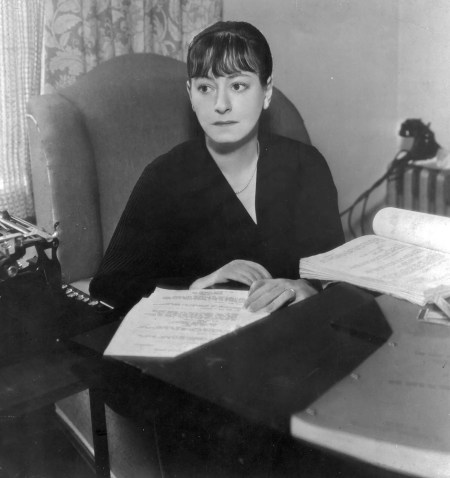
Dorothy-Parker-1939

As Dorothy Parker once said
To her boyfriend, “Fare thee well”

Cole Porter Just One of Those Things

Years ago I was up late reading a poetry anthology when I came across a familiar passage from Wordsworth:

She lived unknown, and few could know
When Lucy ceased to be;
But she is in her grave, and oh,
The difference to me!

I put the book down and thought, “You poor, poor man.” I was briefly flooded with empathy for Lucy and her chronicler. And this sensation connected my life and my various heartaches and disappointments with the turbid ebb and flow of human misery. (Soon I remembered that the people about whom I was reading had been dead for over a century. I picked up my book and went on to the next poem.)

Reading The Complete Poems of Dorothy Parker, a women who “wore [her] heart like a wet, red stain,” I am reminded of the sage* who informs us that “Happiness is a sad song” (10).

Although I’m no stranger to heartache and self-pity, Mrs. Parker obviously possesses, to paraphrase Emily Dickinson, a heart not so airy as mine.

The sun’s gone dim, and
The moon’s turned black;
For I love him, and
He didn’t love back.
(151)

Just about every human being who has ever lived has had a similar experience. But how many of us could condense so much feeling into eighteen beautifully collocated metrical syllables?

(A note on Light Verse: Kurt Vonnegut complained that critics mistook Science Fiction for a urinal, and that’s how I feel about this dismissive term often applied to rhymed poetry which possesses a healthy meter. Even when, for example, Phyllis McGinley writes of serious topics like nuclear annihilation, critics belittle such poetry by classifying it as light verse. This is why I am heartened by the growing presence of poets such as Mrs. Parker and Ogden Nash in the anthologies.)

Of course, the poetry of Dottie Parker would be a dreary place were it not for the courage she demonstrates by climbing back on that horse no matter how many times it throws her.

Better be left by twenty dears
Than lie in a loveless bed;
Better a loaf that’s wet with tears
Than cold, unsalted bread
(134)

And the existential vivacity of the tender heart which continues to grab life by the horns for all its gusto is heroic indeed.

For contrition is hollow and wrathful,
And regret is no part of my plan,
And I think (if my memory’s faithful)
There was nothing more fun than a man!
(172)

Perhaps not coincidentally, the tenacity of Mrs. Parker’s amorousness is matched (if not bested) by the ferocity of her malevolence.

Then if friendships break and bend,
There’s little need to cry
The while I know that every foe
Is faithful till I die.
(70)

Dorothy Parker is a legendary hurler of insults
who penned several composites of enmity which she calls “hate poems.” Here are some of her more artful derisions:

(Serious Thinkers)
They talk about Humanity
As if they had just invented it;
(224)

(Artists)
They point out all the different colors in a sunset
As if they were trying to sell it to you;
(236)

(Free Verse)
They call it that
Because they have to give it away
(237)

(Writers)
They are always pulling manuscripts out of their pockets,
And asking you to tell them, honestly—is it too daring?
(237)

(Tragedians)
The Ones Who Made Shakespeare famous. (246)

(Psychoanalysts)
Where a Freud in need is a Freud indeed,
And we can all be Jung together
(263)

(Overwrought Dramaturgy)
Of the Play That Makes You Think—
Makes you think you should have gone to the movies.
(265)

(Married “Steppers-Out”)
They show you how tall Junior is with one hand,
And try to guess your weight with the other.
(359)

(Bohemians)
People Who Do Things exceed my endurance;
God, for a man who solicits insurance!
(120)

(Men)
They’d alter all that they admired.
They make me sick, they make me tired.
(73)

(Past boyfriends)
The lads I’ve met in Cupid’s deadlock
Were—shall we say—born out of wedlock.
(147)

*Schultz, Charles Happiness is a Warm Puppy

by Richard W. Bray

Devoid

October 22, 2011

A face devoid of love or grace,
A hateful, hard, successful face,

Devoid

I’ve studied all one needs to know ‘bout every little thing
I’ve scoured the biographies of philosophes and kings
I’ve meditated countless hours on all that I have learned
And I’ve concluded modestly that clearly I have earned
The right to state objectively that all I would proclaim
Is exactly what should be, and wouldn’t it be a shame
If Lilliputian intellects and putrid second-raters
Or lily-livered losers and unmanly imitators
Would dare to think that they possess grit and gut and gall
To interrupt my project for the benefit of all?

Undermined by cowards and their miniscule bereavements
Who could not comprehend the scope of my achievement
Like pesky little gnats, they hindered my attention
Allowing mediocrities to cancel my ascension
These trifling mental midgets who dared to halt my plans
Don’t deserve to share the planet with a real fighting man
They can analyze the metrics until the end of time
And never comprehend the dimensions of their crime
When assessing this fiasco, please do not involve me
For I have every confidence that history will absolve me

by Richard W. Bray

Eleven Stanzas that Strike Like a Chime through the Mind

May 29, 2011

Christina Rossetti

Richard Wilbur

e e cummings

Does the road wind up-hill all the way?
Yes, to the very end.
Will the day’s journey take the whole long day?
From morn to night, my friend.

from Uphill by Christina Rossetti

Let Observation with extensive view,
Survey mankind, from China to Peru:
Reark each anxious toil, each eager strife:
Then say how hope and fear, desire and hate,
O’spread with snares the clouded maze of fate,
Where wavering man, betrayed by venomous pride,
To tread the dreary paths without a guide,
But scarce observed, the knowing and the bold
Fall in the general massacre of gold;
Wide-wasting pest! That rages unconfined,
And crowds with crimes the record of mankind;
For gold his sword the hireling ruffian draws,
For gold the hireling judge distorts the laws;
Wealth heaped on wealth, not truth nor safety buys,
The Dangers Gather as the Treasures rise

from The Vanity of Human Wishes (The Tenth Satire of Juvenal Imitated) by Samuel Johnson

We have it and it doesn’t do us any
Good because nobody gets what they
Deserve more than everybody else.

from Family Values by Robert Pinsky

I am tired of tears and laughter,
And men that laugh and weep;
Of what may come hereafter
For men that sow to reap:
I am weary of days and hours,
Blown buds of barren flowers,
Desires and dreams and powers
And everything but sleep.

from Garden of Proserpine by Algernon Charles Swinburne

Thy gowns, thy shoes, thy beds of Roses,
Thy cap, thy kirtle, and thy posies
Soon break, soon wither, soon forgotten:
In folly ripe, in reason rotten.

from The Nymph’s Reply to the Shepherd by Sir Walter Ralegh

Joy’s trick is to supply
Dry lips with what can cool and slake,
Leaving them dumbstruck also with an ache
Nothing can satisfy.

from Hamlen Brook by Richard Wilbur

“I see the guilty world forgiven,”
Dreamer and drunkard sing,
“The ladders let down out of heaven,
The laurel springing from the martyr’s blood,
The children skipping where the weeper stood,
The lovers natural and the beasts all good.”
So dreamer and drunkard sing
Till day their sobriety bring:
Parrotwise with Death’s reply
From whelping fear and nesting lie,
Woods and their echoes ring.
The desires of the heart are as crooked as corkscrews,
Not to be born is the best for man;
The second-best is a formal order,
The dance’s pattern; dance while you can.

from Death’s Echo by W. H. Auden

To fight aloud, is very brave —
But gallanter, I know
Who charge within the bosom
The Cavalry of Woe —

from To Fight Aloud is Very Brave by Emily Dickinson

I knew a woman, lovely in her bones,
When small birds sighed, she would sigh back at them;
Ah, when she moved, she moved more ways than one:
The shapes a bright container can contain!
Of her choice virtues only gods should speak,
Or English poets who grew up on Greek
(I’d have them sing in chorus, cheek to cheek.)

from I Knew a Woman by Theodore Roethke

and nothing quite so least as truth
—i say though hate were why man breathe—
because my father lived his soul
love is the whole and more than all

from my father moved through dooms of love by e.e. cummings

No memory of having starred
Atones for later disregard
Or keeps the end from being hard.

from Provide, Provide by Robert Frost

by Richard W. Bray