Archive for the ‘Morsel’ Category

For All They Care

June 30, 2012

W. H. Auden

Which is more significant, a person or a star?

People could not exist without stars. Not only does our sun provide us with essential warmth, light, and sustenance, but astronomers believe that all solid matter, ourselves included, is made up of the debris from former stars.

Compared to a person, our abiding sun is surely great and grand. But as far as we can tell, a star is neither sentient nor alert to its own existence. So unlike a human being or even a shih-poo who responds to the name of Max, a star will never want for anything.

W. H. Auden ponders his unreciprocated affection for stars and correctly concludes that despite a star’s magnificence, between the two, the poet himself is ultimately “the more loving one.”

Thus human beings gaze at stars with a longing that the stars themselves could never “return.”

Looking up at the stars, I know quite well
That, for all they care, I can go to hell,

And although the breadth of a star’s life is incomprehensible to a human being, a star is nonetheless ephemeral like everything else in our universe. (When the dividend is eternity, all quotients are miniscule.) Someday every star will “disappear or die.”

Getting back to my original question, is a star’s immense, blazing endurance a match for a human being’s cognizance and sensitivity? It’s a rhetorical question, of course. Even if it weren’t a false alternative, the answer would still lie beyond the scope of human imagination. We could not survive in a universe without stars, and as Richard Wilbur inquires,

How shall we dream of this place without us?–

For his part, Thomas Hardy maintains that the “disease of feeling” is overrated, and “all went well” prior to “the birth of consciousness,”

None suffered sickness, love, or loss,
None knew regret, starved hope, or heart-burnings;
None cared whatever crash or cross
Brought wrack to things.

If something ceased, no tongue bewailed,
If something winced and waned, no heart was wrung;
If brightness dimmed, and dark prevailed,
No sense was stung.

Auden is similarly cynical about the ultimate value of human sentimentality:

Were all stars to disappear or die,
I should learn to look at an empty sky
And feel its total darkness sublime,
Though this might take me a little time.

by Richard W. Bray

An Amusing Teacher Story: Tammy’s Puppy

June 22, 2012

Back in the days before substitute teaching assignments were given out by robocomputers, subs would call the early-rising sub-assigners during our lunch hour and beg for work.

One day the sub lady in Pomona granted me an after-lunch half-day assignment for the next afternoon. (Normally if a teacher can’t get a dentist appointment for the late afternoon, she schedules it for the morning and takes the day off. But some districts offer half-day substitutes.) This is usually a pretty good gig for the substitute, particularly in elementary school where most of the heavy lifting (Math and Language Arts) is done before lunch.

The teacher was sitting in the classroom reading her newspaper when I arrived during lunch. I said Hi and she gave me the lesson plans which consisted of a map and one sentence instructing me to walk the students several blocks to and from the theater located at the district office where there was going to a West African Talking Drums concert. This ought to be fun, I thought.

The teacher was out the door before I got a chance to ask her how many parent volunteers she had arranged for the trip. I soon discovered that the answer to that question was zero, and my day went downhill from there.

I picked up the kids from lunch recess, and thirty-two fifth graders and I embarked through the turbulent streets of Pomona, California towards the district office. Normally in such a situation I would put my best parent volunteer at the front of the line, and string the rest of the volunteers throughout the line as I took up the rear in order to encourage slowpokes.

But working alone I was forced to man the front of the line, stopping frequently whenever the students in the back straggled out of view. But we were making good time nonetheless, and I was looking forward to getting good seats for the show.

Suddenly there was a great commotion when a thirty-third soul joined our serpentine. As we walked past Tammy’s house, her puppy which had somehow gotten loose decided to tag along with us. Everyone but Tammy and I were thrilled by this addition to our group. So we all waited as Tammy knocked and knocked on her door, summoning a grandmother who did not answer. I asked Tammy if there were anything else she could do, such as leave the dog with a neighbor. But she just kept knocking on the door.

There was much merriment among the students as my aggravation rose. After what seemed like an eternity of waiting, I implored Tammy to think of something (anything!) that she could do to rid us of our little friend. “Well,” she said, “maybe I could tie him up in the backyard.” She hopped the locked gate and someone handed her the puppy. About ten minutes later she miraculously appeared sans puppy, and we were off.

We were the last group of students to arrive at the theater. I was greeted with dirty looks from several district officials. We had to squeeze into the remaining gaps at the back of the theater. Several of the students were objecting to being separated from their friends as the West African Drummers were filing down the aisle towards the stage.

I may have raised my voice a tad when I said, “Just sit down. Now!”

One of the West African ladies from the drum troupe looked up and asked, “Who is dis terrible man shouting at de cheeldren?

by Richard W. Bray

Ghosts of all my Lovely Sins: Some Thoughts on the Complete Poems of Dorothy Parker

June 9, 2012

Dorothy-Parker-1939

As Dorothy Parker once said
To her boyfriend, “Fare thee well”

Cole Porter Just One of Those Things

Years ago I was up late reading a poetry anthology when I came across a familiar passage from Wordsworth:

She lived unknown, and few could know
When Lucy ceased to be;
But she is in her grave, and oh,
The difference to me!

I put the book down and thought, “You poor, poor man.” I was briefly flooded with empathy for Lucy and her chronicler. And this sensation connected my life and my various heartaches and disappointments with the turbid ebb and flow of human misery. (Soon I remembered that the people about whom I was reading had been dead for over a century. I picked up my book and went on to the next poem.)

Reading The Complete Poems of Dorothy Parker, a women who “wore [her] heart like a wet, red stain,” I am reminded of the sage* who informs us that “Happiness is a sad song” (10).

Although I’m no stranger to heartache and self-pity, Mrs. Parker obviously possesses, to paraphrase Emily Dickinson, a heart not so airy as mine.

The sun’s gone dim, and
The moon’s turned black;
For I love him, and
He didn’t love back.
(151)

Just about every human being who has ever lived has had a similar experience. But how many of us could condense so much feeling into eighteen beautifully collocated metrical syllables?

(A note on Light Verse: Kurt Vonnegut complained that critics mistook Science Fiction for a urinal, and that’s how I feel about this dismissive term often applied to rhymed poetry which possesses a healthy meter. Even when, for example, Phyllis McGinley writes of serious topics like nuclear annihilation, critics belittle such poetry by classifying it as light verse. This is why I am heartened by the growing presence of poets such as Mrs. Parker and Ogden Nash in the anthologies.)

Of course, the poetry of Dottie Parker would be a dreary place were it not for the courage she demonstrates by climbing back on that horse no matter how many times it throws her.

Better be left by twenty dears
Than lie in a loveless bed;
Better a loaf that’s wet with tears
Than cold, unsalted bread
(134)

And the existential vivacity of the tender heart which continues to grab life by the horns for all its gusto is heroic indeed.

For contrition is hollow and wrathful,
And regret is no part of my plan,
And I think (if my memory’s faithful)
There was nothing more fun than a man!
(172)

Perhaps not coincidentally, the tenacity of Mrs. Parker’s amorousness is matched (if not bested) by the ferocity of her malevolence.

Then if friendships break and bend,
There’s little need to cry
The while I know that every foe
Is faithful till I die.
(70)

Dorothy Parker is a legendary hurler of insults
who penned several composites of enmity which she calls “hate poems.” Here are some of her more artful derisions:

(Serious Thinkers)
They talk about Humanity
As if they had just invented it;
(224)

(Artists)
They point out all the different colors in a sunset
As if they were trying to sell it to you;
(236)

(Free Verse)
They call it that
Because they have to give it away
(237)

(Writers)
They are always pulling manuscripts out of their pockets,
And asking you to tell them, honestly—is it too daring?
(237)

(Tragedians)
The Ones Who Made Shakespeare famous. (246)

(Psychoanalysts)
Where a Freud in need is a Freud indeed,
And we can all be Jung together
(263)

(Overwrought Dramaturgy)
Of the Play That Makes You Think—
Makes you think you should have gone to the movies.
(265)

(Married “Steppers-Out”)
They show you how tall Junior is with one hand,
And try to guess your weight with the other.
(359)

(Bohemians)
People Who Do Things exceed my endurance;
God, for a man who solicits insurance!
(120)

(Men)
They’d alter all that they admired.
They make me sick, they make me tired.
(73)

(Past boyfriends)
The lads I’ve met in Cupid’s deadlock
Were—shall we say—born out of wedlock.
(147)

*Schultz, Charles Happiness is a Warm Puppy

by Richard W. Bray

Hundred Dollar Rip-Off

June 6, 2012

images

It was advertised as a chance to have our poetry critiqued by a real live published children’s poet.

We were instructed to bring samples of our work.

So I paid $100 dollars to attend a half-day “poetry workshop” at a lovely private school located in lovely Pacific Palisades, California put on by the SCBWI (the Society of Children’s Book Writers and Illustrators).

Like the several women and one other man who showed up at eight AM that morning, I was percolating with the hope of discovery.  This would be my Dear Mr. Henshaw moment when an authentic published children’s author was going to tell me that I had what it takes to succeed.

But the real live children’s poet who ran this seminar had no intention of soiling her fine artistic temperament by actually reading any our work herself. Instead, we were put into groups and instructed to pass our poems around and leave comments on each other’s work. I got this gem of a comment on my poem My Funny Farm: “Why don’t you try rewriting it without using rhyme?”

In order to kill the last half hour of the seminar without having to engage in a direct one on one conversation with any of us, the Poetess in Charge instructed everyone to place one of her belongings on our respective tables and then each of us was to write a poem about something someone else had supplied.  We were given fifteen minutes to complete this task.

When the woman leading the seminar asked if anyone wanted to read, the women at my table insisted that I share mine. It got a raucous round of laughter, which did not please our instructor one bit. Here’s the poem I wrote that day:

Ode to a Homeopathic PMS Remedy

Cranky, puffy, angry days
Aren’t relieved too many ways
But a homeopathic remedy
Might be what it takes to see
That PMS won’t ruin my day
Now it’s time to go and play

Then I had a nice lunch on the beach in Malibu and went home.

by Richard W. Bray

Listening to the Whirlwind: Theodicy for Deists

May 26, 2012

We dance round in a ring and suppose,
But the Secret sits in the middle and knows

—Robert Frost

Ever tried to talk to a grasshopper?  Of course not.  Yet the moral, intellectual, and existential divide between God and humanity is obviously greater than the gulf between people and insects.  So why do so many human beings expect to hear from God?

Our Judeo-Christian heritage leads us to assume that God is both creator and creation.  (God is in all things but somehow He is also an omnipotent overseer.)  We assume that God must be perfection.  We assume that God must be infinite in relation to both time and space.  And then we expect this marvelous conglomeration of mystery and paradox to speak to us as we would speak to one another.

Unfortunately, God exists in a realm so many notches above our level of understanding that we utterly lack the necessary equipment to understand Him.  Attempting to contemplate God with a human brain makes as much sense as trying to cut the sun in half with a pair of scissors.

Jon Dryden eloquently expresses the folly:

How can the less the Greater comprehend?
Or finite Reason reach Infinity?
For what cou’d Fathom GOD were more than He.

This simple observation makes me deist. (Although I should hasten to add that Dryden explicitly rejects deism in Religio Laici.)

I don’t know what God is; I will never know what God is, and I’m not going to waste my precious time on earth trying to figure out what God is.

Does this make me a candidate for Winston Niles Rumfoord’s  Church of God the Utterly Indifferent?  My answer is an unequivocal maybe.  (Getting mired in a swamp of paradox is perhaps the greatest peril of groping after God.)  Maybe God cares about humanity; maybe God doesn’t care.

My fellow human beings, however, tend to assume that God cares a great deal about us.  And Christians anthropomorphize God to the point that He can actually feel our pain because a God who cannot suffer is insufferable.

But if God loves us so much, why is our world full of suffering and injustice? Unfortunately, there is no humanly comprehensible answer to this question. But there is an entire branch of theology dedicated to “reconciling God’s traditional characteristics of omnibenevolence, omnipotence and omniscience (all-loving, all-powerful, and all-knowing, respectively) with the occurrence of evil in the world.”

Humans have been looking for someone to blame for our lot since Gilgamesh. And as long as we insist upon anthropomorphizing God, we are stuck in the cul-de-sac of asking ourselves why the universe is the way it is.

Interestingly, the Old Testament provides an answer for this question which is as profound as it is unsatisfying:

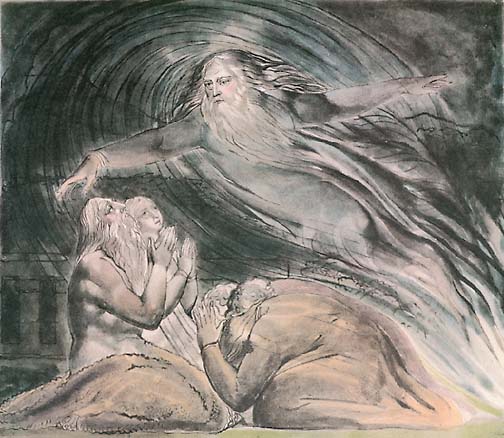
Where wast thou when I laid the foundations of the earth? declare, if thou hast understanding.

Who hath laid the measures thereof, if thou knowest? or who hath stretched the line upon it?

Whereupon are the foundations thereof fastened? or who laid the corner stone thereof;

When the morning stars sang together, and all the sons of God shouted for joy?

Or who shut up the sea with doors, when it brake forth, as if it had issued out of the womb?….

Hast thou commanded the morning since thy days; and caused the dayspring to know his place….

Hast thou entered into the springs of the sea? or hast thou walked in the search of the depth?

Have the gates of death been opened unto thee? or hast thou seen the doors of the shadow of death?

Hast thou perceived the breadth of the earth? declare if thou knowest it all.

Where is the way where light dwelleth? and as for darkness, where is the place thereof….

Who hath divided a watercourse for the overflowing of waters, or a way for the lightning of thunder;

To cause it to rain on the earth, where no man is; on the wilderness, wherein there is no man;

To satisfy the desolate and waste ground; and to cause the bud of the tender herb to spring forth?

Hath the rain a father? or who hath begotten the drops of dew?  (Job 38)

So God’s answer to it all is: It’s none of your damn business and you wouldn’t be capable of understanding it if I told you anyway.

Or, as the wonderful gospel Midrash (You Can’t Hurry God) He’s Right on Time succinctly notes:

I’m God all by myself/And I don’t need nobody else.”

This vast, spectacular universe is not about us.  But then again, of course it is.  (Another paradox.)

If we read the Book of Job imagining God and Satan sitting in a couple of celestial director’s chairs as they toy with Job for sport, then we must conclude that God is a sick, sad, wicked creep.

But once we reject the silly notion that God is merely some sort of human being who lives in outer space, the Whirlwind begins to make a hell of a lot of sense.

by Richard W. Bray

Natural if not Normal

May 20, 2012

Sex is. There is nothing more to be done about it. Sex builds no roads, writes no novels, and sex certainly gives no meaning in life to anything but itself.

—Gore Vidal, United States: Essays 1952-1992 (37)

Sex.  What’s with the persistent human propensity to study, describe, imagine, define, categorize, restrict, denounce, regulate, prohibit, criminalize and constantly talk, talk, talk about what other people are doing in private with their naughty bits?

Sex is a basic human need, essential to the survival of the species. But this is only part of the answer.  Human beings require shelter, for example, yet the subject of housing barely elicits a fraction of the chatter that the Big Nasty generates amongst human interlocutors.

And as W.H. Auden pondered: Why should so much poetry be written about sexual love and so little about eating—which is just as pleasurable and never lets you down—or about family affection, or about the love of mathematics.

According to Gore Vidal, “the sexual attitudes of a given society are the result of political decisions” (539).  This explains why we see so many professional moralists and politicians “solemnly worshiping at the shrine of The Family” (601).  (Like when our president recently went out on a limb to courageously declare that Motherhood is the toughest job in the world.)

Barack Obama’s other recent bold pronouncement, that he has evolved to the point where the idea of gay marriage no longer gives him the willies, made much bigger headlines.

So why the big fuss?  To borrow a phrase from Thomas Jefferson, regardless of my own prejudices or proclivities, it neither picks my pocket nor breaks my leg if Adam wants to marry Steve.  (Yes, I know that Steve could be entitled to partake in Adam’s medical benefits, perhaps raising my health care premiums, but the two fellows will also be paying higher taxes, so I’d be willing to bet that the monetary consequences of their union would probably be a net gain for society at large.)

Gore Vidal contends that our political overseers ghettoize certain types of sexual behavior as a means of maintaining their hegemony over the populace: “In order for the ruling class to rule, there must be arbitrary prohibitions” (442).  Sexual preference is just one of the many divisions, such as  race, class, religion, age, region, gender, etc., which are exploited by los que mandan.  Thus we are informed, particularly from the pulpit, that when it comes to sexual preference, there are only two ways to be: “One team is good, godly, straight; the other is evil, sick, vicious” (442).

Like homosexuality, divorce is also dangerous to the status quo because “A woman who can support herself and her child is a threat to marriage, and marriage is the central institution whereby owners of the world control those who do the work” (540). Vidal notes with his characteristic wit that heterosexual couples are expected “to do their duty by one day getting married in order to bring forth new worker-consumers in obedience with God’s law, which tends to resemble with suspicious niceness the will of society’s owners” (540).  Of course, over the last four decades divorce has become so common that many of the leaders who rail in favor of “family values” are themselves divorced.  This helps explain the fury we hear from some quarters against the damage done to our sacred family unit by homosexuals. At any rate, “it does not suit our rulers to have the proles tomcatting around the way that our rulers do” (606).

The mechanisms which enforce such twisted mores are designed to produce citizens who “serve society as loyal workers and dutiful consumers” (540).  This is not an originally American arrangement; it is merely the machinery of power and profit in action.  And any “activity that might decrease the amount of coal mined, the number of pyramids built, the quantity of junk food confected will be proscribed through laws that, in turn, are based on divine revelations handed down by whatever god or gods happen to be in fashion at the moment” (339-340).

In 1948 Gore Vidal courageously published The City and the Pillar, a coming of age novel about homosexuality.  But Vidal is not celebrated as a hero for gay activists today largely because he rejects the “American passion for categorizing” which endeavors “to create two nonexistent categories—gay and straight” (606).  Vidal therefore scoffs at the notion that such a thing as the “gay community” could ever exist.  (“What in God’s name do Eleanor Roosevelt and Roy Cohn have in common?” he quipped.)

Experience has taught Vidal that “it is possible to have a mature sexual relationship with a woman on Monday, and a mature sexual relationship with a man on Tuesday, and perhaps on Wednesday have both together (admittedly you have to be in good condition for this)” (581).

by Richard W. Bray

Application #2

April 27, 2012

aaaaLangstonHughes

Here’s something I wrote a few years ago in graduate school for Professor Kaplan:

Application #2

Langston Hughes’s poem Harlem complies with Cleanth Brooks’s assessment of modern poetic technique as “full commitment to metaphor.” The poem consists of six cogent metaphors steeped together to create an elixir incomparable to the flavor of any one of these images standing alone. A raisin, an oozing sore, rancid meat, a sugary crust, a sagging load and an explosion are, by themselves, images which either assault or delight the senses. Hughes’s alchemy blends the first four contradictory metaphors, then offers a lull in the image of a sagging load before suggesting the possibility of an explosion.

The splattering of metaphors in Harlem qualifies as irony according to Brooks’s loose definition: “The obvious warping of a statement by context.”

The tension, or “pressure of context,” resulting from the incongruity of the metaphors in Harlem is resolved through the prospect of obliteration (explosion) of the entire batch of metaphors. This final loud, bright, apocalyptic eruption, so inconsistent with the lazy, passive images which precede it, relieves tension by hinting at annihilation.

The liquid quality of the poem’s first four metaphors reveal the fluid quality of human emotions. They also contain three food images and two carnal references, suggesting that the fulfillment of our dreams is a need just as basic and primal as the appetite for food.

by Richard W. Bray

This Business of Saving Souls

April 20, 2012

Richard Wright

This business of saving souls has no ethics“, writes Richard Wright as he recalls how the entire weight of his community was brought down upon him for rejecting Christianity. Wright is certainly not the first person to point out hypocrisies committed in God’s name, and the cogency of Wright’s irony exposes his utter contempt for organized religion. As the author sees it, Christianity is merely one of several methods which society employs to enforce submission upon the masses in general and upon Richard Wright in particular.

Black Boy is overflowing with social forces designed to break Richard Wright down—domestic violence, white terrorism, the media, the school system and the black church all conspire to bridle his spirit. This only makes him angrier and more productive.

For a man who wears the scars of nonconformity as a badge, Wright’s unwillingness to submit to God is perfectly consistent. Like any memoir, Black Boy is an amalgamation of fact, fantasy, and recollection. But this particular autobiography has a remarkably consistent theme: Always the rebel, Richard Wright heroically reveals all forms of human hypocrisy and confronts every injustice perpetrated against him. The institutional repression of the church is just another cross for him to bear.

Wright’s descriptions of the black church seethe with hostility as he chooses to see only the most negative aspects of religion. He is “disgusted” by the “snobbery, clannishness, gossip, intrigue, petty class rivalry, and conspicuous displays of cheap clothing” which he encounters in church. Of course, with the possible exception of “cheap clothing,” these phenomena are apparent in all human institutions. It’s just the way people are. And this vituperation for the church is a function of Wright’s deep–seated misanthropy.

It is disheartening that Wright’s quest to slay all dragons prevents him from experiencing the virtuous aspects of organized Christianity. He is absolutely blind to the worldly fellowship, charity, comfort, hope and spiritual fulfillment religion has to offer. And the immense beauty of religious art and music are completely lost on him. As Wright sees it, “(t)he naked will to power seemed always to walk in the wake of a hymn”.

But this cannot be dismissed as a simple outgrowth of Wright’s Marxist/humanist philosophy. Many confirmed atheists are willing to concede that organized religion can be beneficial to society in various ways despite the plethora of grievous wrongs committed in its name. (Full disclosure: I am a devout deist, but I reject the smugness with which many of the so-called New Atheists attack religion.) The roots of Wright’s profound enmity towards the black church stem from the part of him which could never find solace in groups, not even in a political party which reflected his beliefs.

Richard W. Bray

Scenarios for Discussing Business Ethics

April 13, 2012

aaaaathumb.php

1. Have students rate the awfulness of the following scenarios on a scale from one to ten.

2. Pair and share answers while considering the following questions.

   a) Who gets hurt? How much?
   b) Would you want your mother to know if you did it?
   c) What kind of world would it be if everyone acted like this?

3. Full-class discussion led by teacher.

Scenarios

Dumping toxic waste in a Third World country.

Embezzling from a large corporation.

Embezzling from the widows and orphans fund.

Collecting on a false claim from an insurance company.

Quid pro quo sexual harassment.

Plagiarism in a company report.

Copying computer software without permission.

Bribing foreign officials to get a contract in countries where it is a commonly accepted practice.

Bribing a building inspector instead of fixing faulty electrical equipment.

Only hiring people who belong to the same race or the same gender as you.

Omitting side effect information in a published drug trial.

Profiting from child labor.

Profiting from “sweatshop” labor.

Threatening employees with termination if they don’t work unpaid overtime.

“Spamming” strangers in hopes of attracting clients.

“Cold calling” potential clients in their homes during dinner.

Taking office supplies from your employer on a regular basis.

CEOs getting large compensation and bonuses when they are laying off employees and/or cutting worker salaries and benefits.

Managers who routinely pitch fits and scream at employees.

A restaurant owner skimming money from the tips of waiters and busboys.

Richard W. Bray

In Praise of Clever

April 7, 2012

Clever is underrated.

Clever describes one who possesses brilliance, mental sharpness, originality, or quick intelligence. But the word clever also implies shallowness and superficiality.

Fables teach our children that the clever fox is subordinate to the wise old owl. Cleverness is ephemeral but wisdom abides.

According to this distinction between cleverness and wisdom, cleverness is quick and slick whereas wisdom is an invaluable beverage which must ferment over time: wisdom enlightens; cleverness simply amuses. But without intelligence there is no wisdom; there is merely pablum which seeks to comfort.

And even the least refined cleverness has value. Every flash illuminates, if only for an instant.

I hope you enjoy these witty rhymes from Lyrics on Several Occasions. Ira Gershwin was very clever and that is good enough for me.*

Ira Gershwin rhymed embraceable you with irreplaceable you and silk and laceable you in Embraceable You (29-30)

Ira Gershwin rhymed divorcement with of course, meant and he rhymed painless with ball-and-chainless in Sweet Nevada (78)

Ira Gershwin rhymed enjoyment with for girl and boy meant in Nice Work if You can Get it (96)

Ira Gershwin rhymed caress men with yes men and chessmen in How Long has this Been Going On? (277)

Ira Gershwin rhymed four leaf clover time with (my heart) working overtime in ‘S Wonderful (251)

* I realize, of course, that the word clever has often been used to disparage the accomplishments of Jews, just as the word sinister has often been used to impugn their motives. This is not my intention.

Richard W. Bray