Archive for the ‘Morsel’ Category

First Day of College Composition Class—Syllabus, Tone, and Thesis Statement

February 19, 2017

zzzzthesis

I do more talking on the first day than I usually do. (Reminder: A teacher should always keep a lozenge in her briefcase. Better to have it and not need than to need and not have it.)

I spend the first day of English Composition class teaching about thesis statement and tone.

Of course, I go over the syllabus first. I always hated it when one of my instructors spent the entire first session covering every word of the syllabus, giving us a preview of each upcoming lecture, so I tell the students that they made it this far and they should be able to read a syllabus on their own. Instead, I focus on the required texts for the class, my grading policies, due dates for assignments, and my expectations for appropriate classroom comportment.

I stress the following sentence from my syllabus:

It is important to maintain a cordial demeanor which facilitates free and open discourse.”

In other words, in this classroom we need to be able to disagree with one another without being disagreeable.

I tell my students that it’s perfectly acceptable to say, “Professor Bray, I disagree with everything you just said for the following reasons….”

However, it is not acceptable to say, “Professor Bray, you are stupid and your mother dresses you funny.”

I beg my students to disagree. Please, I tell them, disagree with me, the authors we are covering, and anyone else in the class. That’s what we are here for, the free and open exchange of ideas. My students will receive no brownie points for agreeing with the instructor. This is true for the classroom discussions and also for their essays. Students are not graded on the positions they choose to take; they are evaluated based upon the quality and structure of their arguments and the style of their prose.

In order to teach students about thesis statements and tone, I select two short essays that vary in style and substance; usually I read them a serious article first (for example, Katha Pollitt on reproductive rights or Pat Buchanan on trade policy) and then I read them something lighter (a silly article by Jon Carroll about his cat, perhaps). Before I read the articles, I ask who can tell me what a thesis statement is, and then I type their answers into a machine which magically projects words onto a large screen for all to see.

Their answers will include:

An essay’s argument, an essay’s main point, an essay’s main point distilled into one sentence.

I tell them these answers are correct, but in my class it’s okay to state a thesis in two or even three consecutive sentences rather than trying to jam it all into one very long and awkward sentence with too many clauses and too many commas.

When I ask them where the best place to put their thesis is, they tell me it belongs at the end of their introductory paragraph. I say, “Correct.” (Good job, high school English teachers!)

This is the point where I tell them that different types of writing are bound by different types of conventions and expectations. For student essays (but not for other types of student writing such as journals) I expect them to follow specific conventions, such as placing the thesis statement at the end of the first paragraph and supporting their arguments with “evidence” (the quoted opinions of people who are assumed to know what they are talking about for one reason or another.) I tell them that the two essays we are covering today are written by professional writers for popular consumption. Such authors are under no obligation to follow any of Mr. Bray’s rules for academic writing. For example, fragments and one-sentences paragraphs can be very effective tools, but they are not generally acceptable in academic writing.  Furthermore, many professional writers believe that a thesis statement placed at the end of the introductory paragraph is a clunky device.  And I agree with them, but you will nevertheless be marked down substantially if you do not have a clear thesis statement in any paper you submit to me. However, in the essays we are about to consider, the thesis statement might be at the beginning of the essay, it might be at the end of the essay, it might be broken up and scattered throughout the essay, or it might not exist at all.

Next, I ask my students what the word tone means in relation to writing.

Probable answers include: mood, attitude, voice

I tell them that these are all good answers. I also suggest that they think of tone in relation to a person’s actual speaking voice. Many of the authors I teach are people I have seen on television so I can imagine how they would sound reading a particular essay. For example, in my head I hear how Pat Buchanan stresses and elongates the second syllable of “bamboozled,” one of his favorite verbs.

Then I ask my students for adjectives that could describe the tone of a particular piece of nonfiction prose.

I get answers such as: sad, angry, sarcastic, light, witty.

I tell them these are all good answers.

I inform them that my rule about tone is that is must be appropriate in relation to the chosen subject matter of and essay and also appropriate for the anticipated audience for an essay.

For example, if one is writing about 9/11 in a mainstream American news magazine such as Time, a witty tone would not be appropriate. Also, if one were writing an essay for young children about the adorableness of puppies, a sarcastic tone would not be appropriate.

(I briefly explain the distinction between sarcasm and verbal irony, something we will go into in detail at a later time.)

Lesson Plans

#1 Distribute first article.

#2 Instruct students to get out their writing utensils and number the paragraphs.

#3 Instruct students to look for and mark possible examples of tone and thesis statement as I read the essay aloud.

#4 Instructor reads the essays aloud.

#5 Allow students an additional seven minutes to look for examples of tone and thesis statement.

#6 Pair and share (if time permits and if you’re into that sort of thing).

#7 Review as whole class discussion.

An appropriate answer for an example of tone in the essay would be: “The author is using a verbally ironic tone in paragraph six when she says, “I just love it when my boyfriend leaves me dirty laundry to pick up.”

#8 Repeat steps 1-7 with second article.

#9 Instruct students to save the articles for later use with this exercise on strong verbs.

#10 Remind students that it’s going to be a long semester and send them on their merry little way.

by Richard W. Bray

Seven Ways of Looking at a Line of Poetry

November 6, 2016

zzwaking

Anthropologists tell us* that “some time between 75 thousand and 60 thousand years ago” homo sapiens underwent a remarkable change (194). This event occurred “somewhere on the African continent (most likely somewhere in its eastern or southwestern regions)” (193). Suddenly, our already impressive brains developed the capacity for symbolic thought. Our ancestors, who heretofore merely consisted of roving bands of precocious carnivorous weapon-wielding bipeds, were transformed into artists, shamans, scientists, and engineers. World-domination was now only a matter of time.

These new-and-improved brains rendered representational art, handicraft, metaphor, music, dance, language and poetry essential to our existence.

As Kurt Vonnegut notes, this spectacular transformation gave us not only the capacity and the inclination to produce Beethoven’s Ninth Symphony; it also gave us the capacity and the inclination to

burn people alive in the public square for holding opinions which were locally unpopular, or build factories whose only purpose was to kill people in industrial quantities.

I’m seriously into words. I have argued that it’s ultimately impossible to separate language from poetry because our ancestors began playing with words as soon as they began to invent them. Uttered phonemes are automatically poetic just like every basket and every arrowhead homo sapiens produce is a work of art.

Death and disruption at an early age hurt Theodore Roethke into poetry, as W. H. Auden suggests “mad Ireland” hurt W.B. Yeats into poetry. And oh what prodigious poetry Roethke did make! I’m going to spend a little bit of time talking about how to say the third line of a villanelle Roethke wrote called “The Waking” because my brain spends a lot of time thinking about such things.

A villanelle is a nineteen-line Italian form in which the first and third lines are each repeated three times. (I’ve written a few of them myself.) (A smartass once wrote on this blog that “the cool thing about villanelles is that once you’ve written the first three lines, you’re 42% finished.”)

Here’s the first stanza of Roethke’s “The Waking.”

I wake to sleep, and take my waking slow.
I feel my fate in what I cannot fear.
I learn by going where I have to go.

I told you the dude was prodigious, right? Anyhow, the first and third lines of a good villanelle must be firm and flexible as much heavy lifting is expected of them. Here are some examples:

Time will say nothing but I told you so.

(First line of Auden’s “If I Could tell You”)

(I think I made you up inside my head.)
(Third Line of Sylvia Plath’s “Mad Girl’s Love Song”)

Rage, rage against the dying of the light.

(Third Line of Dylan Thomas’s “Do Not Go Gentle Into That Good Night”)

Now back to “The Waking.” If a reader must read the same lines four times in a nineteen-line poem, the poet should provide her with options about which words to stress. Here are seven ways to say line three of “The Waking”:

#1 I learn by going where I have to go

Learning is about destination rather than free will.

#2 I learn by going where I have to go

The essential lesson is in the destination

#3 I learn by going (pause) where I have to go

The journey, so to speak, is the destination.

#4 I learn by going where I have to go

The lesson is in the doing.

#5 I learn by going where I have to go

The important thing is that the experience is educational.

#6 I learn by going where I have to go.

It’s imperative to take a certain route that is nonetheless educational.

#7 I learn by going where I have to go.

I find out what I’m supposed to do only by doing it.

by Richard W. Bray

*Ian Tattersall, Masters of the Planet

The Funny Men of My Youth

June 27, 2016
Jan Murray

Jan Murray

Sometimes I like to do the Grumpy Old Man routine with my students: “When I was your age, Sonny, I had to walk barefoot to school in the snow, and the long, arduous journey was uphill—both ways.”

None of this is true, of course. My parents always provided me with good shoes and it’s only snowed once in Claremont in the last fifty years. I stole that joke from one of my childhood heroes, Bill Cosby. I still love to tell that joke, but I no longer attribute it to Cosby.  Once the most avuncular man in America, Cosby is now, allegedly, nothing but a sick old creep.

Bill Cosby’s fall pains me; I spent so much time with his comedy LPs as a kid, and it really felt like I knew him. One of my favorite Cosby albums was called I Started Out as a Child. It took me over a decade to get the joke in the title. Another Cosby album title was also quite funny: To my brother Russell, Whom I Slept With (but I still haven’t completely worked out its implications).

The comedy albums of Cosby and The Smothers Brothers were a big part of my childhood.   (For you younger readers, albums, also called records, were large flat black petroleum-based disks that created marvelous sounds when played on something called a turntable.  Albums were very fragile, which may have accentuated the reverence we had for them).   In junior high school I discovered the more “mature” comedy records of George Carlin, Richard Pryor and Cheech and Chong.

When I was a kid, back in the dark ages before VCRs, HBO, and Comedy Central, in order to see the great comedians, you had to watch the three major talk show hosts: Mike Douglas, Merv Griffin, and Johnny Carson. I would rush home to see Mike Douglas in the afternoons and Merv was on in the evening, but Carson, the King of Comedy, was on after my bedtime, so I would listen to The Tonight Show through the slats in the hall door while my parents thought I was asleep.  If I laughed too loud my mom would shout, “Go to bed.”

The old-timer comedians like Buddy Hackett, Jack Benny, and Henny Youngman that I loved to watch on tv when I was a kid frequently spoke about something called “working the Catskills.” Since there was no google back then, I asked my dad what the Catskills were. He said that they were mountains in upstate New York (hills really, by California standards) where people from New York City used to go on vacation.

Decades later I was watching a PBS documentary on the history of Jewish Comedy in America which went into great detail about the Catskills (also known as the Borsch Belt). One of the people featured in the documentary was Jan Murray. I thought, “Jan Murray is Jewish. Who knew?” Then it dawned on me–the overwhelming majority of the comedians I revered as a kid were Jewish. And as I think about it now, the non-Jewish comedians from my youth like Cosby, Bob Hope, George Carlin, Red Skelton, Flip Wilson, Danny Thomas, and Johnny Carson are really the exceptions.

by Richard W. Bray

Women (and Men) in Love

June 19, 2016
Simone De Beauvoir

Simone De Beauvoir

What about romantic love?  Is it merely, as the scientists say,  a trick played upon us by the chemicals in our brains, an evolutionary mechanism that provides a bond that will last long enough to increase a human offspring’s chances for survival?  Yes, probably.  But so what?  Romantic love’s utilitarian origins don’t preclude it from being good and beautiful.

There are several indications that the experience of heterosexual romantic love is in many ways different for men and women?   (I should point out, however, that men and women have many more characteristics in common than we have differences. We are not two separate species. Furthermore, there are myriad variations within members of each gender. And both nature and nurture account for differences between men and women: men’s and women’s brains function somewhat differently and, across cultures, we tend to be socialized in very different ways.)

Several years ago, Johnny Carson asked cartoonist Kathy Guisewhite: “What’s the difference between men and women?”*

Guisewhite replied: “I really don’t think men sit around discussing women the way that women are constantly obsessing about men. You know, we’re constantly asking each other, ‘Why are they like that?’ or ‘Why do they do that?’”

Guisewhite has a point. Women certainly do spend more time talking about men than men spend talking about women. This makes sense from an evolutionary perspective. And for most of Western history women were legally and socially subservient to men, passed along as chattel from father to husband.  This is still their situation in many parts of the world.

When your very existence is dependent upon pleasing someone who is bigger and stronger than you are, someone who has the legal right to assault you at any time, knowing your oppressor becomes an essential survival skill.

In her book The Second Sex, French feminist icon Simone De Beauvoir describes “The Woman in Love”

Since she is anyway doomed to dependence, she will prefer to serve a god rather than obey tyrants—parents, husband, or protector.  She chooses to desire her enslavement so ardently that it will seem to her the expression of her liberty; she will try to rise above her situation as inessential object by fully accepting it; through her flesh, her feelings, her behavior, she will enthrone him as supreme value and reality: she will humble herself to nothingness before him. Love becomes for her a religion (The Second Sex 643).

De Beauvoir chooses an epigraph for “The Women in Love” by Lord Byron which declares that romantic love is “to a man’s life, a thing apart”, while it constitutes “woman’s whole existence.”  This is not entirely true, of course.  Most men do fall in love, and a few of us have even died from a broken heart.

But how many men do you suppose would go out and buy a book like Relationship Rescue by Dr. Phil?


*Carson and Guisewhite quotations are reconstructed from my fallible memory

by Richard W. Bray


Walking Makes Humans What We Are

June 12, 2016

WWHUNTERS

I have never hunted animals. And I used to wonder how hunters walking around lugging heavy guns could ever get close enough to their prey in order to shoot it. Most animals can easily smell/see/hear humans long before the hunters get into firing range and then they could simply run away. Meaty mammals tend to be much faster runners than humans. What I didn’t realize is that human beings are designed to walk and walk and walk until our prey is too exhausted to continue. Then we use our weapons to kill it. And then we cook it and eat it.

In Masters of the Planet, an excellent introduction to human evolution, Ian Tattersall describes how the ability to walk great distances was key to the hunting prowess of homo ergaster, “an extinct ancestral form on the evolutionary scale of the genus Homo” that “lived in eastern and southern Africa during the early Pleistocene, that is, between 1.8 million and 1.3 million years ago.” Tattersall explains that “although homo ergaster would hardly have been fast compared to four-legged predators, its newer slender hips and long legs would have made members of the species exemplary distance runners.”

This evolutionary innovation gives homo sapiens a huge advantage over our prey because, unlike humans, “most mammals do not have the capacity to shed the heat load acquired and generated during sustained activity in the tropic sun, except by pausing in the shade while it slowly dissipates, largely through panting.” That’s why hunters will eventually catch their prey.   “In the heat of the day, the human ability to simply keep going would have allowed these lucky bipeds to single out, say, an antelope, and to keep chasing it, until it fell from heat prostrations” Or we can just kill it with our weapons when we get close enough.

Our ancestors made the remarkable transition from prey to predator.  Human beings are designed to vanquish by walking and running after animals until we get close enough to kill them.  This evolutionary history remains a major component of our collective psyche whether we like it or not.  And we should never forget this, even in an age when, for most of us, meat comes from the back of the supermarket.

So, Aesop’s fable The Tortoise and the Hare, in addition to being a marvelous parable on the efficacy of slow and steady diligence, is also the true story of how Our Hunting Fathers survived. Human beings are designed to “simply keep going” and going and going.

And simply trudging along is how our species came to inhabit and dominate so much of the planet.

I’m really glad that I exist as a human being; I wouldn’t trade in this particular vehicle of consciousness for anything in the world.  But our evolutionary success has had ominous ramifications for many of our fellow inhabitants of planet Earth.

As novelist Kurt Vonnegut notes, the human tendency to simply keep on walking and consuming has a dark side:

humanity itself had become an unstoppable glacier made of hot meat, which ate up everything in sight and then made love, and then doubled in size again.

Soldiers drilling, refugees fleeing, shoppers shopping, children strolling to school. Walking. It’s what we do and it’s one of the most essential things that makes us who we are.

Final word to Fats Domino:

By Richard W. Bray


Writing: Sketch and Fill, Write, Write, Prune, Sitting, Standing, Morning, Afternoon or Night

May 30, 2016
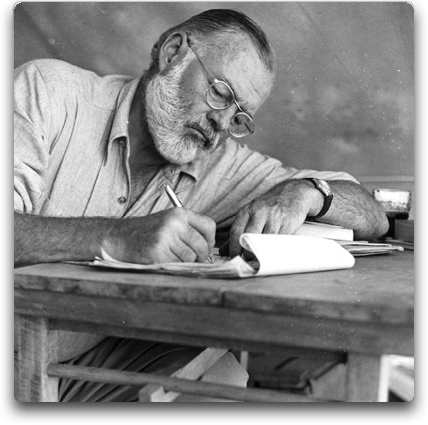
Ernest Hemingway

Ernest Hemingway


I write in the afternoon, like everybody else” asserts Dylan Thomas in the in the Caedmon Collection, a fantastic set of recordings of the poet’s live readings which are introduced by Billy Collins.

This would be a curious comment coming from most writers, but Thomas was a notoriously late drinker. Actually, he was a round-the-clock drinker.  In one of his introductions, Collins laments the foibles of Thomas, who was often confused, lost, and inebriated across America during the early 1950s.  (My dad had tickets to a see Thomas at Bridges Auditorium in Claremont, CA; sadly, as on many other occasions, Thomas was unable to make the show.)

I’m pretty sure most writers write in the morning when the mind is fresh. Many writers such as Kurt Vonnegut had to wake early to write before hitting the day job. Kafka would come home from his job at the insurance agency and nap so he could write when everyone else had gone to sleep and the house was quiet.

Ernest Hemingway’s approach to writing is strongly influenced by Freud.  Hemingway sees creativity as a sort of gas tank that is constantly being refueled by the subconscious mind. Hemingway recommends against allowing the brain to run on empty.

Always stop while you are going good and don’t think about it or worry about it until you start to write the next day. That way your subconscious will work on it all the time. But if you think about it consciously or worry about it you will kill it and your brain will be tired before you start. (Ernest Hemingway On Writing 42)

I don’t know if Graham Greene was familiar with Ernest Hemingway’s philosophy of writing, but he certainly practiced it. Greene had some sort of system that informed him exactly when he had written five hundred words. And that’s how much he wrote every morning, even if had to stop mid-sentence. Pretty soon after that he would start drinking, but this isn’t going to be another post about the inebriated scribbler, is it?

Writers write all sorts of ways: before breakfast, after dinner, dictating, typing, long-hand, short-hand, hunched over a keyboard, sitting up in bed, or standing up. Standing up is how Thomas Jefferson wrote the Declaration of Independence, on a desk that his descendants later sold (along with 130 slaves) to pay off the Great Man’s debts after he died. Jefferson heartily enjoyed the finer things in life, particularly French wine. (Spendthrift Jefferson provides a stark contrast to frugal George Washington who made provisions in his will to leave Martha with a healthy estate and to also grant* manumission to all of his slaves.)

I have a theory that there are basically two types of prose-writers: Sketch and Fill writers and Write, Write, Prune, writers.

I’m a Sketch and Fill writer. I prefer to write in the morning and revise later in the day or during the evening. As my writer’s gas tank nears empty, I often begin to make notes on what I’m going to write about when I return to the keyboard with a fresh brain.

* to boldly split your infinitive is often the more poetic thing to do

by Richard W. Bray

Walt Whitman is the Poet We Deserve in the Age of Trump, but Emily Dickinson Reigns

May 28, 2016

wwemily

There are several reasons why Emily Dickinson does not inhabit her rightful position as the greatest writer our culture has yet produced—she sedulously avoided publicity in her own lifetime (“How dreary – to be – Somebody!”); a comprehensive scholarly edition of her poetry was not compiled until almost seventy years after her death (long after the cannon had been established); she is often celebrated for her winsome poems that find their way into the high school textbooks like “I Shall Not Live in Vain” which represent only a tiny fraction of her output; she wrote short poems. (There is an absurd bias among critics in favor of “epic” poetry). Finally, we cannot overlook the obvious fact that Emily Dickinson was a woman and most of our cannon-selectors have been men, many of whom no doubt shared Nathaniel Hawthorne’s contempt for that “mob of scribbling women”

Moreover, elevating Emily Dickinson to her rightful place atop the pantheon of American poets would call into question the singular supremacy of Walt Whitman. Whitman, who sees himself as the great champion of democracy, claims to “contain multitudes” in his writing, but he merely embodies mountains of self-regard:

If I worship one thing more than another it shall be the spread of
my own body,
or any part of it.

It is his intrepid endeavor to displace God with Self rather than the actual quality of his work which makes Whitman the darling so many humanist critics. As Alfred Kazin notes in God and the American Writer, for Whitman

There is no one supreme Deity, no hierarchy, no heaven. It is on earth and nowhere else that we live out the divine in ourselves to which we are called. We are as gods when we recognize all things as one. Spiritually, we are sovereign—entirely—thanks to our culture of freedom. As we dismiss whatever offends our own souls, so we can trust our own souls for knowledge of the infinite.

Like the self-deluded subjects who claim to see the Emperor’s New Clothes (and like the editors at Social Text who published Alan Sokal’s intentional gibberish) few critics today are able to discern this manifest truth—Walt Whitman is an overblown, narcissistic, self-worshipping buffoon. (“In all people I see myself.”) Of course, in so many ways, Whitman’s solipsism makes him precisely the national icon we deserve, particularly in the Age of Trump. (It is not at all surprising that Bill Clinton gave his girlfriend a copy of a book by Whitman, although we might have expected him to choose “Song of Myself” rather than Leaves of Grass.)

Walt Whitman’s poetry delivers much music but very little sense, irony, or wit. Despite his gargantuan reputation, the words of Whitman taken together hardly amount to a single metaphorical dead white blood cell inside the metaphorical pustule existing inside the metaphorical pimple on Emily Dickinson’s glorious metaphorical backside. Dickinson proves again and again that she is capable of saying more in fewer than thirty syllables than Whitman ever gets across in page after page of his rambling jingle jangle.

One of the wonders of Emily Dickinson’s capacious mind is her ability to entertain opposing thoughts. As Richard Wilbur notes in “Sumptuous Destitution,” his splendid 1959 article on Emily Dickinson, she is “not a philosopher.” This is precisely why she can embrace paradox in a manner that would be difficult for a philosopher, thus expanding our understanding of our bizarre universe.

In “Faith Is a Fine Invention,” for example, Dickinson seems to ridicule the tendency to cling to faith in our modern age.

“Faith” is a fine invention
When Gentlemen can see–
But Microscopes are prudent
In an Emergency.

Note the irony of calling faith (rather than the microscope) an invention. And what is it exactly that a gentleman can see? Evidence of an invisible God, perhaps? But she is also lampooning those whose superstitious faith prevents them from seeing what wonders science reveals. One is reminded of Christian Scientists who would deny their children medical attention on religious grounds.

In “I Never Saw a Moor,” however, Dickinson defends faith entirely for its own sake. If you will pardon the tautology, she knows because she knows.

I never saw a moor;
I never saw the sea,
Yet know I how the heather looks
And what a billow be.
I never spoke with God,
Nor visited in heaven.
Yet certain am I of the spot
As if the checks were given.

Paradox is not a manifestation of reality; it is a consequence of the limitations of human perception. As Kurt Vonnegut notes in the novel Deadeye Dick, birth and death amount to the opening and closing of a “peephole.” Great poets enable us to slightly expand the boundaries of our peephole. That’s why my favorite philosophers are mostly poets.

by Richard W. Bray

Let’s Face the Music and Dance

May 22, 2016

wwhauden

The earth is an oyster with nothing inside it,
Not to be born is the best for man;

W.H. Auden, The Dead Echo

Wow. That’s pretty depressing. In fact, I wrote that listening to Auden read “The Dead Echo”* from The Voice of the Poet series makes me want to lie down in the fetal position and turn out all the lights.

Is our human existence, as Auden suggests, so meaningless that we would be better off without it? No. Because Love.

In his famous soliloquy Tomorrow and Tomorrow and Tomorrow Shakespeare’s Macbeth complains that

Life’s but a walking shadow, a poor player,
That struts and frets his hour upon the stage,
And then is heard no more. It is a tale
Told by an idiot, full of sound and fury,
Signifying nothing.

As an ardent nonbeliever, I don’t see how human existence signifies anything beyond itself. But our existence is nonetheless pretty awesome when considered on its own terms.

I’m pretty sure that there isn’t any anthropomorphized God up in outer space listening to all our prayers, a god who cares about every little thing that happens in the universe, including the death of every sparrow.   Yet I see reason for hope in this terrifying realization because it informs me that human beings must rely upon one another instead of inventing a god in order to assuage our cosmic loneliness.

However, Auden makes another claim in “The Dead Echo” which haunts me to the core of my being:

A friend is the old old tale of Narcissus

In other words, our hunger for Love is merely a manifestation of ego since we are only capable of viewing the world through the prism of our own interests and our own self-perception. As Auden explains in his collection of essays called “The Dyer’s Hand” :

Almost all of our relationships begin and most of them continue as forms of mutual exploitation, a mental or physical barter, to be terminated when one or both partners run out of good.

This is true, of course. But it hardly renders Love meaningless.  The act of caring about others is selfish and selfless at the same time.  It’s one of life’s many paradoxes.  Our lives are full of paradox not because that’s how the universe is designed; we see life as being full of paradox because that’s how our brains are designed.

When Samuel Goldwyn complained that a script she had submitted “ended on a sad note,” Dorothy Parker noted

“I know this will come as a shock to you, Mr. Goldwyn, but in all history, which has held billions and billions of human beings, not a single one ever had a happy ending.”

So what should we do about this whole being alive thing?  Well, in addition to depressing the hell out of us in “The Dead Echo,” Auden provides us with some practical advice:

Throw down the mattock and dance while you can.

And as another poet notes, between birth and death, It ain’t no sin to be glad you’re alive.

So the loveliest and most courageous thing we can do is acknowledge the hurt and ugly in our lives and still manage, somehow, to face the music and dance.

* Auden elsewhere refers to this poem as “Death’s Echo”

by Richard W. Bray

Thanks, Max

May 15, 2016

wwThanxMax


Why are chase scenes so common in motion pictures? Why do television stations interrupt their regularly scheduled programs to broadcast live police pursuits? Are we rooting for the chasers or the chased? Richard Wilbur suspects it’s the latter. In his poem “Man Running,” Wilbur comments on our tendency to “darkly cheer” the fugitive and “wish him, guiltily, a sporting chance.” Wilbur speculates in the poem’s concluding stanzas that the popularity of chase scenes might be a function of evolution.

Sharing with him our eldest dread
Which, when it gathers a sleeping head,
Is a place mottled, ominous, and dim

Remembered from the day
When we descended from the trees
Into the shadow of our enemies
Not lords of nature yet, but naked prey.

(Collected Poems, Page 9)

Recently in our evolutionary history, human beings made the dramatic transition from prey to predator. But the terror and trauma of millions of years of being feasted upon by other animals has left a strong imprint on our psyche. (Even city kids are terrified of wild animals.)

In her book Blood Rites: Origins and History of the Passions of War, Barbara Ehrenreich posits the provocative thesis that human bellicosity, particularly as it manifests itself in our perpetual contemporary war-making activity, is largely the result of our atavistic need to overcome animal predators.

When our ancestors figured out how to make weapons and how to work in unison by communicating with one another, it was time for some epic payback on our furry enemies.

Homo sapiens arrived in Eurasia roughly 45,000 years ago, and very shortly thereafter, virtually every large species of prey animal and competing predator was gone. The patently obvious deduction is that Homo sapiens intentionally and methodically wiped out all those other species.

Man, the new king of the jungle, obliterated the competition:

Cave bears, saber-toothed tigers, mammoths, rhinos, lions, leopards, dholes–fierce as they were, they all vanished from the forests and steppes of Eurasia.

And even the Neanderthals, our most serious completion for world domination, “first drastically dwindled and then vanished as well.”

So how did our ancestors transmute from “naked prey” into such effective killing machines? Anthropologists tell us that three evolutionary developments were a key factors in making us the baddest species on the planet: big brains, opposable thumbs, and speech. But according to Steve Donoghue’s review of The Invaders: How Humans and Their Dogs Drove Neanderthals to Extinction (a new book by Pat Shipman) dogs also played an essential role in our rise to global dominance:

a pack of canines can detect prey long before humans can, and they can chase that prey farther and longer than humans can, and, crucially, they can keep that prey at bay and stationary until humans can arrive with their superior numbers and projectile weapons. The wolf-dogs would have realized in short order that in exchange for their instinctive distrust of hominins the arrangement would garner them more reliable kills. And the humans would have seen that the wolf-dogs were helping to secure more meat than they’d provide if they themselves were simply slaughtered. And so the 35,000-year-old partnership between humans and dogs began – in multiple genocides.

So I think it’s time for me to publically say, “Thank you, Max, you adorable little Shih-poo early warning intruder protection device. Thank you and all your canine ancestors for enabling us to eliminate the competition.”


by Richard W. Bray

Cruel to Be Cruel

May 9, 2016
Frank O'Hara

Frank O’Hara


J.K. Simmons garnered an Academy Award for his portrayal of the cruel, exacting, excellence-obsessed music teacher Terrence Fletcher in the movie Whiplash.  Fletcher tells his struggling student that “there are no two words more harmful in the English language than ‘good job.’” In other words, Fletcher argues, he is merely hard on people for their own good, pushing them to achieve new levels of excellence.

Fletcher is echoing Hamlet’s assertion that “I must be cruel only to be kind.” Today in our success-worshipping culture the clichéd notion that we are doing people a favor when we are hard on them is repeated often by parents, teachers, and others who suggest that they only want the best for us while they are abusing us.

But we should ask to whom, exactly, is Hamlet being kind. Notice that Hamlet makes his famous cruel-to-be-kind assertion right after he stabs Polonius in fit of rage. Yet Polonius was merely guilty of eavesdropping, hardly a capital offense. However, Hamlet demurs when presented with an opportunity to kill Claudius, the man who murdered Hamlet’s father.  (Claudius is certainly a much more appropriate target for Hamlet’s sword than Polonius.)

Hamlet is a cruel, insufferable, whimpering coward who, like Terrence Fletcher, is usually cruel just to be cruel. For sport, Hamlet badgers poor, innocent Ophelia, a woman who simply wants to love him. Later Hamlet whines when he discovers that Ophelia has committed suicide.

So Hamlet abuses people for fun and Terrence Fletcher abuses people because he wants to win jazz competitions. They’re both losers in my book.

However, the obviously hypocritical and self-serving sadism of Fletcher and Hamlet notwithstanding, there certainly are times when it is necessary to be hard on people.

But when is outright cruelty justifiable?  I’m not a big fan of fussing and fighting, yet Alfred Kazin notes in his memoir A Walker in the City that sometimes a healthy screaming row is necessary in order to clear the air, so to speak: “In Yiddish we broke all the windows to let a little air into the house” (119).

And the poet Frank O’Hara makes a similar point:

Hate is only one of many responses
true, hurt and hate go hand in hand
but why be afraid of hate, it is only there
think of filth, is it really awesome
neither is hate
don’t be shy of unkindness, either
it’s cleansing and allows you to be direct
like an arrow that feels something

out and out meanness, too, lets love breathe

Some people enjoy hurting other people; I don’t.  It sounds pretty wacky to me, but according to physicists, all matter is connected. So maybe when we attack others we are actually attacking ourselves. Or maybe Allan Seager’s description of poet Theodore Roethke also applies to me: “his despair seems to prove that he already had the prime requisites of a poet, a tingling sensitivity as if he lacked an outer layer of skin.”

by Richard W. Bray