Posts Tagged ‘Kurt Vonnegut’

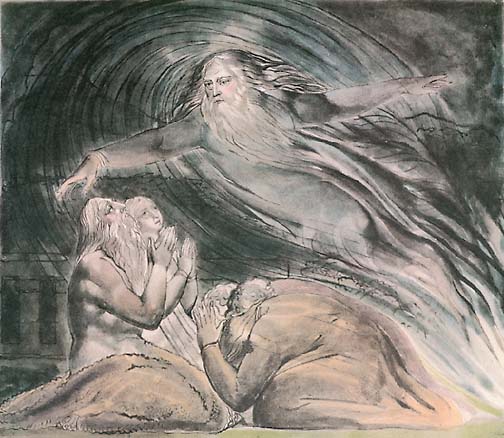
Listening to the Whirlwind: Theodicy for Deists

May 26, 2012

We dance round in a ring and suppose,
But the Secret sits in the middle and knows

—Robert Frost

Ever tried to talk to a grasshopper?  Of course not.  Yet the moral, intellectual, and existential divide between God and humanity is obviously greater than the gulf between people and insects.  So why do so many human beings expect to hear from God?

Our Judeo-Christian heritage leads us to assume that God is both creator and creation.  (God is in all things but somehow He is also an omnipotent overseer.)  We assume that God must be perfection.  We assume that God must be infinite in relation to both time and space.  And then we expect this marvelous conglomeration of mystery and paradox to speak to us as we would speak to one another.

Unfortunately, God exists in a realm so many notches above our level of understanding that we utterly lack the necessary equipment to understand Him.  Attempting to contemplate God with a human brain makes as much sense as trying to cut the sun in half with a pair of scissors.

Jon Dryden eloquently expresses the folly:

How can the less the Greater comprehend?
Or finite Reason reach Infinity?
For what cou’d Fathom GOD were more than He.

This simple observation makes me deist. (Although I should hasten to add that Dryden explicitly rejects deism in Religio Laici.)

I don’t know what God is; I will never know what God is, and I’m not going to waste my precious time on earth trying to figure out what God is.

Does this make me a candidate for Winston Niles Rumfoord’s  Church of God the Utterly Indifferent?  My answer is an unequivocal maybe.  (Getting mired in a swamp of paradox is perhaps the greatest peril of groping after God.)  Maybe God cares about humanity; maybe God doesn’t care.

My fellow human beings, however, tend to assume that God cares a great deal about us.  And Christians anthropomorphize God to the point that He can actually feel our pain because a God who cannot suffer is insufferable.

But if God loves us so much, why is our world full of suffering and injustice? Unfortunately, there is no humanly comprehensible answer to this question. But there is an entire branch of theology dedicated to “reconciling God’s traditional characteristics of omnibenevolence, omnipotence and omniscience (all-loving, all-powerful, and all-knowing, respectively) with the occurrence of evil in the world.”

Humans have been looking for someone to blame for our lot since Gilgamesh. And as long as we insist upon anthropomorphizing God, we are stuck in the cul-de-sac of asking ourselves why the universe is the way it is.

Interestingly, the Old Testament provides an answer for this question which is as profound as it is unsatisfying:

Where wast thou when I laid the foundations of the earth? declare, if thou hast understanding.

Who hath laid the measures thereof, if thou knowest? or who hath stretched the line upon it?

Whereupon are the foundations thereof fastened? or who laid the corner stone thereof;

When the morning stars sang together, and all the sons of God shouted for joy?

Or who shut up the sea with doors, when it brake forth, as if it had issued out of the womb?….

Hast thou commanded the morning since thy days; and caused the dayspring to know his place….

Hast thou entered into the springs of the sea? or hast thou walked in the search of the depth?

Have the gates of death been opened unto thee? or hast thou seen the doors of the shadow of death?

Hast thou perceived the breadth of the earth? declare if thou knowest it all.

Where is the way where light dwelleth? and as for darkness, where is the place thereof….

Who hath divided a watercourse for the overflowing of waters, or a way for the lightning of thunder;

To cause it to rain on the earth, where no man is; on the wilderness, wherein there is no man;

To satisfy the desolate and waste ground; and to cause the bud of the tender herb to spring forth?

Hath the rain a father? or who hath begotten the drops of dew?  (Job 38)

So God’s answer to it all is: It’s none of your damn business and you wouldn’t be capable of understanding it if I told you anyway.

Or, as the wonderful gospel Midrash (You Can’t Hurry God) He’s Right on Time succinctly notes:

I’m God all by myself/And I don’t need nobody else.”

This vast, spectacular universe is not about us.  But then again, of course it is.  (Another paradox.)

If we read the Book of Job imagining God and Satan sitting in a couple of celestial director’s chairs as they toy with Job for sport, then we must conclude that God is a sick, sad, wicked creep.

But once we reject the silly notion that God is merely some sort of human being who lives in outer space, the Whirlwind begins to make a hell of a lot of sense.

by Richard W. Bray

The Perils of Bardolatry: Harold Bloom’s Limited Perception of Hamlet

September 14, 2011

Harold Bloom

The Perils of Bardolatry: Harold Bloom’s Limited Perception of Hamlet

The activity of art is based on the fact that a man, receiving through his sense of hearing or sight another man’s expression of feeling, is capable of experiencing the emotion which moved the man who expressed it.

Leo Tolstoy, What is Art? (178)

The essential function of art is moral. Not aesthetic, not decorative, not pastime and recreation. But moral.

D.H. Lawrence, Studies in Classic American Literature (180)

When Kurt Vonnegut was working on Slaughterhouse-Five, he told movie-producer Harrison Starr that it was going to be an anti-war novel.

“Why don’t you write an anti-glacier book instead?” Starr quipped.

Vonnegut found the comment amusing, agreeing that wars are “as easy to stop as glaciers.” This knowledge did not dissuade Vonnegut from completing his masterpiece because he realized that no work of art could ever rectify the human situation, and only the silliest sort of fool creates a work of art hoping somehow to fix the world. (This is what logicians refer to as assigning an irrelevant goal.)

But literature has its uses. And W. H. Auden notwithstanding, poetry makes all sorts of things happen. Great works of art render our world a lot more beautiful and slightly less confusing.

Harold Bloom, one of America’s most acclaimed literary critics, has released a curious collection of musings on William Shakespeare’s Hamlet entitled Poem Unlimited. According to Bloom, “of all poems” Hamlet is the “most unlimited,” and, as a “meditation upon human fragility in confrontation with death,” the play “competes only with the world’s great scriptures” (3).

Bloom has long been an idiosyncratic critic, cocksure about his own brilliance and emphatic about the singular authenticity of his opinions. His general predisposition towards even the most revered literary figures is often miserly in terms of handing out approbation. For example, Bloom dismisses Matthew Arnold’s oeuvre in one sentence: “Arnold, long admired both for his poetry and for his literary criticism, was not particularly good at either” (The Best Poems of the English Language 684).

And like the notoriously fussy Mikey from the Life Cereal advertisement of my youth, when Bloom finally comes across something that pleases him, he really likes it.

Hamlet remains our world’s most advanced drama, imitated but scarcely transcended by Ibsen, Chekhov, Pirandello, and Beckett. You cannot get beyond Hamlet, which establishes the limits of theatricality. (7).

Of course, Bloom is hardly the first critic to gush over Hamlet.

It is perhaps not necessary to emphasize the quality of the prose in Hamlet. Here are passages which represent the highest point Shakespeare ever reached in this medium….it is the excellence and the importance of the prose which separates Hamlet from, and in many ways above, all the other plays (George H. W. Rylands, Words and Poetry 159).

So Bloom, a devout secularist who considers “Bardolatry” to be “only another name for authentic response to Shakespeare,” is ecstatic about Hamlet (7). This play’s the thing for Bloom, and its eponymous hero is the pinnacle of literary achievement, eliciting rapturous bellows of praise from the usually cantankerous critic:

[Hamlet] himself is a frontier of consciousness yet to be passed (7);

Hamlet always has had nothing in common with his father, his mother and his uncle. He is a kind of changeling…fathered by himself (9);

Hamlet becomes the freest artist of himself in all literature (51);

We cannot play upon him: he is cleverer than we are, and more dangerous (54);

[T]he likes of] whom we have scarcely encountered before (82);

[H]e is more intelligent than you are, whoever you are (88);

[H]e is a mortal god in an immortal play (90);

Hamlet is the truth, insofar as any hero of consciousness can be (96).

Thus inebriated in adoration, Bloom almost completely ignores the enigma at the core of Hamlet’s personality which has confounded and infuriated critics for centuries: Yes, Hamlet is a devilishly clever young man, full of all sorts of wonderful words. But he is also cruel, capricious, and ditheringly indecisive. Indeed, the very expression “playing Hamlet” is a synonym for indecisiveness.

No one could seriously question Bloom’s assertion that Hamlet is a font of fabulous words. But if, as D. H. Lawrence argues, the moral function of art is paramount, then there is no escaping the fact that Hamlet is an abject failure as a man. If Hamlet had simply killed Claudius (the man who murdered Hamlet’s father), so much senseless death and mayhem could have been avoided. The Polonius family—who, whatever their faults, were decent, loyal and loving human beings—is utterly destroyed due to Hamlet’s vacillating stupidity.

Unlike Hamlet, Laertes has no need to navigate a sea of words in order to determine the right course of action. Hamlet himself speaks of Laertes as a “great gentleman,” and Hamlet admires the “bravery of his grief.” Furthermore, the similarity of their plight is not lost on Hamlet, who says of Laertes, “by the image of my cause, I see/The portraiture of his.”

Yet Harold Bloom will have none of it: “Laertes is too absurdly slight to be Hamlet’s ‘second self,’ as many critics aver” (104).

Along with Laertes, the other heroic figure in Hamlet is Horatio. According to Hamlet, Horatio is

A man that fortune’s buffets and rewards
Hast ta’en with equal thanks: and blest are those
Whose blood and judgement are so well commedled
That they are not a pipe for fortune’s finger
To sound what stop she please. Give me that man
That is not passion’s slave, and I will wear him
In my heart’s core, ay, in my heart of heart,
As i do thee.

Again, Bloom is unwilling to listen, not even to Hamlet:

Though critics have asserted that Hamlet finds qualities in Horatio that are absent from himself, they are plainly mistaken. Hamlet is so various that he contains every quality, while Horatio, totally colorless, has none to speak of (15).

Alan Lerner jested that “The French don’t care what they do actually/As long as they pronounce it properly.” Similarly, Harold Bloom doesn’t care what Hamlet does, actually—whom he berates, whom he stabs, whom he has murdered, whom he brutishly badgers to the point of suicide, how many ways he contradicts himself, how many people die for his indecisiveness—as long as Hamlet collocates his lovely words better than anyone else.

by Richard W. Bray

The Three Types of Irony and an Amusing Teacher Story

December 4, 2010

Coincidence is NOT irony

As George Carlin and others have pointed out, sportscasters, particularly baseball announcers, have an irony problem. Many of them simply don’t understand what the word means. Usually they mistake coincidence for situational irony. For example, an announcer might say,

“It’s ironic that Stubby McGillicutty broke the single season RBI record in Anaheim where Angel great Jackie Fullcup, whose record McGillicutty broke, spent his entire career.”

No. IT’S COINCIDENTAL.

The Three Types of Irony

1) Verbal IronySaying what you DON’T mean

Definition: A speaker means something different than, often the opposite of, what she says.

Examples:

“I can’t wait to start writing these forty-seven reports.”

“My walk home was only twenty-three blocks.”

(Note: The terms sarcasm and irony are often used interchangeably, but there is a semantic difference. Sarcasm is meant to insult or cause harm. So strictly speaking, “Great, I forgot my umbrella” is ironic, whereas “You call this a cup of coffee?” is sarcastic.)

2) Situational IronyThe gods are laughing at me by giving me ten thousand spoons when I just need a knife.*

Definition: When the outcome of actions or events is different than the desired or expected result

Examples:

If Dave died because he was allergic to the antibiotics that were supposed to save him, he is not merely a victim of bad luck. There is an oddly perverse poetry in Dave’s plight. Such a phenomenon as situational irony would only occur to a species which has a concept of fairness and a tendency to automatically anthropomorphize Fate.

The Psychic Friends Network went bankrupt due to “unforeseen circumstances.”

(George Carlin’s marvelous book Brain Droppings has some wonderful examples of situational irony, particularly the one about the Kurd who survives a brutal attack by Saddam Hussein at the end of the First Gulf War and escapes over the mountains only to be crushed by an airdropped box of humanitarian aid. If you want to teach Carlin on situational irony, however, be prepared to explain about the Kurds and the first Gulf War and to tell them who Darryl Stingley was.)

3) Dramatic IronyThe reader or audience knows something fictional characters don’t

Definition: When we say something is ironic we almost never mean dramatic irony. Dramatic irony occurs when the reader or audience has important knowledge which is withheld from a character or characters in a story, a movie, or a play.

The most obvious example of this is when the young lady in the slasher flick doesn’t realize that the guy in the hockey mask with the meat cleaver is hiding behind the hot tub—but we do.

Perhaps a more erudite example would be that the audience knows who Oedipus Rex’s parents really are.

* From the song Ironic by Alanis Morissette which can be a good teaching tool because it contains some hits and several misses. (Rain on your wedding day is simply a case of bad luck unless you are having an outdoor wedding in Southern California in June and all your bridesmaids are wearing paper dresses.) The song has been much-derided by English teachers because it contains one example of verbal irony, four examples of situational irony, six examples of bad luck, two examples of stupidity and one example of coincidence.

Evaluation

State whether the following are examples of verbal irony, situational irony, dramatic irony or not ironic in any way.

1. “Oh, great! It’s raining and I forgot my umbrella.”

2. I failed the test because I did not study.

3. Dave’s blood pressure medication gave him a heart attack.

4. Batman doesn’t know that the Joker is waiting for him, but the audience does.

5. Cal Poly Pomona and Cal Poly SLO are both located in California.

6. The box of airdropped humanitarian aid landed on the refugee and killed him.

7. I missed the job interview because I overslept.

8. “Thank you for this ticket, Officer. You just made my day.”

9. Three celebrities died in three separate plane crashes yesterday.

10. “I heard that sun block causes cancer.”

An Amusing Teacher Story (which is in no way ironic)

I made a class of college freshman read Welcome to the Monkey House, a collection of short stories by Kurt Vonnegut. At the end of the quarter we watched some videos of stories from the book which were introduced by the author. Before class a student came up to me and asked how the man in the video could be Vonnegut when it says on the book jacket that he is “our finest black-humorist.” I explained that there are people who practice dark humor and there are also African-American humorists.

Richard W. Bray

Some Thoughts on The Spooky Art

October 24, 2010

norman-mailer

Some Thoughts on The Spooky Art

The problem with naturalism is that there are just so many ways of saying that life is futile. About a hundred years ago when God was freshly deceased in the modern mind, Jack London, Theodore Dreiser and Stephen Crane had room to ruminate about the bleak, harsh unfairness of it all without getting stuck in naturalism’s inevitable cul-de-sac. Artful naturalism can still be written (see Being Dead by Jim Crace), but novelists with a metaphysical predisposition have many more aesthetic avenues to explore than devout nonbelievers.

Unlike so many twentieth century writers who were unable to reconcile belief in an anthropomorphized deity with the carnage and horror of two world wars and the Holocaust, Norman Mailer saw the supernatural everywhere. He was a confirmed mystic who was constantly groping after salvation in his tempestuous personal and artistic life.

In The Spooky Art, a compilation of the novelist’s musings about the craft of writing, Mailer insists that an “ongoing and conceivably climactic war between God and the Devil” manifests itself in the quotidian world of human strife (307). This is no mere literary affectation. Although Mailer did not ascribe to a particular faith, he was afflicted with a mercurial temperament which sought a deity that was, interestingly, much like himself:

“I confess that I have no attachment to organized religion. I see God, rather, as a Creator, as the greatest artist.”

Mailer enjoyed quoting Kierkegaard — I have a theory that Kierkegaard is more quoted than read. And he was deeply concerned with matters of good, evil, courage, and existence. Mailer argues that it is ludicrous to contemplate a universe without an active deity and some form of an afterlife (Mailer’s money is on reincarnation).

“Carnage walks the aisles of history hand in hand with philosophy. If there is no afterworld where the contest continues, then existence is indeed absurd” (148).

Sparkling literary careers have been wrought from that absurdity (see Brecht, Vonnegut, Kafka, and the Hebrew wit who wrote the Book of Job). But a diverse group of modern writers, including Fyodor Dostoevsky, G. K. Chesterton, Graham Green, Flannery O’Connor, John Updike, W. H. Auden and T.S. Eliot, have been theists.

It is not surprising that the pugnacious novelist and raconteur would have an idiosyncratic approach to religion. Mailer submerged everything that frightened and confused him into a big, dark pit which is alternately seen as hell or his own subconscious. For Mailer, the two are deeply connected. He asks us to

“Suppose the unconscious has a root in the hereafter that our conscious mind does not”(138).

For a novelist, the subconscious is a magic and mysterious font “and you never know where your words are coming from, those divine words” (70). Mailer, who was “always a little uneasy when my work comes to me without much effort,” liked to think of his unconscious as a “separate creature”(127, 143).

The novel Nightwood is a mad dreamy reactionary assault on society written by a brilliant, confused and obviously self-loathing woman, Djuna Barnes. In the section “Watchman, What of the Night?” Dr. Matthew Mighty O’Connor argues that night time—sleep time—is when the devil does his battling. Nightwood is a bizarre and disturbing book for many reasons, but Dr. O’Connor’s rant about sleep, “that unpeopled annihilation” in many ways explains how Mailer sees his own relationship with his unconscious (95).

…the day and the night are related by their division. The very constitution of twilight is a fabulous reconstruction of fear, fear bottom-out and wrong side up. Every day is thought upon and calculated, but the night is not premeditated. The Bible lies the one way, but the night-gown the other (87).

Norman Mailer takes his craft seriously and he fears the decline of “serious” novelists such as himself because “[n]ovels that reinvigorate our view of the subtlety of moral judgments are essential to a democracy” (161). Surveying the present state of fiction in America, Mailer laments how “the smart money would bet against the serious novel”(51). (Mailer’s observation, “I don’t think Jackie Susann went to bed with Rainer Maria Rilke on her night table,” gives us an idea about his regard for un-serious novelists(49).

For Mailer, the difference between “serious” novels and bestsellers is that the latter generally do not challenge their readers:


“mega-best-seller readers want to be able to read and read and read–they do not want to ponder any truly unexpected revelations. Reality might lie out there, but that is not why they are reading”
(51).

Norman Mailer was not sanguine about the future of fiction in America, a profession that has long been plagued with “various pirates, cutthroats racketeers, assassins, pimps, rape artists, and general finks (57).” And he has even less faith in our press which produces a “[n]ausea-broth of TV pundit-heads, coming to an intellectual climax every night” (83). A co-founder of the Village Voice in 1955, Mailer is hailed as an “innovator of narrative” . Here is his portrait of the journalist’s life:

“One half is addiction, adrenaline, anecdote shopping, deadlines, dread, cigar smoke, lung cancer, vomit, feeding The Goat; the other is Aloha, Tahiti, old friends, and the free ride to the eleventh floor of the Sheraton-Chicago, Patterson-Liston Press Headquarter, everything is free.” (185).

by Richard W. Bray

Some Thoughts on Slaughterhouse-Five

September 15, 2010

Some Thoughts on Slaughterhouse-Five

Like Billy Pilgrim, the hapless protagonist in his great anti-war novel Slaughterhous-Five, Kurt Vonnegut survived “the greatest massacre in European history” (101). Vonnegut and several other American prisoners of war were spared incineration during the Allied firebombing of Dresden because they were quartered in an underground slaughterhouse. When Vonnegut and his compatriots emerged after the night of pyrotechnics, they discovered a moonscapes containing the charred remains of “one hundred and thirty thousand people” (165). In the novel Billy Pilgrim tells actress Montana Wildhack that the “little logs” he saw “lying around” Dresden after the attack were actually “people who had been caught in the fire storm” (179).

Slaughterhouse-Five is a novel about time, space, fate, extraterrestrial creatures, irony, violence, verisimilitude, greed, revenge, and grace. But mostly it’s about war, “the incredible artificial weather that Earthlings sometimes create for other Earthlings when they don’t want those other Earthlings to inhabit Earth any more” (106).

War is always failure: A failure of imagination; a failure of compassion; a failure of communication; a failure of restraint. Kurt Vonnegut is repulsed when Americans celibrate the ugliest and stupidest thing human beings do by having parades and singing songs like “Glory, Glory Hallelujah.” He suggests a more fitting tribute:

“Perhaps, when we remember wars, we should take off our clothes and paint ourselves blue and go on all fours all day long and grunt like pigs. That would surely be more appropriate than noble oratory and shows of flags and well-oiled guns” (Cat’s Cradle).

Americans emerged from World War II with a hard-won sense of pride that our soldiers and citizens had endured many hardships in order to destroy great evil. This is true, of course, but life is never this simple. There is always much bad accompanying even the greatest good. For example, the defeat of Nazism would not have been possible without the immeasurable sacrifice of the people of the Soviet Union. So in order to destroy Hitler, America had to support Stalin’s equally putrid regime, which would continue to enslave much of the world for decades. We also found it necessary to incinerate hundreds of thousand of civilians in Dresden, Hamburg, Tokyo, Nagasaki and Hiroshima (not a complete list).

Determining the rightness of actions which caused so much death, suffering and despair is beyond the capabilities of any human, so I cannot say with certainty that WWII had to be fought. However, Kurt Vonnegut is willing to concede that America’s role in WWII was necessary, although it left us with some unfortunate legacies:

One of the great American tragedies is to have participated in a just war. It’s been possible for politicians and movie-makers to encourage us we’re always good guys. The Second World War absolutely had to be fought. I wouldn’t have missed it for the world. But we never talk about the people we kill. This is never spoken of.

The “success” of the raid on Dresden is largely omitted from the official narrative of WWII (191). Even today, Americans are smugly self-congratulatory when we speak about WWII, as if the entire world should be perpetually thanking us. But as Vonnegut notes, it’s never right to feel good about war.

“I myself have seen the bodies of schoolgirls who were boiled alive in a water tower by my own countrymen, who were proud of fighting pure evil at the time” (116).

So what can we learn from a book about the ugliest and stupidest things that human beings do? Kurt Vonnegut doesn’t offer any easy answers. Slaughterhouse-Five “is short and jumbled and jangled” in content and narrative “because there is nothing intelligent to say about a massacre” (19).

The greatest wisdom in Slaughterhouse-Five is offered by the Tralfamadorians, a race of extraterrestrial beings who abduct Billy Pilgrim in order to study earthlings. The Tralfamadorians, who function in four dimensions, are able to see a person’s entire life span at once. From this perspective

All time is all time. It does not change. It does not lend itself to warnings or explanations. It simply is. Take it moment by moment, and you will find that we are all, as I’ve said before, bugs in amber (86).

Slaughterhouse-Five is not the feel good Oprah Book of the Month. There is no Secret, and this is all the advice you get:

“one thing Earthlings might learn to do, if they tried hard enough: Ignore the awful times, and concentrate on the good ones” (117).

When Kurt Vonnegut was writing Slaughterhouse-Five, he told movie producer Harrison Starr that he was working on an anti-war novel:

“Why don’t you write an anti-glacier book instead?” Starr asked (3).

Vonnegut agreed with Starr on the futility of his project: “What he meant, of course, was that there would always be wars, that they were as easy to stop as glaciers. I believe that, too” (3).

Since that time (1968), however, humanity has made considerable progress in the War on Glaciers. This thought might have aroused a chuckle from Vonnegut, but I doubt it would have heartened him much.

One final thought from Robert Browning


In one year they sent a million fighters forth
South and North,
And they built their gods a brazen pillar high
As the sky,
Yet reserved a thousand chariots in full force–
Gold, of course.
Oh heart! oh blood that freezes, blood that burns!
Earth’s returns
For whole centuries of folly, noise and sin!
Shut them in,
With their triumphs and their glories and the rest!
Love is best.

by Richard W. Bray

My Top Ten Booklist (In no particular order)

March 23, 2010

Franz De Waal

My Top Ten Booklist (In no particular order)

#1 Ishi in Two Worlds: A Biography of the Last Wild Indian in North America by Theodora Kroeber

…so far as any record shows or any story relates, no member of the United States Army ever shot a single Yana Indian, whose multiple murder remained a home and civilian and strictly extralegal operation. (62) There’s a line in the song Sun City by Steven Van Zandt reminding us that Apartheid “ain’t that far away.” Episodes in Extermination, the fourth chapter of Ishi, written in a beautifully plain and sober tone, makes our own proximity to the horrors of genocide painfully clear.

#2 Primates and Philosophers by Franz De Waal

Chimpanzees think by feeling, just like we do:

In my own experience, chimpanzees pursue power as relentlessly as some in Washington and keep track of given and received services in a marketplace of exchange. Their feelings may range from gratitude for political support to outrage if one of them violates a social rule. All of this goes far beyond mere fear, pain, and anger: the emotional life of these animals is much closer to ours than once held possible. (76)

#3 War is a Force that Gives us Meaning by Chris Hedges

This indispensable book, which came out when our society was still very sick with war fever, tells us that war

Is peddled by mythmakers–historians, war correspondents, filmmakers, novelists and the state–all of whom endow it with qualities it often does possess: excitement, exoticism, power, chances to rise above our small stations in life, and a bizarre and fantastic universe that has grotesque and dark beauty. It dominates culture, distorts memory, corrupts language, and infects everything around it, even humor, which becomes preoccupied with the grim perversities of smut and death. Fundamental questions about the meaning, or meaninglessness, of our place on the planet are laid bare when we watch those around us sink to the lowest depths. War exposes the capacity for evil that lurks not far below the surface within all of us. And this is why for many war is so hard to discuss once it’s over (3)


#4 United States: Essays 1952-1992 by Gore Vidal

This collection of essays proves that in addition to being a damn fine novelist, Vidal is simply our finest living essayist. From his essay Theodore Roosevelt: An American Sissy:

Give a sissy a gun and he will shoot everything in sight….There is something strangely infantile in this obsession with dice-loaded physical courage when the only courage that matters in political or even “real” life is moral. Although TR was often reckless and always domineering in politics, he never showed much real courage, and despite some trust-busting, he never took on the great ring of corruption that ruled and rules in this republic. But then, he was born part of it. (733)

#5 Love Medicine by Louise Erdrich

A much underappreciated masterpiece. An earlier post demonstrated that Erdrich is a master of the simile. Some more examples:

Then the vest plunged down against her, so slick and plush that it was like being rubbed by an enormous tongue. (5)

My mother held out a heavy tin one (spoon) from the drawer and screwed her lips up like a coin purse to kiss me. (12)

On the much traveled, evil Sister Leopolda: Perhaps she was just sent around to test her Sisters’ faith, like a spot checker in a factory.(45)

She thought of everything so hard that her mind felt warped and sodden as a door that swells up in spring. (107)

Dot was a diligent producer of milk, however. Her breasts, like overfilled inner tubes, strained at her nylon blouses. (210)

#6 Slaughterhouse-Five by Kurt Vonnegut

The greatest and most important American novel published during the second half of the twentieth century. So it goes.

#7 The Quiet American by Graham Greene

Here’s Greene on innocence, which, as Arnold Rampersad wryly noted, is a famed American virtue:

Innocence always calls mutely for protection when it would be so much wiser to guard ourselves against it: innocence is like a dumb leper who has lost his bell, wandering the world, meaning no harm.(29)

#8 The Collected Poems of W. H Auden

The only artists who have made a comparable impression on my consciousness are Vonnegut, Sarah Vaughan and Ella Fitzgerald. And I shall continue to revere Auden until the day when I surrender my smidge of nitrogen to the World Fund. (690) (btw, the collected poems are not the complete poems because Auden left out many with which he later became unsatisfied. A notable omission is September 1, 1939 which was excised because Auden eventually decided that the line We must love one another or die constitutes a false alternative.)

#9 The Complete Poems of Emily Dickinson

Perhaps foolishly, in the spirit of Ernest Hemingway’s notoriously silly aspiration to knock Mr. Shakespeare on his ass, I would argue that Dickinson is the first, and quite possibly the only, American poet capable of going toe-to-toe with the Bard.

#10 The Complete Poems of Dorothy Parker

I recoil somewhat at the realization that there exists a profound kindred empathy in the deepest recesses of my psyche for this sad, sad, angry, witty woman.


by Richard W. Bray