Archive for the ‘Robert Frost’ Category

This Happy Now

January 20, 2015
Not Me and Max

Not Me and Max

As soon as Max sees me grab the leash, he goes into spasms of delight, jumping in the air and making little pirouettes. Joy. It’s not just for humans.

(I try not to say the word “walk” in front of Max unless I’m ready to take him for one. So in order not to tease him, I’ll say, “Maybe I’ll take Max for a ‘W-Word’ later this afternoon.”)

Like so many poets, Max is giddy for the natural world, and he cannot contain his enthusiasm for outside smells, sights, and sounds. And like Max, William Wordsworth began to cultivate his love of nature exploring “those few nooks to which my happy feet/ Were limited.”

Unlike so many human beings, however, Max is not overburdened by the demands of his quotidian existence. And I’m pretty sure he’s never given much thought to the meaning of life. It is therefore unlikely that Max could share with Mr. Wordsworth

That blessed mood
In which the burthen of the mystery,
In which the heavy and the weary weight
Of all this unintelligible world
Is lighten’d:—that serene and blessed mood,
In which affections gently lead us on,
Until, the breath of this corporeal frame,
And even the motion of our human blood
Almost suspended, we are laid asleep
In body, and become a living soul:
While with an eye made quiet by the power
Of harmony, and the deep power of joy,
We see into the things of life

But ecstasy also hurts. Wordsworth referred to such ecstatic moments as “spots of time.” Spots of time are often induced by nature, and as Sheldon W. Liebman explains, nature is “a domain in which the fundamental conditions of life are mixed, even paradoxical.” Ecstasy hurts because even in its thrall we realize that soon we will return to a world where

That time is past,
And all its aching joys are now no more,

Once we get beyond joy “And all its dizzy raptures” we are once again confined to “The still, sad music of humanity”

In the poem “Hamlen Brook,” Richard Wilbur calls this phenomenon “joy’s trick.” (Collected Poems 115).

Confronted with the immense beauty of the natural world, Wilbur laments his inability to “drink all this”

Joy’s trick is to supply
Dry lips with what can cool and slake,
Leaving them dumbstruck also with an ache
Nothing can satisfy.

For his part, Robert Frost argues that “Happiness Makes Up In Height For What It Lacks In Length” (Collected Poems 445).

There are many moments in Frost’s poetry when

We went from house to wood
For change of solitude. (445)

And the trick for human beings is to appreciate this happy now on its own terms. Frost explains in “Two Look at Two” (283).

‘This must be all.’ It was all. Still they stood,
A great wave from it going over them,
As if the earth in one unlooked-for favor
Had made them certain earth returned their love.

by Richard W. Bray
Listening to the Whirlwind: Theodicy for Deists

May 26, 2012

We dance round in a ring and suppose,
But the Secret sits in the middle and knows

—Robert Frost

Ever tried to talk to a grasshopper?  Of course not.  Yet the moral, intellectual, and existential divide between God and humanity is obviously greater than the gulf between people and insects.  So why do so many human beings expect to hear from God?

Our Judeo-Christian heritage leads us to assume that God is both creator and creation.  (God is in all things but somehow He is also an omnipotent overseer.)  We assume that God must be perfection.  We assume that God must be infinite in relation to both time and space.  And then we expect this marvelous conglomeration of mystery and paradox to speak to us as we would speak to one another.

Unfortunately, God exists in a realm so many notches above our level of understanding that we utterly lack the necessary equipment to understand Him.  Attempting to contemplate God with a human brain makes as much sense as trying to cut the sun in half with a pair of scissors.

Jon Dryden eloquently expresses the folly:

How can the less the Greater comprehend?
Or finite Reason reach Infinity?
For what cou’d Fathom GOD were more than He.

This simple observation makes me deist. (Although I should hasten to add that Dryden explicitly rejects deism in Religio Laici.)

I don’t know what God is; I will never know what God is, and I’m not going to waste my precious time on earth trying to figure out what God is.

Does this make me a candidate for Winston Niles Rumfoord’s  Church of God the Utterly Indifferent?  My answer is an unequivocal maybe.  (Getting mired in a swamp of paradox is perhaps the greatest peril of groping after God.)  Maybe God cares about humanity; maybe God doesn’t care.

My fellow human beings, however, tend to assume that God cares a great deal about us.  And Christians anthropomorphize God to the point that He can actually feel our pain because a God who cannot suffer is insufferable.

But if God loves us so much, why is our world full of suffering and injustice? Unfortunately, there is no humanly comprehensible answer to this question. But there is an entire branch of theology dedicated to “reconciling God’s traditional characteristics of omnibenevolence, omnipotence and omniscience (all-loving, all-powerful, and all-knowing, respectively) with the occurrence of evil in the world.”

Humans have been looking for someone to blame for our lot since Gilgamesh. And as long as we insist upon anthropomorphizing God, we are stuck in the cul-de-sac of asking ourselves why the universe is the way it is.

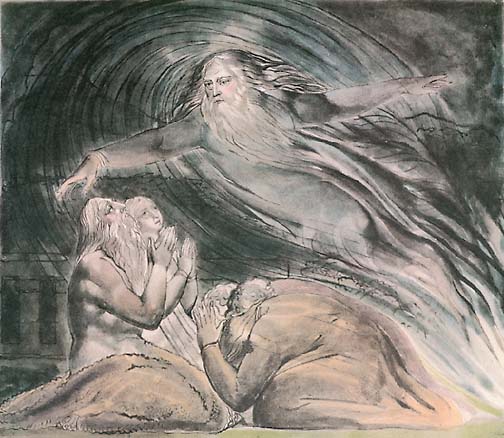
Interestingly, the Old Testament provides an answer for this question which is as profound as it is unsatisfying:

Where wast thou when I laid the foundations of the earth? declare, if thou hast understanding.

Who hath laid the measures thereof, if thou knowest? or who hath stretched the line upon it?

Whereupon are the foundations thereof fastened? or who laid the corner stone thereof;

When the morning stars sang together, and all the sons of God shouted for joy?

Or who shut up the sea with doors, when it brake forth, as if it had issued out of the womb?….

Hast thou commanded the morning since thy days; and caused the dayspring to know his place….

Hast thou entered into the springs of the sea? or hast thou walked in the search of the depth?

Have the gates of death been opened unto thee? or hast thou seen the doors of the shadow of death?

Hast thou perceived the breadth of the earth? declare if thou knowest it all.

Where is the way where light dwelleth? and as for darkness, where is the place thereof….

Who hath divided a watercourse for the overflowing of waters, or a way for the lightning of thunder;

To cause it to rain on the earth, where no man is; on the wilderness, wherein there is no man;

To satisfy the desolate and waste ground; and to cause the bud of the tender herb to spring forth?

Hath the rain a father? or who hath begotten the drops of dew?  (Job 38)

So God’s answer to it all is: It’s none of your damn business and you wouldn’t be capable of understanding it if I told you anyway.

Or, as the wonderful gospel Midrash (You Can’t Hurry God) He’s Right on Time succinctly notes:

I’m God all by myself/And I don’t need nobody else.”

This vast, spectacular universe is not about us.  But then again, of course it is.  (Another paradox.)

If we read the Book of Job imagining God and Satan sitting in a couple of celestial director’s chairs as they toy with Job for sport, then we must conclude that God is a sick, sad, wicked creep.

But once we reject the silly notion that God is merely some sort of human being who lives in outer space, the Whirlwind begins to make a hell of a lot of sense.

by Richard W. Bray

Eleven Stanzas that Strike Like a Chime through the Mind

May 29, 2011

Christina Rossetti

Richard Wilbur

e e cummings

Does the road wind up-hill all the way?
Yes, to the very end.
Will the day’s journey take the whole long day?
From morn to night, my friend.

from Uphill by Christina Rossetti

Let Observation with extensive view,
Survey mankind, from China to Peru:
Reark each anxious toil, each eager strife:
Then say how hope and fear, desire and hate,
O’spread with snares the clouded maze of fate,
Where wavering man, betrayed by venomous pride,
To tread the dreary paths without a guide,
But scarce observed, the knowing and the bold
Fall in the general massacre of gold;
Wide-wasting pest! That rages unconfined,
And crowds with crimes the record of mankind;
For gold his sword the hireling ruffian draws,
For gold the hireling judge distorts the laws;
Wealth heaped on wealth, not truth nor safety buys,
The Dangers Gather as the Treasures rise

from The Vanity of Human Wishes (The Tenth Satire of Juvenal Imitated) by Samuel Johnson

We have it and it doesn’t do us any
Good because nobody gets what they
Deserve more than everybody else.

from Family Values by Robert Pinsky

I am tired of tears and laughter,
And men that laugh and weep;
Of what may come hereafter
For men that sow to reap:
I am weary of days and hours,
Blown buds of barren flowers,
Desires and dreams and powers
And everything but sleep.

from Garden of Proserpine by Algernon Charles Swinburne

Thy gowns, thy shoes, thy beds of Roses,
Thy cap, thy kirtle, and thy posies
Soon break, soon wither, soon forgotten:
In folly ripe, in reason rotten.

from The Nymph’s Reply to the Shepherd by Sir Walter Ralegh

Joy’s trick is to supply
Dry lips with what can cool and slake,
Leaving them dumbstruck also with an ache
Nothing can satisfy.

from Hamlen Brook by Richard Wilbur

“I see the guilty world forgiven,”
Dreamer and drunkard sing,
“The ladders let down out of heaven,
The laurel springing from the martyr’s blood,
The children skipping where the weeper stood,
The lovers natural and the beasts all good.”
So dreamer and drunkard sing
Till day their sobriety bring:
Parrotwise with Death’s reply
From whelping fear and nesting lie,
Woods and their echoes ring.
The desires of the heart are as crooked as corkscrews,
Not to be born is the best for man;
The second-best is a formal order,
The dance’s pattern; dance while you can.

from Death’s Echo by W. H. Auden

To fight aloud, is very brave —
But gallanter, I know
Who charge within the bosom
The Cavalry of Woe —

from To Fight Aloud is Very Brave by Emily Dickinson

I knew a woman, lovely in her bones,
When small birds sighed, she would sigh back at them;
Ah, when she moved, she moved more ways than one:
The shapes a bright container can contain!
Of her choice virtues only gods should speak,
Or English poets who grew up on Greek
(I’d have them sing in chorus, cheek to cheek.)

from I Knew a Woman by Theodore Roethke

and nothing quite so least as truth
—i say though hate were why man breathe—
because my father lived his soul
love is the whole and more than all

from my father moved through dooms of love by e.e. cummings

No memory of having starred
Atones for later disregard
Or keeps the end from being hard.

from Provide, Provide by Robert Frost

by Richard W. Bray